


Taiwan must act to preempt potential Section 301 investigations as US President Donald Trump moves to a new tariff strategy, following a US Supreme Court ruling that voided tariff measures, an academic said yesterday.
Countries running the largest trade surpluses with the US face a growing likelihood of Section 301 investigations, Chung-Hua Institution for Economic Research president Lien Hsien-ming (連賢明) said.
Section 301 refers to a provision of the Trade Act of 1974 that allows Washington to impose retaliatory tariffs over perceived unfair trade practices, including the running of large trade surpluses.
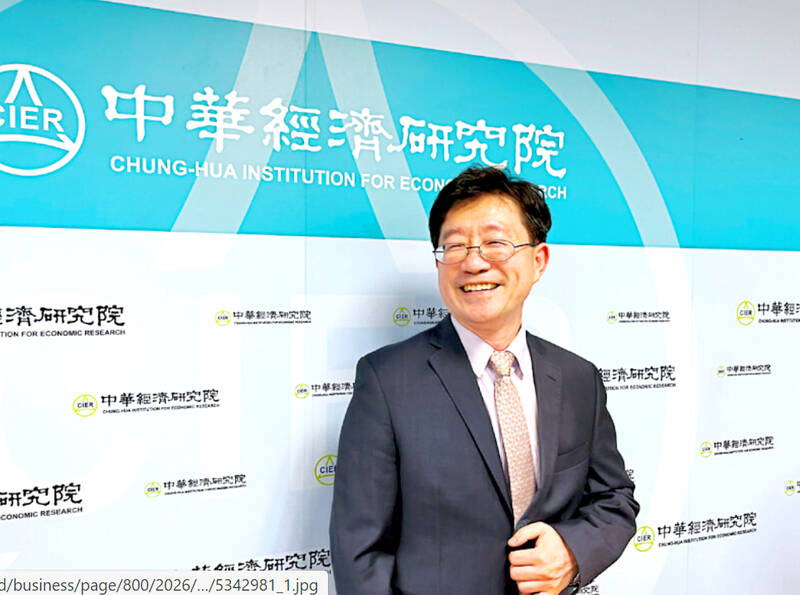
Photo: Hsu Tzu-ling, Taipei Times
Because Taiwan has become the fourth-largest source of the US’ trade deficit, totaling about US$160 billion, it would not be that difficult for Washington to build a case for a Section 301 probe, Lien wrote on social media on Sunday.
“Taiwan must brace for the next round of Section 301 investigations,” Lien said, urging the government to prepare a response strategy without suggesting what it might be.
The issue for Taiwan is that its trade surplus with the US has ballooned in the past two years due to massive demand for chips and servers for use in data centers or artificial intelligence products, items that it specializes in.
Trump invoked Section 122 of the Trade Act of 1974 to impose a 15 percent global surcharge, up from 10 percent announced earlier, after the US Supreme Court on Friday struck down tariffs he had imposed on trading partners, including Taiwan, under the
International Emergency Economic Powers Act (IEEPA).
The Trump administration vowed to leverage additional trade tools, including Section 301 investigations, to circumvent the ruling and press ahead with his tariff agenda.
Lien observed that Section 122 does not permit country-specific tariff rates and therefore would not necessarily reduce the trade deficit, but it allows the administration to quickly restore tariff coverage for up to 150 days without congressional approval.
Lien expected the Trump administration would increasingly rely on Section 232 of the Trade Expansion Act of 1962 — a national security-based measure — alongside Section 301 to restore differentiated tariff rates.
For the moment, all articles and parts of articles that currently are or later become subject to section 232 actions are exempt from the Section 122 temporary import duty, according to a statement issued on Friday by the White House.
Taipei and Washington signed the Taiwan-US Agreement on Reciprocal Trade on Feb. 12, cutting tariffs to 15 percent from the 20 percent under the IEEPA, while Taiwanese semiconductors were granted most-favored treatment under Section 232.
However, the agreement has yet to be reviewed and ratified by the Legislative Yuan.
On Saturday, the Chinese Nationalist Party (KMT) urged the government to renegotiate the deal, and clarify whether the agreement is still valid.
The KMT’s Johnny Chiang (江啟臣), deputy legislative speaker, yesterday warned that Trump would utilize every measure possible to address trade deficits, and he called on the government to manage the situation and help industries prepare for potential fallout.
Former Taiwan People’s Party legislator Chang Chi-kai (張?楷) said that since the trade issue is still evolving, Taiwan should “wait and see.”
Chang suggested that the Legislative Yuan delay reviewing the agreement until the US policy direction becomes fully clear.
The Legislative Yuan had arranged a session for the Cho and Cabinet members to report on the trade agreement and its impacts on Taiwan next month.

FUKUOKA SITUATION: Japanese media reported that the pathogen is expected to be identified by the summer, while the CDC downplayed the idea that it was hMPV A “mysterious cold-like illness” reported in Japan’s Fukuoka Prefecture does not seem to be a new disease, but Japanese authorities have been asked about the situation, the Centers for Disease Control (CDC) said yesterday. The Fukuoka Prefectural Medical Association on Wednesday told a news conference that a “mystery cold” that has become a hot topic on social media is “highly likely to be caused by some kind of viral infection,” Japan’s KBC News reported. “Many people are experiencing symptoms starting with a sore throat, followed by a runny nose, phlegm and a severe cough,” KBC News reported, citing association officials. Health authorities are

Nvidia Corp CEO Jensen Huang (黃仁勳) arrived in Taiwan yesterday ahead of upcoming AI and technology events, saying he plans to meet with clients and Taiwan Semiconductor Manufacturing Co Chairman C.C. Wei (魏哲家) during his visit. After landing at Taipei Songshan Airport, Huang posed for photos with fans and handed out Yakult drinks to reporters and supporters waiting at the scene, saying he has “a lot to do” during the trip. Asked about reports that Nvidia’s planned headquarters site in Taipei’s Beitou Shilin Technology Park could break ground on May 27, Huang said that if the company holds an event, he would

The Ministry of Finance this afternoon announced the winning numbers for the March-April uniform invoice lottery. The winning number for the NT$10 million (US$318,060) special prize is 19531471, and the winning number for the NT$2 million grand prize is 85941329. Three numbers were drawn for the NT$200,000 first prize: 07225810, 20231230 and 83518781. Those with receipts matching the last seven digits of any of the first-prize numbers will win the NT$40,000 second prize, while those matching the last six digits will win the NT$10,000 third prize. Those whose receipts match the last five digits of the first-prize numbers can claim the NT$4,000 fourth prize,

SIX SUBSIDIES: The monthly allowance for older farmers is to increase to NT$10,000, and NT$5,000 is to be given to homemakers under the national pension system, Lai said The government is to implement major welfare policies for disadvantaged groups, including raising the monthly allowance for older farmers to NT$10,000 and providing homemakers with NT$5,000 per month, President William Lai (賴清德) said yesterday. Lai made the remarks during a visit to Wangling Temple in Chiayi County, saying that the planned increases were being introduced amid economic growth and an increase in tax revenue. Touting a policy, in which the government plans to provide a monthly allowance of NT$5,000 for every child under the age of 18 in a bid to address Taiwan’s low birthrate, Lai said that if received for the


 RSS
RSS