


Do not use eye drops indiscriminately, as the wrong kind could damage the cornea, a doctor warned on Tuesday.
Many people stay up late over the Lunar New Year holiday binge-watching television or playing video games, and often use eye drops to relieve dry or sore eyes, Tri-Service General Hospital ophthalmologist Tai Ming-cheng (戴明正) said.
Mild symptoms of dry eyes often improve with rest, but if discomfort persists, artificial tears should be considered, he said.
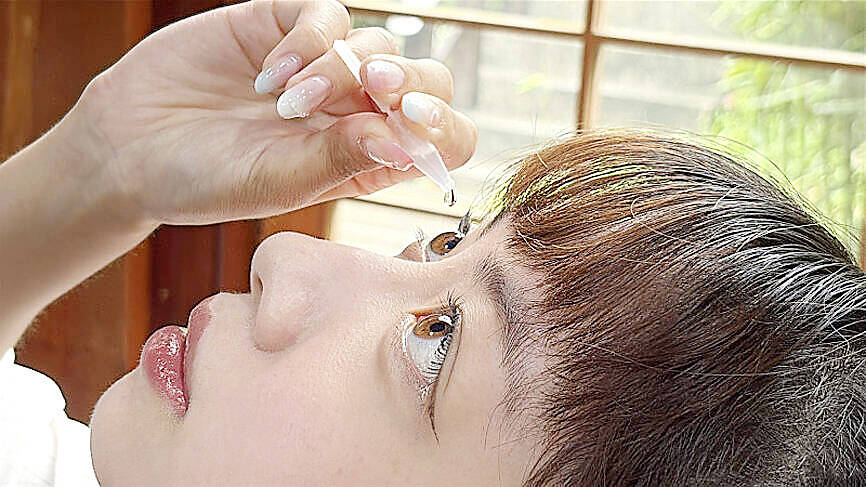
Photo: Lin Chih-yi, Taipei Times
However, people should understand their needs before purchasing artificial tears, as some over-the-counter products contain hyaluronic acid, lipids or other lubricating ingredients, Tai said.
Those who need to apply drops more than four times a day should choose preservative-free formulas to avoid corneal damage from high-frequency use, he said.
Most preservative-free products are sold in single-use packaging, and people can consult pharmacists for guidance, he added.
Some over-the-counter drops contain steroids or other chemical ingredients that could cause side effects if used frequently, Tai said.
While some eye drops claim to provide a refreshing sensation and temporary relief, long-term or daily use is not recommended, he said.
Meanwhile, a doctor on Monday advised people to stay moisturized, get plenty of sleep and avoid certain foods to prevent skin conditions commonly seen during the holidays.
Xerotic eczema, seborrheic dermatitis and herpes are often reported after long holiday breaks, Linkou Chang Gung Memorial Hospital dermatologist Huang Yu-hui (黃毓惠) said.
Staying up late is a major cause of skin problems, the most common consequence of which is flare-ups of seborrheic dermatitis, leading to dandruff on the scalp or eyebrows, she said.
If immunity drops due to fatigue, cold sores, caused by infection with the herpes simplex virus, might also appear around the lips, Huang said.
The best skin care is sleep, she said, advising people to go to bed before 11pm, with their skin regaining its firmness and elasticity after a week of adequate rest.
Those with a history of seborrheic dermatitis should use anti-dandruff shampoo, she added.
Holiday banquets with rich dishes could also pose hidden skin hazards, Huang said.
Patients with rosacea should avoid alcohol and spicy foods to prevent pustules and redness, she said.
Foods that claim to boost immunity — such as ginseng, lingzhi mushrooms, mutton hot pot and ginger duck stew — could further disrupt an already imbalanced immune system for those with autoimmune conditions, such as atopic dermatitis or psoriasis, she added.
For those who enjoy winter soaks in hot springs, Huang warned that cold weather combined with hot spring water could easily trigger xerotic eczema, particularly on the lower legs.
She recommended using petroleum jelly as a simple and safe option to relieve symptoms.
Lotions with stronger moisturizing effects, especially products labeled for atopic dermatitis that are fragrance and alcohol free, are also recommended, she said.
Moisturizer should be applied before symptoms appear, and applied multiple times a day — in the morning, midday, in the evening and before bed — to keep in moisture during cold, dry weather, to prevent xerotic eczema, she said.

The first of 10 new high-capacity trains purchased from South Korea’s Hyundai Rotem arrived at the Port of Taipei yesterday to meet the demands of an expanding metro network, Taipei Rapid Transit Corp (TRTC) said yesterday. The train completed a three-day, 1,200km voyage from the Port of Masan in South Korea, the company said. Costing NT$590 million (US$18.79 million) each, the new six-carriage trains feature a redesigned interior based on "human-centric" transportation concepts, TRTC said. The design utilizes continuous longitudinal seating to widen the aisles and optimize passenger flow, while also upgrading passenger information displays and driving control systems for a more comfortable

Instead of focusing solely on the threat of a full-scale military invasion, the US and its allies must prepare for a potential Chinese “quarantine” of Taiwan enforced through customs inspections, Stanford University Hoover fellow Eyck Freymann said in a Foreign Affairs article published on Wednesday. China could use various “gray zone” tactics in “reconfiguring the regional and ultimately the global economic order without a war,” said Freymann, who is also a nonresident research fellow at the US Naval War College. China might seize control of Taiwan’s links to the outside world by requiring all flights and ships entering or leaving Taiwan
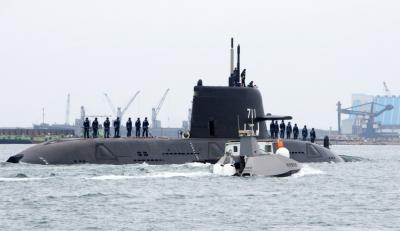
Taiwan's first indigenous defense submarine, the SS-711 Hai Kun (海鯤, or Narwhal), departed for its 13th sea trial at 7am today, marking its seventh submerged test, with delivery to the navy scheduled for July. The outing also marked its first sea deployment since President William Lai (賴清德) boarded the submarine for an inspection on March 19, drawing a crowd of military enthusiasts who gathered to show support. The submarine this morning departed port accompanied by CSBC Corp’s Endeavor Manta (奮進魔鬼魚號) uncrewed surface vessel and a navy M109 assault boat. Amid public interest in key milestones such as torpedo-launching operations and overnight submerged trials,

Quarantine awareness posters at Taiwan Taoyuan International Airport have gone viral for their use of wordplay. Issued by the airport branch of the Animal and Plant Health Inspection Agency, the posters feature sniffer dogs making a range of facial expressions, paired with advisory messages built around homophones. “We update the messages for holidays and campaign needs, periodically refreshing materials to attract people’s attention,” quarantine officials said. “The aim is to use the dogs’ appeal to draw focus to quarantine regulations.” A Japanese traveler visiting Taiwan has posted a photo on X of a poster showing a quarantine dog with a


 RSS
RSS