


Writing spring couplets is good for one’s health, as it trains hand-eye coordination, concentration and cognitive ability, and can even help ease anxiety and loneliness, Taiwanese academics said.
Calligraphy trains coordination between the eyes, hands and brain, as the eyes follow the brushstrokes and communicate with the brain, which in turn moves the hands, National Taiwan Normal University Chinese professor Huang Ming-li (黃明理) said on Saturday.
Standing and writing larger pieces extends the range of physical activity, he added.
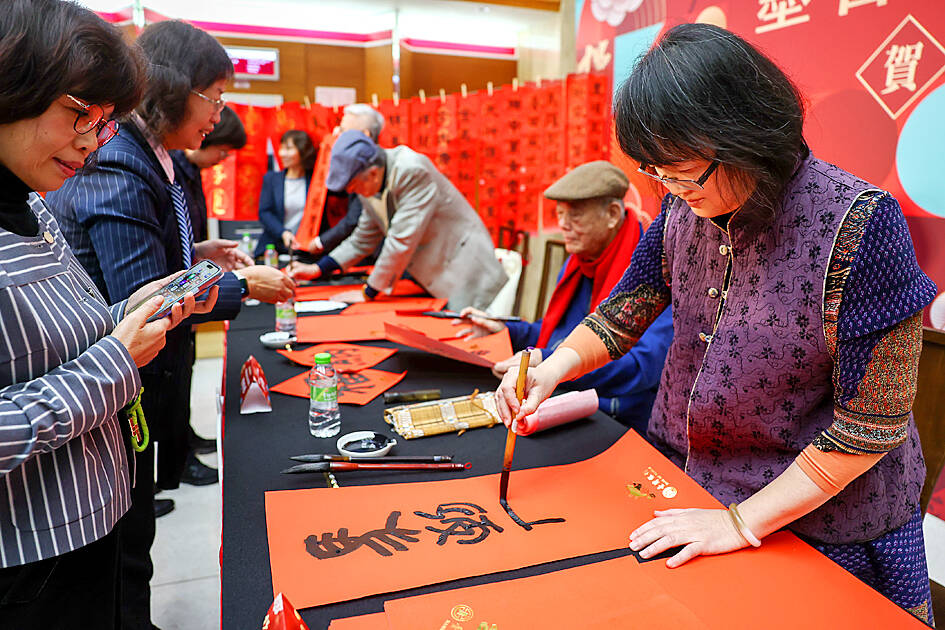
Photo: CNA
Hua Wu Ink Calligraphy founder Juan Ying-tung (阮穎彤) said that practicing calligraphy strengthens small muscles in the fingers and helps the brain better control the body’s extremities, supporting “unity between hand and mind.”
It helps prevent cognitive degeneration in older people, improve coordination and sharpen concentration as the writer focuses on the structure and strokes of each character, she said.
In this busy modern world, focusing on each individual stroke and being present in the moment can help soothe anxiety and provide peace and calm, she added.
Writing spring couplets during the Lunar New Year can bring even greater benefits, Huang said.
Picking up a brush, dipping it in ink and writing on special red paper for the holiday creates a sense of novelty, especially since brushes are rarely used in daily life, he said.
Spring couplets are full of positive messages and good wishes, and can be paired with zodiac-themed illustrations, he said.
Freely writing and drawing on festive, red paper can lift one’s spirits, he added.
Juan said she recently led a spring couplet writing session for older people.
Although the event was quiet, she could feel excitement in the air, she said.
Older people could freely express their New Year’s wishes through auspicious words and interact with others by sharing their work, Juan said.
This strengthens their social connections and fosters positive emotional development, she added.
In related news, Huafan University said it is planning to launch a calligraphy appreciation program for people 30 and older, hoping to revitalize the art as data show a serious decline in calligraphy talent nationwide.
The curriculum would cover calligraphy fundamentals, creative design, market practices and exhibitions, Dean of the College of Humanities and Arts Huang Chih-yang (黃智陽) said.
The program hopes to support the field of calligraphy and address the lack of rising artists, he said.
The soul of calligraphy lies in human sentiment and artistic talent, which digital tools and artificial intelligence cannot replace, Huafan University president Lee Tien-jen (李天任) said.
To further promote calligraphy, the university’s East Asian Calligraphy Research Center is hosting an exhibition featuring works by 32 famous calligraphers with a range of styles, showing the limitless possibilities of calligraphy.
The exhibition runs until March 4.

SECURITY: Starlink owner Elon Musk has taken pro-Beijing positions, and allowing pro-China companies to control Taiwan’s critical infrastructure is risky, a legislator said Starlink was reluctant to offer services in Taiwan because of the nation’s extremely high penetration rates in 4G and 5G services, the Ministry of Digital Affairs said yesterday. The ministry made the comments at a meeting of the legislature’s Transportation Committee, which reviewed amendments to Article 36 of the Telecommunications Management Act (電信管理法). Article 36 bans foreigners from holding more than 49 percent of shares in public telecommunications networks, while shares foreigners directly and indirectly hold are also capped at 60 percent of the total, unless specified otherwise by law. The amendments, sponsored by Chinese Nationalist Party (KMT) Legislator Ko

The eastern extension of the Taipei MRT Red Line could begin operations as early as late June, the Taipei Department of Rapid Transit Systems said yesterday. Taipei Rapid Transit Corp said it is considering offering one month of free rides on the new section to mark its opening. Construction progress on the 1.4km extension, which is to run from the current terminal Xiangshan Station to a new eastern terminal, Guangci/Fengtian Temple Station, was 90.6 percent complete by the end of last month, the department said in a report to the Taipei City Council's Transportation Committee. While construction began in October 2016 with an

NON-RED SUPPLY: Boosting the nation’s drone industry is becoming increasingly urgent as China’s UAV dominance could become an issue in a crisis, an analyst said Taiwan’s drone exports to Europe grew 41.7-fold from 2024 to last year, with demand from Ukraine’s fight against Russian aggression the most likely driver of growth, a study showed. The Institute for Democracy, Society and Emerging Technology (DSET) in a statement on Wednesday said it found that many of Taiwan’s uncrewed aerial vehicle (UAV) sales were from Poland and the Czech Republic. These countries likely transferred the drones to Ukraine to aid it in its fight against the Russian invasion that started in 2022, it said. Despite the gains, Taiwan is not the dominant drone exporter to these markets, ranking second and fourth
The New Taipei City Art Museum this weekend plans to celebrate its first anniversary with a two-day extravaganza featuring live concerts and a large-scale synchronized fireworks and drone display, the New Taipei City Cultural Affairs Department said. The two-day celebrations are to take place in the museum’s outdoor park, with markets and live performances by singers including Ann Bai (白安), Bii (畢書盡) and the Cosmos People (宇宙人), the department said. The highlight on both evenings would be the "Echoes of Light" show, an aerial spectacle combining fireworks and drone performances designed around the concept of "dual stages in the sky," it


 RSS
RSS