


President William Lai (賴清德) yesterday called on lawmakers across party lines to promptly pass a special defense budget and the central government’s general budget once the legislature reconvenes after the Lunar New Year recess.
Lai made the remarks at Longshan Temple (龍山寺) in Taipei’s Wanhua District (萬華) where he offered prayers for the nation’s prosperity, peace and good weather, and wished the public the best of luck and good fortune in the Year of the Horse.
He was joined by Democratic Progressive Party (DPP) Secretary-General Hsu Kuo-yung (徐國勇) and DPP lawmakers to offer incense and distribute red envelopes to the public.
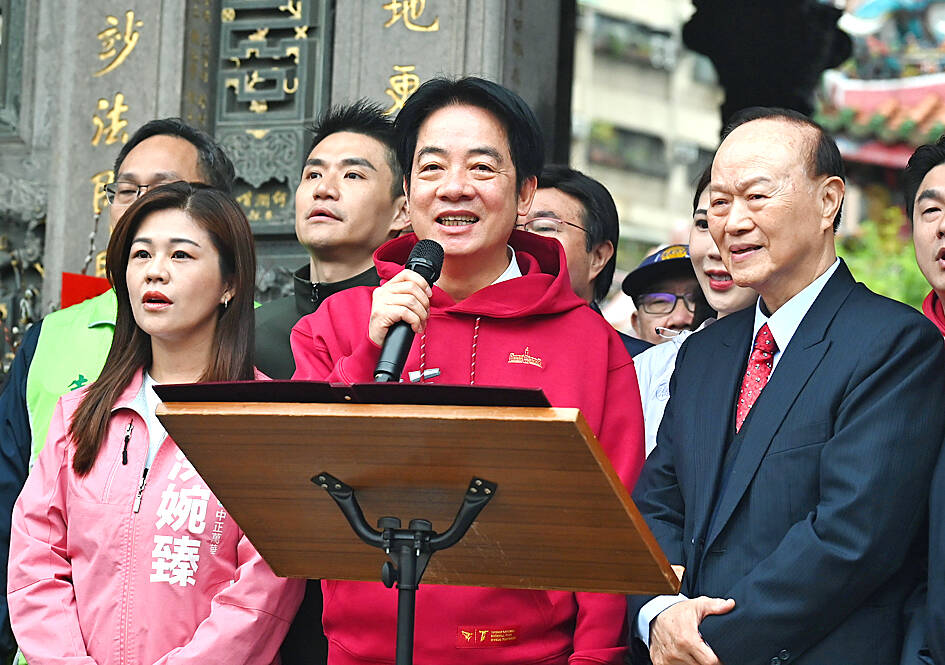
Photo: Wang Yi-sung, Taipei Times
Lai said he was pleased to return to Longshan Temple to pray for Taiwan and extend New Year greetings to the nation.
Economic development will be the government’s top priority this year, he said, adding that Taiwan saw strong economic growth last year and the stock market also performed well.
The nation should build on this foundation to keep moving forward, he said, urging the legislature to pass the central government’s general budget so that the economy could progress and the government could better care for the public.
The special defense budget has to be approved as well, as the nation would not be safe without national defense despite economic growth, he added.
The NT$1.25 trillion (US$39.7 billion) special defense budget was proposed by the Executive Yuan late last year for this year through 2033 to bolster the nation’s defense resilience and asymmetric capabilities.
The opposition-dominated legislature has repeatedly blocked its review since Lai announced it in November last year, demanding that the president brief lawmakers and take questions on the proposal.
The Lai administration and the DPP have said that subjecting the president to questioning by the legislature is unconstitutional and infringes on the balance of power among the branches of government.
Lai yesterday expressed hope that ruling and opposition parties would put the nation and the public first, and swiftly pass both the defense and general budgets after the legislature opens its new session.
Legislative caucuses have reached a consensus that the fifth session of the 11th Legislative Yuan is to begin on Tuesday next week.
Premier Cho Jung-tai (卓榮泰) is expected to deliver a policy address that day, followed by a briefing on March 3 regarding the results and impacts of Taiwan-US tariff negotiations.
In a joint statement on Monday, Legislative Speaker Han Kuo-yu (韓國瑜) and Deputy Legislative Speaker Johnny Chiang (江啟臣), both members of the KMT, said the special defense budget would be a top priority for the legislature when it reconvenes after the holiday.
Separately yesterday, Taiwan People’s Party (TPP) Chairman Huang Kuo-chang (黃國昌), in response to media queries, said his party would take a rational approach to reviewing US arms sales to Taiwan and the nation’s self-defense needs.
Huang reiterated the TPP’s stance that defense spending should reach 3 percent of GDP, saying that strengthening Taiwan’s defense capabilities and safeguarding the nation has always been a core stance of the party.
Former TPP chairman Ko Wen-je (柯文哲) yesterday said the best solution would be for the DPP, the KMT and the TPP to submit their respective defense proposals to legislative committees for review so that the issue could be resolved as soon as possible.
He added that the TPP would likely propose amendments after communicating with the US.

FUKUOKA SITUATION: Japanese media reported that the pathogen is expected to be identified by the summer, while the CDC downplayed the idea that it was hMPV A “mysterious cold-like illness” reported in Japan’s Fukuoka Prefecture does not seem to be a new disease, but Japanese authorities have been asked about the situation, the Centers for Disease Control (CDC) said yesterday. The Fukuoka Prefectural Medical Association on Wednesday told a news conference that a “mystery cold” that has become a hot topic on social media is “highly likely to be caused by some kind of viral infection,” Japan’s KBC News reported. “Many people are experiencing symptoms starting with a sore throat, followed by a runny nose, phlegm and a severe cough,” KBC News reported, citing association officials. Health authorities are

Nvidia Corp CEO Jensen Huang (黃仁勳) arrived in Taiwan yesterday ahead of upcoming AI and technology events, saying he plans to meet with clients and Taiwan Semiconductor Manufacturing Co Chairman C.C. Wei (魏哲家) during his visit. After landing at Taipei Songshan Airport, Huang posed for photos with fans and handed out Yakult drinks to reporters and supporters waiting at the scene, saying he has “a lot to do” during the trip. Asked about reports that Nvidia’s planned headquarters site in Taipei’s Beitou Shilin Technology Park could break ground on May 27, Huang said that if the company holds an event, he would

The Ministry of Finance this afternoon announced the winning numbers for the March-April uniform invoice lottery. The winning number for the NT$10 million (US$318,060) special prize is 19531471, and the winning number for the NT$2 million grand prize is 85941329. Three numbers were drawn for the NT$200,000 first prize: 07225810, 20231230 and 83518781. Those with receipts matching the last seven digits of any of the first-prize numbers will win the NT$40,000 second prize, while those matching the last six digits will win the NT$10,000 third prize. Those whose receipts match the last five digits of the first-prize numbers can claim the NT$4,000 fourth prize,
SIX SUBSIDIES: The monthly allowance for older farmers is to increase to NT$10,000, and NT$5,000 is to be given to homemakers under the national pension system, Lai said The government is to implement major welfare policies for disadvantaged groups, including raising the monthly allowance for older farmers to NT$10,000 and providing homemakers with NT$5,000 per month, President William Lai (賴清德) said yesterday. Lai made the remarks during a visit to Wangling Temple in Chiayi County, saying that the planned increases were being introduced amid economic growth and an increase in tax revenue. Touting a policy, in which the government plans to provide a monthly allowance of NT$5,000 for every child under the age of 18 in a bid to address Taiwan’s low birthrate, Lai said that if received for the


 RSS
RSS