


Doctors advised people with rheumatoid arthritis to manage the condition with an anti-inflammatory diet and appropriate cold and heat therapy during flare-ups, after Japanese Prime Minister Sanae Takaichi was briefly hospitalized when her symptoms worsened.
Takaichi, who led the Liberal Democratic Party (LDP) to a sweeping victory in the House of Representatives election earlier this month, was admitted to hospital on Friday after her rheumatoid arthritis flared up. She had earlier canceled a television interview on Feb. 1 due to severe hand pain, and on Saturday reassured the public about her condition on social media.
Japanese media reported that she sought treatment at a hospital in Shinjuku, Tokyo, saying her symptoms intensified during the election campaign and that she only had time for a full examination after the vote. The LDP said frequent handshaking during the campaign aggravated her condition. She has previously been pictured with bandaged fingers.
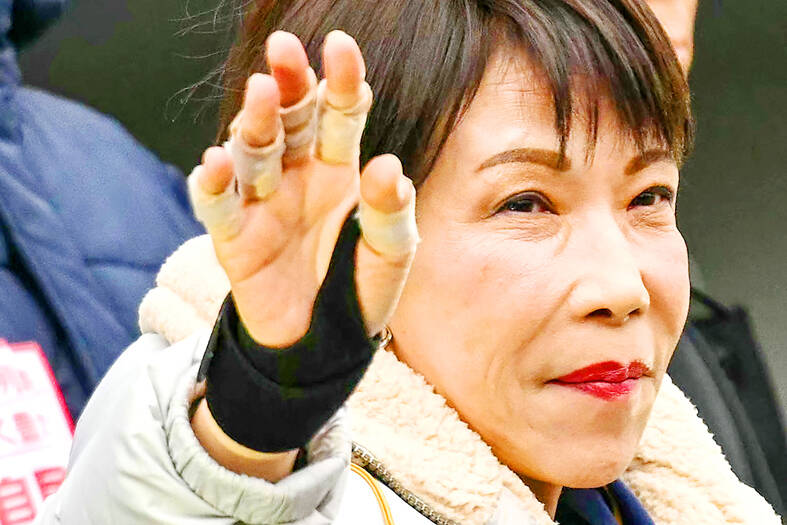
Photo: AFP
Rheumatoid arthritis is a chronic autoimmune disease in which the immune system attacks the joints, causing inflammation, swelling and damage to joints and tendons.
It most commonly affects people aged 30 to 50 and is two to three times more prevalent in women, Taoyuan Armed Forces General Hospital said.
About 80 percent of patients first develop symptoms in the small joints of the hands and wrists, typically in a symmetrical pattern. Early signs include joint pain, swelling and prolonged morning stiffness. As the disease progresses, it can lead to joint deformity, muscle atrophy, reduced mobility and complications affecting other organs, it said.
A medical evaluation is recommended for those who experience morning stiffness lasting more than one hour for more than six weeks, swelling in multiple joint areas for more than six weeks, rheumatoid nodules or symmetrical joint swelling, it said.
An evaluation might include X-rays to assess joint erosion and a blood test to detect the autoantibody known as rheumatoid factor, it said.
Physicians advise patients to rest for at least 10 minutes each hour during daily activities, perform gentle stretching exercises such as yoga, tai chi, cycling or aquatic exercise, and apply ice during acute flare-ups to reduce inflammation, followed by heat therapy to ease stiffness and improve circulation.
Assistive devices can reduce strain on affected joints, and a balanced diet rich in vitamins, protein, calcium and iron is recommended.
Chen Yu-hung (陳鈺泓), an orthopedist at Far Eastern Memorial Hospital in New Taipei City, said people with rheumatoid arthritis should avoid foods that could exacerbate inflammation, including refined sugars, starches, red and processed meats, alcohol and sugary drinks.
Instead, he recommends anti-inflammatory foods such as fish rich in omega-3 fatty acids, vegetables, fruits, whole grains and nuts.
Although rheumatoid arthritis cannot be cured, current treatments can effectively control symptoms and slow disease progression if people follow medical advice and make appropriate lifestyle adjustments, he said.

NATIONAL SECURITY: Authorities are working to confirm the identities of the military personnel involved and investigating possible illegal conduct and regulatory violations Authorities are probing possible national security implications after Kinmen police and immigration officers on Sunday found a Chinese woman allegedly posing as a tourist while engaging in prostitution involving more than 10 military personnel. The woman, surnamed Chen (陳), has since been deported, authorities said, adding that investigators are still working to confirm the identities of those implicated, as the records only listed code names and aliases. The case stemmed from a report received by the Kinmen District Prosecutors’ Office on Friday last week from the Jinhu Precinct of the Kinmen County Police Bureau. On Sunday, police, along with the National Immigration

GLOBALGIVING: ‘ Caving to external pressure is not acceptable for an organization that has cultivated justice reform and human rights for 30 years,’ one NGO said A slew of non-government organizations (NGOs) have withdrawn from the GlobalGiving fundraising platform after it announced it would use “Chinese Taipei” instead of “Taiwan” from next month. The Taiwan Good Rice Association wrote on Facebook on Friday that it was informed on April 28 via a teleconference call of the change, which was made because the platform wanted to operate in China. Taiwan Good Rice is to terminate all cooperative relationships with GlobalGiving in response to the platform’s “unilateral and non-negotiable” decision to remove references to Taiwan, the NGO said. “Taiwan is in the official name of Taiwan Good Rice Association and the

HEAVY WEATHER: Typhoon Jangmi is due to crash straight into the Ryukyus as airlines look to shift flights to larger aircraft or cancel flights to Okinawa entirely Taiwan’s international air carriers announced flight adjustments over the weekend as Typhoon Jangmi is forecast to hit the Ryukyu Islands today and tomorrow. The Central Weather Administration (CWA) upgraded Jangmi from a tropical storm to a typhoon at 8am yesterday, with the eye located 580km south of Naha city. It was moving north at 19kph. Today, China Airlines’ CI-120, CI-121, CI-122 and CI-123 flights between Taoyuan and Naha, Okinawa, have been canceled as well as CI-132 and CI-133 between Kaohsiung and Naha. EVA Air’s BR-112, BR-113, BR-186 and BR-185 flights between Taoyuan and Naha are also canceled. Low-cost carrier Tigerair Taiwan canceled IT-230,
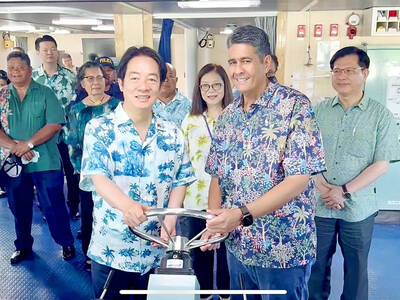
MULTIPRONGED APPROACH: China has sought to pressure Palau across a number of fronts, but the island nation has staunchly resisted overtures to ditch Taiwan Palau has been firm in backing Taiwan despite Chinese pressure that uses tourism economics, cyberattacks and criminal infiltration as tools to threaten the Pacific ally into renouncing its recognition of Taiwan as a sovereign state. The Presidential Office yesterday announced that Vice President Hsiao Bi-khim (蕭美琴) would visit Palau from Saturday to Wednesday next week at the invitation of Palauan President Surangel Whipps Jr. Whipps in April said in an interview that China had outspokenly asked Palau to “denounce Taiwan.” “And we have said: ‘We have no enemies, but nobody tells us who our friends are,’” he said. Whipps has told reporters multiple times


 RSS
RSS