

The government plans to quickly submit the Taiwan-US Agreement on Reciprocal Trade (ART) and a full impact assessment to the Legislative Yuan, Vice Premier Cheng Li-chiun (鄭麗君) said yesterday.
Average tariffs on US exports would drop from 35.7 percent to 12.33 percent after the deal signed on Thursday last week, which confirmed a 15 percent US tariff for Taiwanese goods that does not stack on the most-favored-nation rate.
Cheng, Minister Without Portfolio Yang Jen-ni (楊珍妮), US Trade Representative Jamieson Greer and US Secretary of Commerce Howard Lutnick presided over the signing ceremony in Washington.
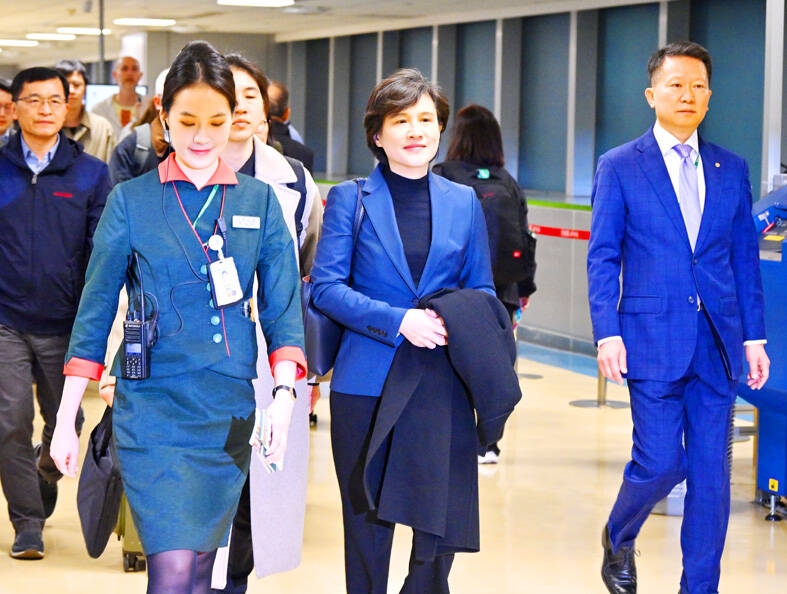
Photo: Liu Hsin-de, Taipei Times
Under the direction of Premier Cho Jung-tai (卓榮泰), the Executive Yuan would send the text of the ART, the investment memorandum of understanding and an overall impact assessment to the legislature “as soon as possible” after the Lunar New Year holiday, Cheng said.
The Executive Yuan would continue communicating in a bid for support from lawmakers and the public, she added.
“Welcome home, Li-chiun,” President William Lai (賴清德) commented on the post, thanking all members of the negotiation team.
“Taiwan has definitely become more resilient and prosperous thanks to your efforts,” he added
Elsewhere, a foreign affairs official said that following the signing of the ART, there would be a qualitative shift in Taiwan-US cooperation, upgrading from a “buyer-seller” dynamic to a “security partnership” centered on “collective defense.”
The ART is a milestone for bilateral economic and trade ties, the official said on condition of anonymity.
Taiwan and the US have also signed a pact agreeing to the principles of the Pax Silica Declaration during the sixth round of talks in Washington last month, they said.
Both countries are setting up task forces for key areas, such as supply chain security and uncrewed aircraft system component certification, to promote safe and resilient supply chains, the official said.
Taiwan-US relations are moving along a predictable, sustainable and institutionalized trajectory driven by a convergence of security trust, economic interdependence and industrial upgrading, they said, adding that the deepening relationship is not solely driven by regional dynamics.
Taiwan and the US have for years been collaborating on democratic governance, disaster prevention and relief, public health and social resilience under the Global Cooperation and Training Framework, bolstering the nation’s role in the democratic camp, they said.
On the national security front, as the concept of collective defense has gained prominence, Taiwan has shifted from a traditional model of “self-funded arms purchases” to being incorporated into the US’ security framework of Foreign Military Financing, the official said.
That shift would mean the nation is no longer just an end user, but a security partner incorporated into Washington’s regional security framework, navigating toward collective defense, the official added.
The US’ National Security Strategy showed that Washington intends to unite allies, and promote collective defense and burden-sharing to maintain peace and stability in the Indo-Pacific region, the official said, adding that Taiwan’s critical role in the region is evident.
The signing of the ART is a historical moment for the two countries as they become formal strategic economic partners, they said.
This positioning goes beyond trade facilitation to encompassing investment commitments, industrial cluster planning and two-way technological cooperation, reflecting Taiwan’s status as a trusted and indispensable node in the restructuring of global supply chains, the official said.
Taiwan’s structural transformation — systematically reducing its dependence on investment and trade with China — has provided a solid foundation for the relationship, they added.
Additional reporting by CNA
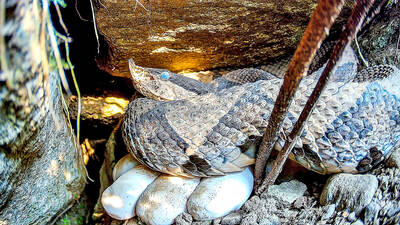
NATURE TAKES ITS COURSE: The agency’s head said he felt a sense of loss watching red-banded snakes eat the babies, as they had decided on non-intervention The Forestry and Nature Conservation Agency yesterday released a documentary on a hundred-pace viper that had incubated 16 eggs, all of which hatched, but only a baby viper escaped after they were attacked by red-banded snakes. The agency’s Taichung branch last year launched the viper reproduction monitoring project soon after forest rangers Lin Chun-yu (林俊佑) and Chou Chia-cheng (周家成) spotted a pregnant hundred-pace viper in a grass-covered burrow near a parking lot in Tbulan Village (松鶴部落). The Atayal village, in Taichung’s Heping District (和平), is headed by Ecyang Yapu, who was positive about the project and assisted in access control and power
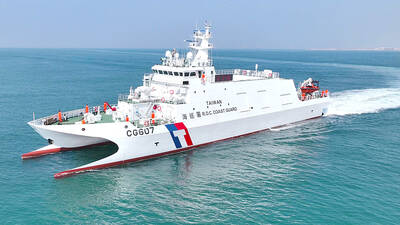
The Coast Guard Administration (CGA) yesterday said that it had deployed vessels to “monitor” Chinese ships operating in waters off the east coast. The CGA said it dispatched vessels in response to a China Coast Guard announcement that it had carried out another “routine law-enforcement patrol” in waters off the east coast. “The CGA firmly rejects China’s cognitive warfare campaign of ‘law enforcement in name, jurisdictional expansion in practice,’” it said on X. As of 11am yesterday, two China Coast Guard ships were “loitering and drifting” about 105 nautical miles (195km) and 74 nautical miles east of Green Island (綠島) respectively, it said. It
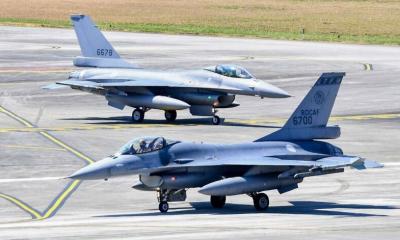
The first two F-16V Block 70 jets Taiwan purchased from the US were spotted unexpectedly turning back after departing from Hawaii yesterday, potentially further delaying delivery of the aircraft. Taiwan has purchased 66 of the F-16 C/D Block 70 jets to be deployed at Chihhang Air Base (志航基地) in Taitung County and operated by the air force's 7th Tactical Fighter Wing to defend Taiwan’s eastern region. Two single-seat jets, bearing serial No. 6727 and 6728, were spotted taking off from Hickam Field in Hawaii yesterday, observers said. Based on the precedent set during the delivery of Taiwan's older F-16 Block 20s, the new
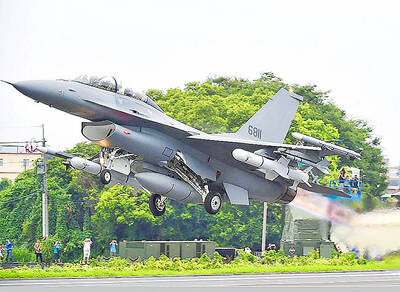
A sharp rise in compensation to be paid by air force officers who leave before completing their required service could indicate an increase in pilots leaving the military early, an analyst said on Friday, warning that the trend could worsen a shortage of experienced personnel. Chieh Chung (揭仲), a researcher at the Association for Strategic Foresight, issued the warning even though the number of volunteer military personnel is expected to increase next year. The planned headcount for volunteer military personnel, covering officers, noncommissioned officers (NCO) and enlisted soldiers, is 158,223 for next year, up 4,258 from 153,965 this year, Chieh said. The increase


 RSS
RSS