


The Forestry and Nature Conservation Agency is hosting a special exhibition titled “100Y Forest Rhythms” to demonstrate the century-old history of forestry development in Taiwan, with interactive installations and free audio guide provided to enrich visitor experience.
The exhibition, at the Taiwan Design Museum of the Songshan Cultural and Creative Park in Taipei, began last week and is to run through July 26.
It begins with the scientific approach-based forest planning project launched in 1925 during the Japanese colonial era.
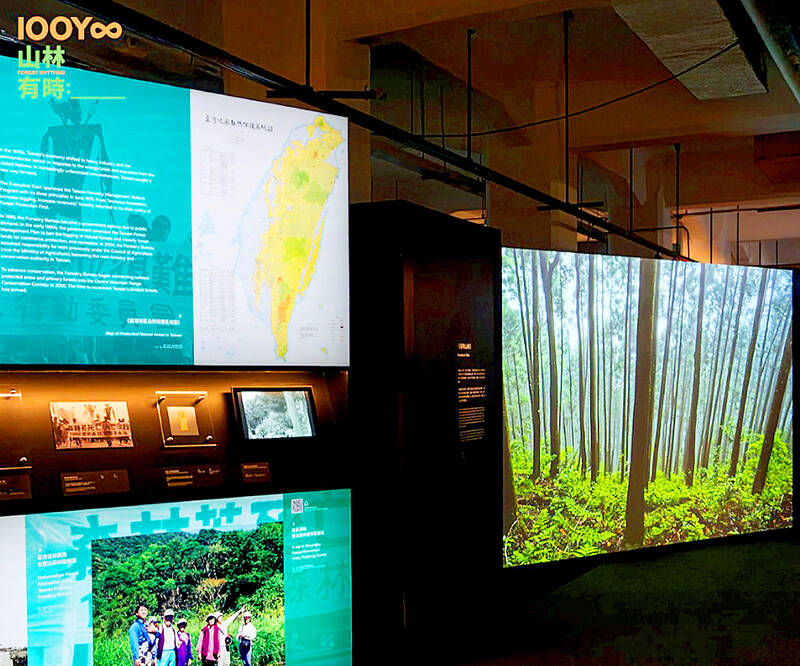
Photo: Screen grab from the Forestry and Nature Conservation Agency’s Facebook page
The exhibition illustrates the “forest-protection first” policy of the 1950s and the Great Forestation Campaign in the 1960s.
It then reaches the turning point of 1975, when forestry development shifted from a focus on economic growth to forest conservation.
Following the natural-forest logging ban promulgated in 1991, the government announced 2017 to be the year of domestic timber, with the goal of reducing reliance on imported timber and promoting a reduction in the transportation carbon footprint, the exhibition shows.
Forestry policies became more focused on biodiversity, conservation and sustainable development of forest resources after the bureau was restructured as the agency in 2023, it shows.
Agency Director-General Lin Hwa-ching (林華慶) said Taiwan’s forestry policies varied with contemporary needs under different governments, leading to significant changes in forest landscapes and ecosystems over the past century.
Forests are not only about trees and timber, but also about wildlife and human communities, he said.
The needs of people and wildlife that live in forests and rely on the woods for their livelihoods should also be considered in forestry policies and forest management, he said.
While timber has been the focus of forestry policy over the past century, given its economic benefits, non-timber forest resources, such as biodiversity or cultural heritage, could also be leveraged to develop ecotourism or non-timber forestry products such as wood oil, thereby creating a more diverse and sustainable forestry industry, Lin said.
The benefits of Taiwan’s rich forest resources should be shared among people and wildlife living in the woods, as well as be extended to urban residents, he said.
The exhibition showcases now rarely seen devices like a hand-cranked telephone, as well as other tools often used in forestry, including wood-marking hammers and small timber scribes.
It also allows visitors to experience aerial photography with a telescope and navigation in an era without GPS, while songs sung by forest workers are presented to provide a glimpse of the life of working in forests in the past century.

FUKUOKA SITUATION: Japanese media reported that the pathogen is expected to be identified by the summer, while the CDC downplayed the idea that it was hMPV A “mysterious cold-like illness” reported in Japan’s Fukuoka Prefecture does not seem to be a new disease, but Japanese authorities have been asked about the situation, the Centers for Disease Control (CDC) said yesterday. The Fukuoka Prefectural Medical Association on Wednesday told a news conference that a “mystery cold” that has become a hot topic on social media is “highly likely to be caused by some kind of viral infection,” Japan’s KBC News reported. “Many people are experiencing symptoms starting with a sore throat, followed by a runny nose, phlegm and a severe cough,” KBC News reported, citing association officials. Health authorities are

Nvidia Corp CEO Jensen Huang (黃仁勳) arrived in Taiwan yesterday ahead of upcoming AI and technology events, saying he plans to meet with clients and Taiwan Semiconductor Manufacturing Co Chairman C.C. Wei (魏哲家) during his visit. After landing at Taipei Songshan Airport, Huang posed for photos with fans and handed out Yakult drinks to reporters and supporters waiting at the scene, saying he has “a lot to do” during the trip. Asked about reports that Nvidia’s planned headquarters site in Taipei’s Beitou Shilin Technology Park could break ground on May 27, Huang said that if the company holds an event, he would

The Ministry of Finance this afternoon announced the winning numbers for the March-April uniform invoice lottery. The winning number for the NT$10 million (US$318,060) special prize is 19531471, and the winning number for the NT$2 million grand prize is 85941329. Three numbers were drawn for the NT$200,000 first prize: 07225810, 20231230 and 83518781. Those with receipts matching the last seven digits of any of the first-prize numbers will win the NT$40,000 second prize, while those matching the last six digits will win the NT$10,000 third prize. Those whose receipts match the last five digits of the first-prize numbers can claim the NT$4,000 fourth prize,

SIX SUBSIDIES: The monthly allowance for older farmers is to increase to NT$10,000, and NT$5,000 is to be given to homemakers under the national pension system, Lai said The government is to implement major welfare policies for disadvantaged groups, including raising the monthly allowance for older farmers to NT$10,000 and providing homemakers with NT$5,000 per month, President William Lai (賴清德) said yesterday. Lai made the remarks during a visit to Wangling Temple in Chiayi County, saying that the planned increases were being introduced amid economic growth and an increase in tax revenue. Touting a policy, in which the government plans to provide a monthly allowance of NT$5,000 for every child under the age of 18 in a bid to address Taiwan’s low birthrate, Lai said that if received for the


 RSS
RSS