


The US’ new "America First Arms Transfer Strategy" could benefit Taiwan, though much would depend on how it is implemented and whether Taipei approves sufficient funding, US defense experts said yesterday.
The new foreign military sales (FMS) guidance could be helpful for Taiwan "if done properly,” said Mark Montgomery, a retired rear admiral in the US Navy and a senior fellow at the Foundation for Defense of Democracies.
Montgomery was referring to US President Donald Trump's signing of an executive order titled "Establishing an America First Arms Transfer Strategy."
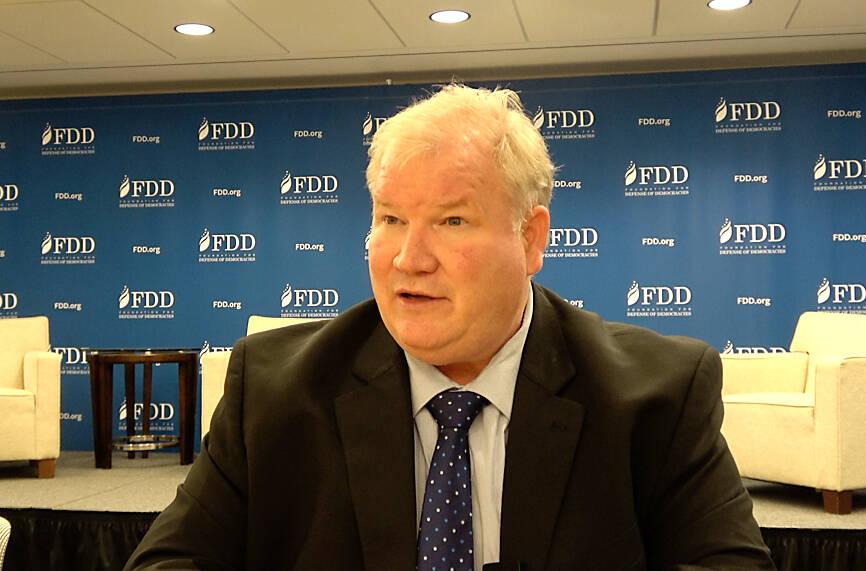
Photo: CNA
The order, signed last week, marked a policy shift toward prioritizing US arms sales and transfers to partners with higher defense spending and greater strategic importance, replacing the long-standing first-come, first-served delivery approach.
However, the order "is only a small fraction of the reform that is needed within the FMS process to reduce the backlogs of deliveries many countries, like Taiwan, are experiencing," Montgomery said in an e-mailed comment.
The order's "vague" wording made it hard to assess how the new policy would affect Taiwan, said John Dotson, director of the Global Taiwan Institute, a Washington-based think tank.
He cited two key sections of the order, the first of which states that foreign arms sales would be used to "support domestic reindustrialization, expand production capacity, and improve the resilience of the United States defense industrial base."
The language in that section could be interpreted to mean that arms sales would prioritize larger-ticket items, such as aircraft, missiles or heavy artillery such as High Mobility Artillery Rocket Systems, Dotson said.
The wording could also be interpreted as support for possible collaborative programs between the US and Taiwan, such as the development of uncrewed aerial vehicles, he said.
"My educated guess is that supporting 'domestic reindustrialization' probably leans more" toward the former interpretation, Dotson said, adding that such a focus on "big-ticket" items could prioritize some Middle Eastern customers.
The second key part of the order states that the US would prioritize arms sales and transfers to partners "that have invested in their own self-defense and capabilities, have a critical role or geography in United States plans and operations, or contribute to our economic security," Dotson said.
The language referring to "critical geography" and the connection to US economic interests "could be taken as a veiled invocation of support for Taiwan," he said.
However, the reference to "partners that have invested in their own defense" would add pressure on Taiwan’s opposition parties to approve the proposed special defense budget and other defense improvement programs, Dotson said.
He was referring to a NT$1.25 trillion (US$39.81 billion) eight-year special defense budget that was proposed by the government late last year, but remains stalled in the opposition-controlled Legislative Yuan.
The legislature has also yet to approve the government's general budget proposal for this year, which would boost defense funding — including veterans' and coast guard expenses — by NT$93.8 billion, or 20.1 percent, to NT$949.5 billion.
That figure is equivalent to 3.32 percent of Taiwan's GDP, government data showed, and would bring Taiwan closer to its goal of raising its defense spending to 5 percent of its GDP by 2030.

LOUD AND PROUD Taiwan might have taken a drubbing against Australia and Japan, but you might not know it from the enthusiasm and numbers of the fans Taiwan might not be expected to win the World Baseball Classic (WBC) but their fans are making their presence felt in Tokyo, with tens of thousands decked out in the team’s blue, blowing horns and singing songs. Taiwanese fans have packed out the Tokyo Dome for all three of their games so far and even threatened to drown out home team supporters when their team played Japan on Friday. They blew trumpets, chanted for their favorite players and had their own cheerleading squad who dance on a stage during the game. The team struggled to match that exuberance on the field, with
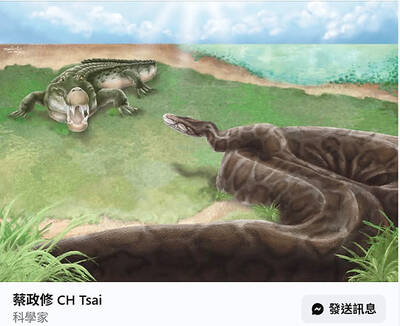
Taiwanese paleontologists have discovered fossil evidence that pythons up to 4m long inhabited Taiwan during the Pleistocene epoch, reporting their findings in the international scientific journal Historical Biology. National Taiwan University (NTU) Institute of Ecology and Evolutionary Biology associate professor Tsai Cheng-hsiu (蔡政修) led the team that discovered the largest snake fossil ever found in Taiwan. The single trunk vertebra was discovered in Tainan at the Chiting Formation, dated to between 400,000 and 800,000 years ago in the Middle Pleistocene, the paper said. The area also produced Taiwan’s first avian fossil, as well as crocodile, mammoth, saber-toothed cat and rhinoceros fossils, it said. Discoveries

Taiwanese paleontologists have discovered fossil evidence that pythons up to 4m long inhabited Taiwan during the Pleistocene epoch, reporting their findings in the international scientific journal Historical Biology. National Taiwan University (NTU) Institute of Ecology and Evolutionary Biology associate professor Tsai Cheng-hsiu (蔡政修) led the team that discovered the largest snake fossil ever found in Taiwan. A single trunk vertebra was discovered in Tainan at the Chiting Formation, dated to between 800,000 to 400,000 years ago in the Middle Pleistocene, the paper said. The area also produced Taiwan’s first avian fossil, as well as crocodile, mammoth, sabre-toothed cat and rhinoceros fossils, it said. Discoveries
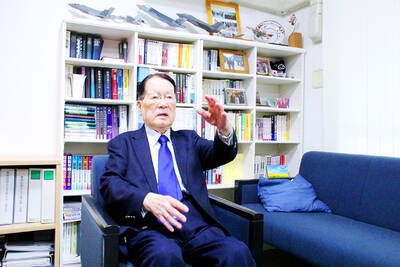
Whether Japan would help defend Taiwan in case of a cross-strait conflict would depend on the US and the extent to which Japan would be allowed to act under the US-Japan Security Treaty, former Japanese minister of defense Satoshi Morimoto said. As China has not given up on the idea of invading Taiwan by force, to what extent Japan could support US military action would hinge on Washington’s intention and its negotiation with Tokyo, Morimoto said in an interview with the Liberty Times (sister paper of the Taipei Times) yesterday. There has to be sufficient mutual recognition of how Japan could provide


 RSS
RSS