


The Food and Drug Administration (FDA) yesterday offered a “3-5-2 formula” — three tips for reheating food safely, five food sanitation and safety guidelines, and two types of food to avoid — to ensure food safety and prevent foodborne illnesses during the Lunar New Year holiday.
With the long holiday approaching, families are likely to gather for a traditional reunion dinner and other festive feasts, and leftovers are frequently reheated for subsequent meals, but there are risks of food poisoning if food is stored or reheated improperly, the FDA said.
The food safety “temperature danger zone” is roughly between 7°C to 60°C, it said, adding that food poisoning bacteria can quickly grow to unsafe levels or even produce toxins when food is kept in this temperature range, so people should remember three key points for reheating food safely.
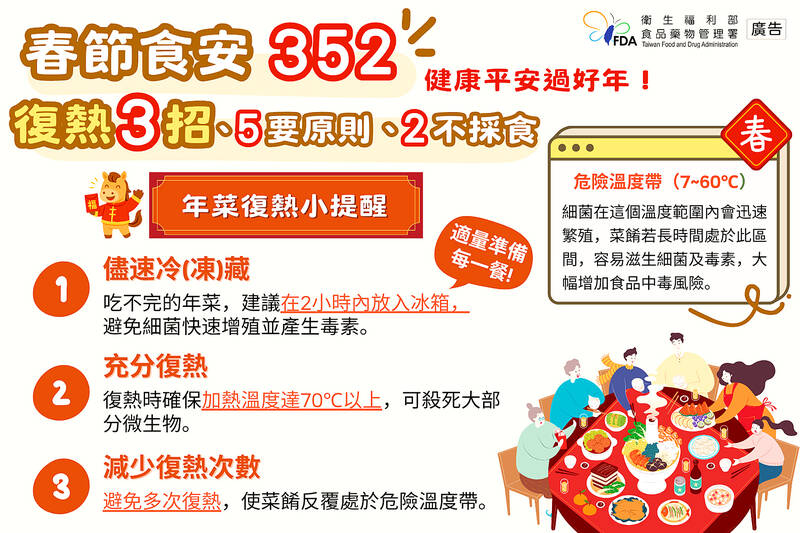
Photo courtesy of the Food and Drug Administration
First, leftovers should be stored in the refrigerator within two hours to prevent the rapid growth of pathogens or toxin production.
Second, leftover food should be reheated to a core temperature of 70°C or higher to kill most bacteria that might have grown during storage, it said.
Third, people should avoid reheating leftovers too many times, as it increases the risk of bacterial growth and foodborne illness, the FDA added.
The FDA suggested that people keep in mind five principles for food sanitation and safety.
First, washing their hands thoroughly with soap, with specific attention to easily missed areas such as fingertips or under the nails, especially after using the toilet, before preparing or eating a meal.
Second, make sure ingredients are fresh and uncontaminated, and third, keep raw food ingredients separate from cooked or ready-to-eat foods, as well as utensils and cutting boards for raw and cooked foods, to avoid cross contamination and food poisoning, it said.
The fourth principle is cooking food thoroughly, especially high-risk foods such as oysters, clams and other shellfish, which are prone to norovirus contamination.
Fifth, storing food at proper temperatures, such as putting ready-to-eat foods in the refrigerator within two hours, it added.
The FDA said that people should avoid two types of foods — drinking untreated mountain spring water, and eating unknown plants and animals.
It said untreated mountain spring water might contain harmful bacteria, viruses, parasites, insect eggs and wild animal excrement, or it might even be contaminated with heavy metals or pesticide.
To prevent poisoning, people should also avoid picking wild plants, including vegetable-like plants or mushrooms, or catching wild animals such as fish, shellfish or cephalopods to eat, it said, adding that they should avoid giving or accepting these items from unsafe sources.
Separately, the National Health Insurance (NHI) Administration on Tuesday said that after it allocated a NT$1.6 billion (US$50.8 million) subsidy to encourage hospitals, clinics and pharmacies to open during the nine-day Lunar New Year holiday, the number of hospital outpatient clinics that would be open during the holiday has increased by at least 12 percent.
It encouraged people to use its NHI Mobile Easy Access app to look up which healthcare facilities are open, or to find “urgent care centers” and “special clinics for infectious disease” before seeking medical attention for mild illnesses and injuries to avoid overcrowding emergency rooms.


UPGRADE: The Kang Ding-class frigate is replacing its Chaparall missiles with Tien Chien II and Hua Yang VLS, which would provide it with long-range, 360° air defense Taiwan plans to produce 1,200 to 1,376 Hai Chien II missiles (海劍二, Sea Sword II) — also known as TC-2N — to serve as the standard air defense system of the navy’s surface combatant fleet, a source said yesterday. Last week, the Hai Chien II, the naval version of the Tien Kung II missile (天劍二, Sky Sword II), completed a live-fire test in waters off the National Chungshan Institute of Science and Technology’s Jiupeng facility (九鵬) in Pingtung County’s Manjhou Township (滿州). The MIM72 Chaparral and other dated air defense missiles that currently arm Taiwanese ships have inadequate range to combat Chinese

REASONS FOR TRAVEL: An assistant professor said that proposed amendments to penalize drivers if they used drugs overseas would not deter people from traveling People who operate a motor vehicle under the influence of marijuana would have their driver’s license revoked, even if they used the substance while overseas, the Ministry of Transportation and Communications said yesterday, citing proposed amendments to the Road Traffic Management and Penalty Act (道路交通管理處罰條例). The amendments would also authorize the government to revoke the licenses of people determined to have used Category 1 or Category 2 narcotics, even if they were not operating a vehicle while under the influence of drugs, as well as ban them from taking the license test for three years, the ministry said. People aged 18 or
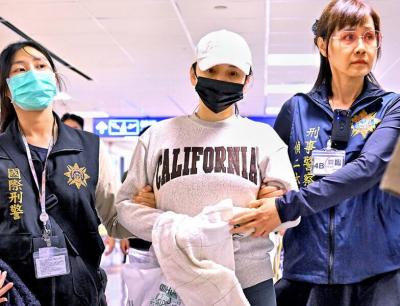
Johanne Liou (劉喬安), a Taiwanese woman who shot to unwanted fame during the Sunflower movement protests in 2014, returned to Taiwan last night after being deported from the US. She is to stand trial in Taiwan for charges involving embezzlement, fraud and drug crimes. The Criminal Investigation Bureau (CIB) said it took her into custody at Taiwan Taoyuan International Airport and would first question her before transferring her to the New Taipei District Prosecutors’ Office. She was arrested upon disembarking a flight from San Francisco that landed shortly before 7pm. Liou absconded to the US in 2019 after jumping bail

Shih Hsin University President Chen Ching-he (陳清河) yesterday issued a public apology for comments made in his commencement speech last week, stating that he has asked the school to suspend his duties and halt his wages for two months as a show of contrition. At the commencement ceremony on May 30, Chen said, “If you don’t manage your time well, or your own emotions, or your health, then I am telling every one of you — put a quick end to ‘you,’ because the world has no need for ‘you.’” The comments have sparked significant controversy online, and Chen through an open


 RSS
RSS