


Images from the Taiwan-made Formosat-8 Chi Po-lin Satellite have been released for the first time, showing that Taiwan is an indispensable part of the international space industry, Vice President Hsiao Bi-khim (蕭美琴) said today.
Publicly released images from the satellite show domestic landmarks including the Hsinchu Science Park and Anping Port (安平港), as well as international cities such as Barcelona and Tokyo.
The image of Tokyo even clearly captures lettering on the Olympic stadium, Hsiao said on Facebook.
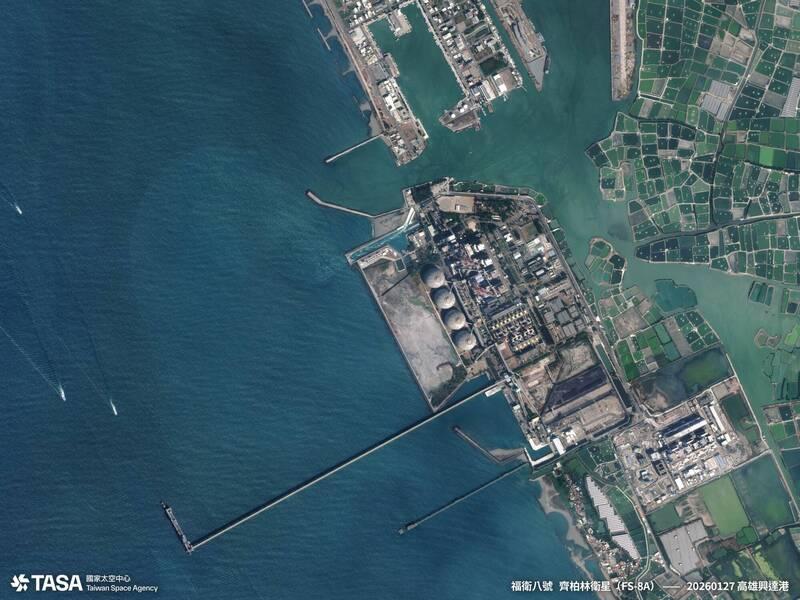
Photo courtesy of the Taiwan Space Agency
There were no overexposure issues, and the satellite’s impressive 1m resolution is the result of eight years of hard work by the Taiwan Space Agency (TASA), Hsiao said.
This achievement shows the world that beyond Taiwan’s semiconductor and technology industries, the nation has the ability to leave its mark on the galaxy, she said.
She also thanked the satellite’s namesake Chi Po-lin (齊柏林) — the late documentary filmmaker known for recording Taiwan through aerial imagery — for continuing to watch over Taiwan from the stars.
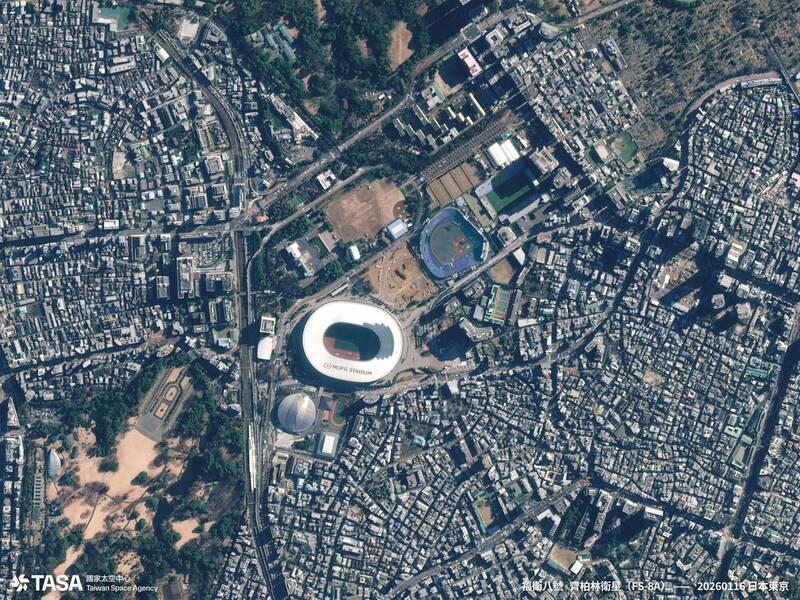
Photo courtesy of the Taiwan Space Agency
“Like the sky, Taiwan’s courage knows no bounds,” Hsiao said.
The satellite, codenamed FS-8A, is the first of the Taiwan-made Formosat-8 constellation project directed by TASA.
It was launched on Nov. 29 last year from the Vandenberg Space Force Base in California.
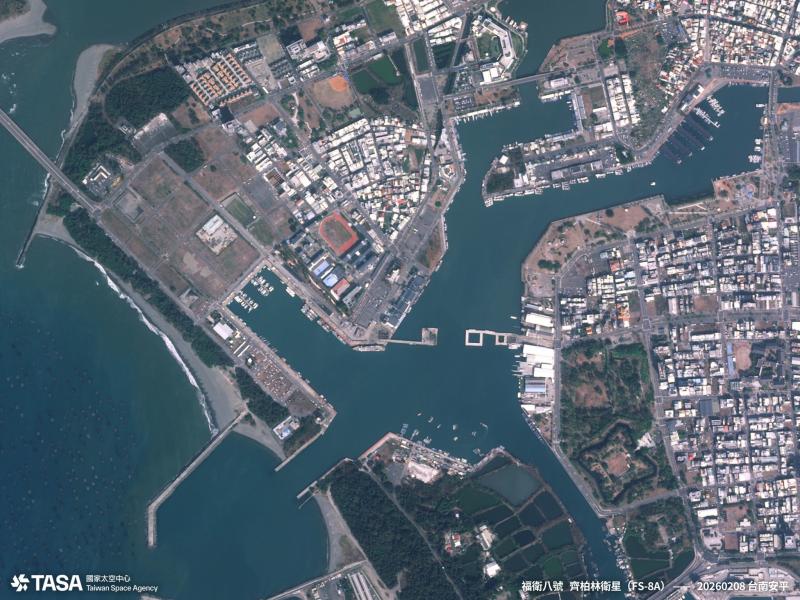
Photo courtesy of the Taiwan Space Agency

LOUD AND PROUD Taiwan might have taken a drubbing against Australia and Japan, but you might not know it from the enthusiasm and numbers of the fans Taiwan might not be expected to win the World Baseball Classic (WBC) but their fans are making their presence felt in Tokyo, with tens of thousands decked out in the team’s blue, blowing horns and singing songs. Taiwanese fans have packed out the Tokyo Dome for all three of their games so far and even threatened to drown out home team supporters when their team played Japan on Friday. They blew trumpets, chanted for their favorite players and had their own cheerleading squad who dance on a stage during the game. The team struggled to match that exuberance on the field, with
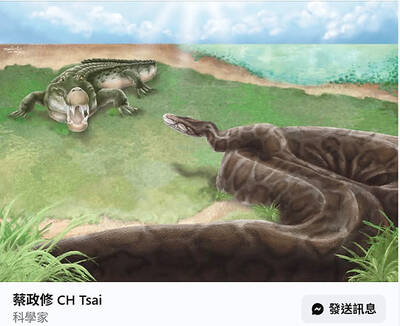
Taiwanese paleontologists have discovered fossil evidence that pythons up to 4m long inhabited Taiwan during the Pleistocene epoch, reporting their findings in the international scientific journal Historical Biology. National Taiwan University (NTU) Institute of Ecology and Evolutionary Biology associate professor Tsai Cheng-hsiu (蔡政修) led the team that discovered the largest snake fossil ever found in Taiwan. The single trunk vertebra was discovered in Tainan at the Chiting Formation, dated to between 400,000 and 800,000 years ago in the Middle Pleistocene, the paper said. The area also produced Taiwan’s first avian fossil, as well as crocodile, mammoth, saber-toothed cat and rhinoceros fossils, it said. Discoveries

Taiwanese paleontologists have discovered fossil evidence that pythons up to 4m long inhabited Taiwan during the Pleistocene epoch, reporting their findings in the international scientific journal Historical Biology. National Taiwan University (NTU) Institute of Ecology and Evolutionary Biology associate professor Tsai Cheng-hsiu (蔡政修) led the team that discovered the largest snake fossil ever found in Taiwan. A single trunk vertebra was discovered in Tainan at the Chiting Formation, dated to between 800,000 to 400,000 years ago in the Middle Pleistocene, the paper said. The area also produced Taiwan’s first avian fossil, as well as crocodile, mammoth, sabre-toothed cat and rhinoceros fossils, it said. Discoveries

Whether Japan would help defend Taiwan in case of a cross-strait conflict would depend on the US and the extent to which Japan would be allowed to act under the US-Japan Security Treaty, former Japanese minister of defense Satoshi Morimoto said. As China has not given up on the idea of invading Taiwan by force, to what extent Japan could support US military action would hinge on Washington’s intention and its negotiation with Tokyo, Morimoto said in an interview with the Liberty Times (sister paper of the Taipei Times) yesterday. There has to be sufficient mutual recognition of how Japan could provide


 RSS
RSS