


China would offer firm support for "patriotic pro-reunification forces" in Taiwan and strike hard against "separatists," the top Chinese official in charge of Taiwan policy said today.
This year's annual "Taiwan Work Conference" was held in Beijing yesterday and today.
Addressing the meeting, Chinese People's Political Consultative Conference Chairman Wang Huning (王滬寧), the CCP’s fourth-ranked leader, said officials must advance the "great cause of national reunification," Xinhua news agency reported.
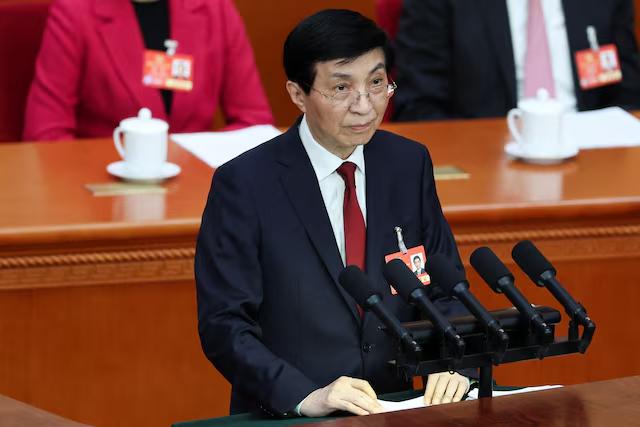
Photo: Reuters
Wang stressed the need to uphold the “one China” principle and the “1992 consensus” to firmly combat "Taiwan independence separatist forces and oppose interference by external forces,” Xinhua said.
The so-called “1992 consensus,” a term former Mainland Affairs Council chairman Su Chi (蘇起) in 2006 admitted making up in 2000, refers to a tacit understanding between the Chinese Nationalist Party (KMT) and the Chinese government that both sides of the Strait acknowledge there is “one China,” with each side having its own interpretation of what “China” means.
The party would move in line with Chinese President Xi Jinping’s (習近平) “Thought on Socialism with Chinese Characteristics for a New Era” to resolve the Taiwan issue and “advance the great cause of China’s unification,” Wang was reported as saying.
He also called for facilitating people-to-people and primary-level exchanges, and supporting Taiwanese compatriots, especially young people, seeking to study, work and live in China, Xinhua said.
He further emphasized the importance of supporting the development of Taiwanese businesspeople and enterprises in China, so that people on both sides of the Strait could share the opportunities and achievements of Chinese modernization, it said.
Wang was speaking just a week after meeting a delegation from the KMT, who were in Beijing for a meeting of party think tanks.
Speaking to reporters earlier today in Taipei, KMT Vice Chairman Hsiao Hsu-tsen (蕭旭岑), who led the delegation to Beijing, said there had been no discussion of political topics when they met Wang, as the trip was aimed at discussing issues such as tourism.
The KMT has been eyeing a meeting between new party Chairwoman Cheng Li-wun (鄭麗文) and Xi, he said, adding that if there was any "confirmed news" about that, the party would announce it.
The government had not responded to requests for comment as of press time.
Meanwhile, sources in Beijing said that the Chinese Communist Party (CCP) has formulated four key objectives for intervening in Taiwan’s elections through local election task forces, “united front” work and cognitive warfare tactics aimed at influencing public opinion online.
Beijing’s creation of task forces at the "Taiwan Work Conference" was “a form of aggression against Taiwan,” Taiwan Economic Democracy Union convener Lai Chung-chiang (賴中強) said.
He urged people to recognize which candidates are supported by the CCP and be aware of China’s election interference tactics.
The CCP is planning to use economic coercion, economic incentives and political maneuvering to intervene in Taiwan’s local elections this year, he said.
One of the tactics would be to impose sweeping bans on imports of certain agricultural or food products, then selectively reopen imports for regions or companies connected to the political figures it supports, he said.
He referenced previous import bans on Taiwanese pineapple custard apples, grouper fish, kaoliang liquor and tea, which were selectively lifted to support specific candidates from the KMT.
The public should better understand these tactics and condemn China’s use of economic coercion to influence democratic elections, as that would reduce the impact of CCP interference, he said.
Taiwan has made progress diversifying exports for agricultural products and reducing reliance on the Chinese market, which would also help to counter these effects, he said.
Moreover, the CCP regularly provides trips to China for village chiefs, community organization leaders and residents, which would likely continue on a large scale in the lead-up to the elections, he said.
Online cognitive warfare tactics would also continue and expand this year, with new tactics expected to emerge, he said.

Actor Darren Wang (王大陸) was sentenced to six months in prison, commutable to a fine, by the New Taipei District Court today for contravening the Personal Data Protection Act (個人資料保護法) in a case linked to an alleged draft-dodging scheme. Wang allegedly paid NT$3.6 million (US$114,380) to an illegal group to help him evade mandatory military service through falsified medical documents, prosecutors said. He transferred the funds to Chen Chih-ming (陳志明), the alleged mastermind of a draft-evasion ring, although he lost contact with him as he was already in detention on fraud charges, they said. Chen is accused of helping a

SECURITY: Starlink owner Elon Musk has taken pro-Beijing positions, and allowing pro-China companies to control Taiwan’s critical infrastructure is risky, a legislator said Starlink was reluctant to offer services in Taiwan because of the nation’s extremely high penetration rates in 4G and 5G services, the Ministry of Digital Affairs said yesterday. The ministry made the comments at a meeting of the legislature’s Transportation Committee, which reviewed amendments to Article 36 of the Telecommunications Management Act (電信管理法). Article 36 bans foreigners from holding more than 49 percent of shares in public telecommunications networks, while shares foreigners directly and indirectly hold are also capped at 60 percent of the total, unless specified otherwise by law. The amendments, sponsored by Chinese Nationalist Party (KMT) Legislator Ko

NON-RED SUPPLY: Boosting the nation’s drone industry is becoming increasingly urgent as China’s UAV dominance could become an issue in a crisis, an analyst said Taiwan’s drone exports to Europe grew 41.7-fold from 2024 to last year, with demand from Ukraine’s fight against Russian aggression the most likely driver of growth, a study showed. The Institute for Democracy, Society and Emerging Technology (DSET) in a statement on Wednesday said it found that many of Taiwan’s uncrewed aerial vehicle (UAV) sales were from Poland and the Czech Republic. These countries likely transferred the drones to Ukraine to aid it in its fight against the Russian invasion that started in 2022, it said. Despite the gains, Taiwan is not the dominant drone exporter to these markets, ranking second and fourth

The eastern extension of the Taipei MRT Red Line could begin operations as early as late June, the Taipei Department of Rapid Transit Systems said yesterday. Taipei Rapid Transit Corp said it is considering offering one month of free rides on the new section to mark its opening. Construction progress on the 1.4km extension, which is to run from the current terminal Xiangshan Station to a new eastern terminal, Guangci/Fengtian Temple Station, was 90.6 percent complete by the end of last month, the department said in a report to the Taipei City Council's Transportation Committee. While construction began in October 2016 with an


 RSS
RSS