


Independent Legislator May Chin (高金素梅) was today questioned after prosecutors searched her office over alleged corruption involving assistant expenses and national security concerns tied to campaign finances.
The Ministry of Justice Investigation Bureau’s national security unit searched Chin’s residence at 6am this morning, seizing her computer hard drive, personal mobile phone and other devices, Chinese-language media reports said.
Investigators searched Chin’s office at the Legislative Yuan at 9:30am, reports said.
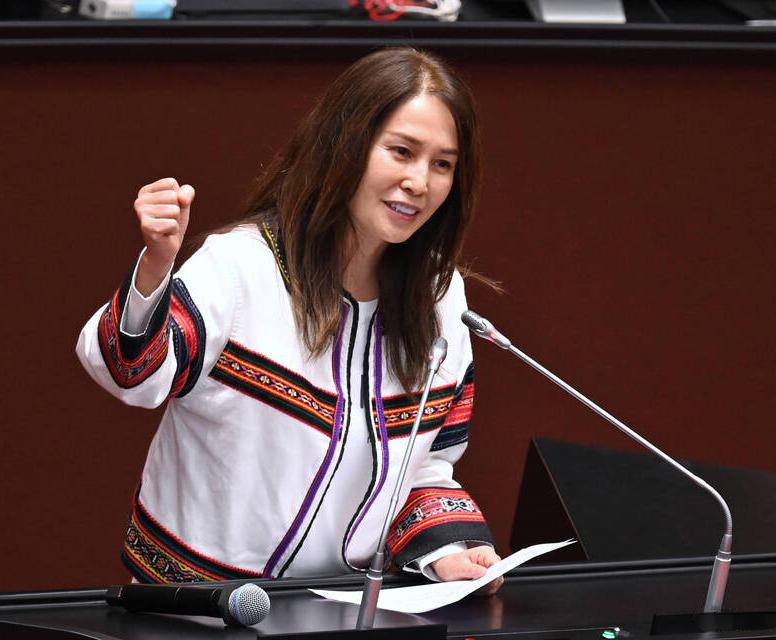
Photo: Taipei Times file photo
The search was carried out in accordance with the law, the Legislative Yuan said, adding that it was not aware of the case’s details due to non-disclosure during an investigation.
Prosecutors are investigating Chin for allegedly claiming assistant fees for staff who did not actually work, in contravention of the Anti-Corruption Act (貪污治罪條例), sources said.
Chin’s legislative campaign was also allegedly backed by Chinese funding, potentially breaching the Anti-Infiltration Act (反滲透法), sources said.
Chin and her assistant, surnamed Chang (張), among others, are suspected of embezzling assistant fees, contravening the Medical Devices Act (醫療器材管理法) and fraudulently obtaining subsidies, the Taipei District Prosecutors’ Office said.
Investigators searched 30 locations, including Chin’s office and residence, as well as the residences of other suspected parties, and summoned 18 people involved in the case for questioning, the office said.
The 18 include Chin, Chang, independent Taitung County Councilor Chen Cheng-tsung (陳政宗), independent Hualien County Councilor Chien Chih-lung (簡智隆) and independent Pingtung City Councilor Aljui Piyuvel (越秋女), sources said.
They would be transferred to the Taipei District Prosecutors’ Office for questioning later today, people familiar with the matter said.
None of them have yet to respond to requests for comment.
Prosecutors are investigating Piyuvel, Chin’s former team member, who allegedly bribed voters during the 2022 local elections with COVID-19 rapid test kits that were made in China, sources said.
Piyuvel was acquitted in a first trial, but investigators confirmed that Chin had collected and provided the tests.
Authorities are now investigating whether importing the tests complied with regulations and whether China was involved.
Chin has served as a legislator representing the highland indigenous constituency for more than 20 years, since first taking up the position in 2002.
Her political alignment has shifted from being an independent to being part of the Non-Partisan Solidarity Union or the People First Party caucus.
After the Non-Partisan Solidarity Union disbanded, Chin returned to being an independent legislator, but acts as part of the Chinese Nationalist Party’s (KMT) pan-blue coalition and participates in their negotiations.
Chin has long courted controversy over her close interactions with China, including meetings with senior Chinese leaders, attending a 2015 military parade in China and portraying herself as representative of Taiwan’s ethnic minorities while promoting pro-Beijing narratives.
She has also faced sustained criticism at home for her legislative performance, with watchdog groups citing low attendance and limited bill participation.
Additional reporting by Liu Wan-lin and Lee Wen-hsin

FUKUOKA SITUATION: Japanese media reported that the pathogen is expected to be identified by the summer, while the CDC downplayed the idea that it was hMPV A “mysterious cold-like illness” reported in Japan’s Fukuoka Prefecture does not seem to be a new disease, but Japanese authorities have been asked about the situation, the Centers for Disease Control (CDC) said yesterday. The Fukuoka Prefectural Medical Association on Wednesday told a news conference that a “mystery cold” that has become a hot topic on social media is “highly likely to be caused by some kind of viral infection,” Japan’s KBC News reported. “Many people are experiencing symptoms starting with a sore throat, followed by a runny nose, phlegm and a severe cough,” KBC News reported, citing association officials. Health authorities are

Nvidia Corp CEO Jensen Huang (黃仁勳) arrived in Taiwan yesterday ahead of upcoming AI and technology events, saying he plans to meet with clients and Taiwan Semiconductor Manufacturing Co Chairman C.C. Wei (魏哲家) during his visit. After landing at Taipei Songshan Airport, Huang posed for photos with fans and handed out Yakult drinks to reporters and supporters waiting at the scene, saying he has “a lot to do” during the trip. Asked about reports that Nvidia’s planned headquarters site in Taipei’s Beitou Shilin Technology Park could break ground on May 27, Huang said that if the company holds an event, he would

The Ministry of Finance this afternoon announced the winning numbers for the March-April uniform invoice lottery. The winning number for the NT$10 million (US$318,060) special prize is 19531471, and the winning number for the NT$2 million grand prize is 85941329. Three numbers were drawn for the NT$200,000 first prize: 07225810, 20231230 and 83518781. Those with receipts matching the last seven digits of any of the first-prize numbers will win the NT$40,000 second prize, while those matching the last six digits will win the NT$10,000 third prize. Those whose receipts match the last five digits of the first-prize numbers can claim the NT$4,000 fourth prize,

SIX SUBSIDIES: The monthly allowance for older farmers is to increase to NT$10,000, and NT$5,000 is to be given to homemakers under the national pension system, Lai said The government is to implement major welfare policies for disadvantaged groups, including raising the monthly allowance for older farmers to NT$10,000 and providing homemakers with NT$5,000 per month, President William Lai (賴清德) said yesterday. Lai made the remarks during a visit to Wangling Temple in Chiayi County, saying that the planned increases were being introduced amid economic growth and an increase in tax revenue. Touting a policy, in which the government plans to provide a monthly allowance of NT$5,000 for every child under the age of 18 in a bid to address Taiwan’s low birthrate, Lai said that if received for the


 RSS
RSS