


Hsu Kun-hua (徐琨華), director of the film Murder of the Century (世紀血案), late on Sunday evening issued an apology, adding he would withdraw from the film’s production.
The film, based on the unsolved 1980 murders of democracy advocate Lin I-hsiung’s (林義雄) mother and twin seven-year-old daughters, has triggered a controversy after it came to light that it had been shot without the consent of the family.
Moreover, many have questioned Hsu’s personal involvement in the film, as he is a grandson of Hsu Mei-lin (徐梅鄰), the then-spokesman of the Taiwan Garrison Command — the primary secret police and state security organization operating under martial law, which conducted censorship and political repression at the time.
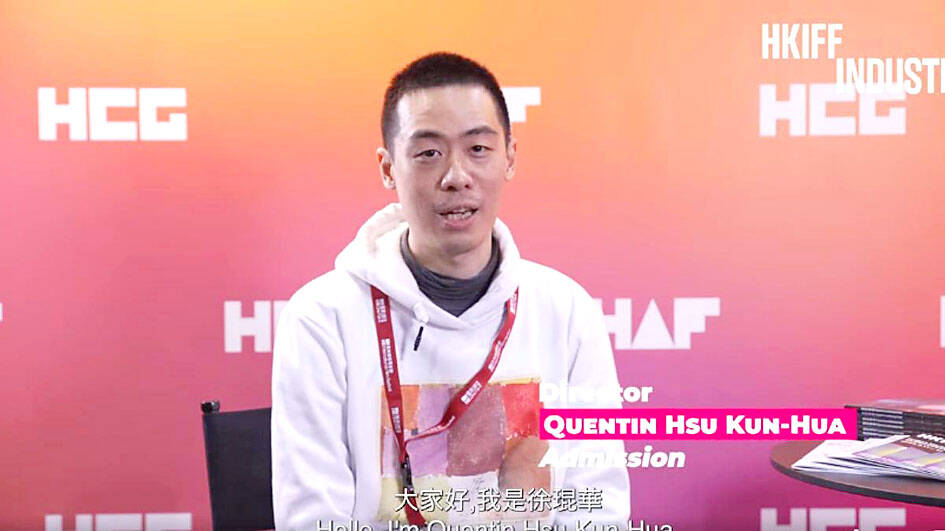
Photo: Screen grab from HKIFF Industry’s Facebook page
Hsu Kun-hua said the screenplay was written by producer Sam Su (蘇敬軾), adding that during their initial discussions, the consent of the people involved and their family members was raised, to which he said that Su had responded that, because Lin has stated publicly that he did not wish to speak about the misfortune suffered by his family, “we hoped to respect Lin’s wishes while moving forward with the film project.”
With regards to his identity as Hsu Mei-lin’s grandson, Hsu Kun-hua said he grew up in Taiwan’s democratic and free society, and understands the meaning of right, wrong and justice.
“The social scars left by the martial law era have yet to be fully healed and this has meant that my personal background and the tragedy of the Lin family case still involve a difficult and unavoidable process of adjustment,” he said.
“I failed to recognize that my identity itself constitutes a form of harm to the victims’ families. This was a lapse in judgement on my part and I am willing to accept all criticism,” he added.
Alongside expressing his apology to Lin, he announced that he would immediately remove himself from all involvement in the film’s post-production.
His statement followed apologies from other cast members, including Candy Yang (楊小黎), Jian Man-shu (簡嫚書), Nana Lee (李千娜) and Johnny Kou (寇世勳).
See ‘Murder’ on Page 8

FUKUOKA SITUATION: Japanese media reported that the pathogen is expected to be identified by the summer, while the CDC downplayed the idea that it was hMPV A “mysterious cold-like illness” reported in Japan’s Fukuoka Prefecture does not seem to be a new disease, but Japanese authorities have been asked about the situation, the Centers for Disease Control (CDC) said yesterday. The Fukuoka Prefectural Medical Association on Wednesday told a news conference that a “mystery cold” that has become a hot topic on social media is “highly likely to be caused by some kind of viral infection,” Japan’s KBC News reported. “Many people are experiencing symptoms starting with a sore throat, followed by a runny nose, phlegm and a severe cough,” KBC News reported, citing association officials. Health authorities are

Nvidia Corp CEO Jensen Huang (黃仁勳) arrived in Taiwan yesterday ahead of upcoming AI and technology events, saying he plans to meet with clients and Taiwan Semiconductor Manufacturing Co Chairman C.C. Wei (魏哲家) during his visit. After landing at Taipei Songshan Airport, Huang posed for photos with fans and handed out Yakult drinks to reporters and supporters waiting at the scene, saying he has “a lot to do” during the trip. Asked about reports that Nvidia’s planned headquarters site in Taipei’s Beitou Shilin Technology Park could break ground on May 27, Huang said that if the company holds an event, he would

Carrefour Taiwan is to begin using a new name from the start of July, but it cannot divulge the name until then, the chairman of the supermarket chain's parent company said today. President Chain Store Co chairman Lo Chih-hsien (羅智先) was asked by reporters after a shareholders' meeting to confirm whether the company has settled on a new name for the supermarket brand. In March, the government-registered name of two Carrefour Taiwan branches was quietly changed to "Le Chia Kang" (樂家康) in Chinese, raising speculation that has been selected as the name. Lo said that because of local regulations and contractual obligations, the
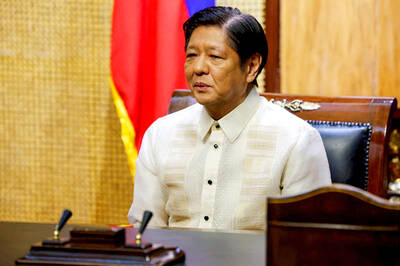
The Philippines would likely be involved in any conflict over Taiwan due to its proximity to the democracy claimed by China, President Ferdinand Marcos Jr said, reiterating a stance that risks angering Beijing. “In the Philippines, we do not have a choice because Taiwan is so close to the Philippines and we have almost 200,000 Filipino nationals living and working in Taiwan,” Marcos said in an interview with Japanese media in Manila on Monday. The Philippine leader’s comments come ahead of a state visit to Japan next week, where he is to meet with Japanese Prime Minister Sanae Takaichi to discuss security


 RSS
RSS