


Young people studying journalism and communication in Hong Kong no longer aspire to become reporters after graduation, according to Kwan Chun-hoi (關震海), the founder of independent news outlet Hong Kong Feature (誌).
“One reason is the danger: Journalists risk intimidation and face little job security. Another is financial: Independent, non-mainstream media outlets simply lack funding,” Kwan said in a an interview with the Liberty Times (sister paper of the Taipei Times).
Hong Kong Feature focuses on in-depth reporting on local community developments, politics, economics and popular culture. It aims to document issues important to Hong Kongers before 2047 — the year marking the planned end of the “one country, two systems” framework under which Hong Kong is promised limited autonomy within China.

Photo: Chen Yu-fu, Taipei Times
“The goal of Hong Kong Feature is to leave behind diverse records of Hong Kong. There is still space for reporting,” Kwan said, adding that the outlet also covers Asia-Pacific news.
However, reporting on issues such as Sino-Japanese relations carries greater risk, because they involve “the state,” he said.
“For a local media outlet, touching on a national red line is extremely difficult,” he said.
Some topics are entirely off-limits, such as the 1989 Tiananmen Square protests and massacre, he added.
“If something absolutely must be discussed, it would not be done in Hong Kong,” he said.
Kwan said he has learned to adapt to the atmosphere created by the territory’s National Security Law, which has not yet become an insurmountable obstacle.
However, he said that Hong Kong faces a deeper structural crisis: a lack of industry and capital, combined with journalism graduates’ unwillingness to enter the profession.
Kwan, who previously worked for Hong Kong’s now-defunct Apple Daily, said people once entered the media despite risks and low pay, because they could report on stories they believed mattered.
“If Hong Kong has less freedom than before, then the journalistic spirit is even more necessary now,” he said.
Taiwan should be aware that before the National Security Law, Hong Kong still had opportunities to help itself, but failed to act in time, Kwan said.
“By the time people wanted to act, it was already too late,” he said.
“We can no longer speak openly in Hong Kong, and we cannot enter schools — many things are no longer allowed,” Kwan said.
He added that Taiwan’s press freedom was won at the cost of human lives and should be cherished.
It is essential to educate society about the value of journalism, treasure every news story and cultivate new reporters, he said.
Taiwan’s media ecosystem still needs significant improvement, he added.
Kwan said Hong Kong journalists no longer know which topics are safe and which are sensitive.
“Every report is a gamble,” he said. “For every story, 70 percent of the effort goes into thinking about what comes after.”
While the media can report that Apple Daily founder Jimmy Lai (黎智英) has been sentenced to 20 years in prison, interviewing Lai’s daughter could cross a red line, he said, adding that interviewing Taiwanese political figures for commentary could also risk contravening Article 23 of the Hong Kong Basic Law, which targets secession, subversion, terrorism and collusion with foreign forces.
While criticism of general administrative departments is still possible, questioning law enforcement agencies — including the police, customs and other disciplined services — faces far greater resistance, Kwan said.
“Journalists have to avoid the police — and the triads,” he said, adding that reporters constantly probe where red lines lie.
Social incidents can be reported with solid evidence, but reporting on the police requires extreme caution, he said.
Just like in China, Hong Kong’s red lines shift daily, he added.
“Many Hong Kongers ask whether the truth about the fire [Wang Fuk Court fire on Nov. 26 last year] would have emerged faster if Apple Daily still existed. My answer is: Probably,” he said. “The fire was a wake-up call. Staying silent can still get you killed. Speaking out might land you in prison. So you must speak — at least a little.”
Many people in Hong Kong now refuse to use their real names when interviewed, fearing government retaliation, Kwan said, adding that “this is the reality facing journalism in Hong Kong today.”

SECURITY: Starlink owner Elon Musk has taken pro-Beijing positions, and allowing pro-China companies to control Taiwan’s critical infrastructure is risky, a legislator said Starlink was reluctant to offer services in Taiwan because of the nation’s extremely high penetration rates in 4G and 5G services, the Ministry of Digital Affairs said yesterday. The ministry made the comments at a meeting of the legislature’s Transportation Committee, which reviewed amendments to Article 36 of the Telecommunications Management Act (電信管理法). Article 36 bans foreigners from holding more than 49 percent of shares in public telecommunications networks, while shares foreigners directly and indirectly hold are also capped at 60 percent of the total, unless specified otherwise by law. The amendments, sponsored by Chinese Nationalist Party (KMT) Legislator Ko
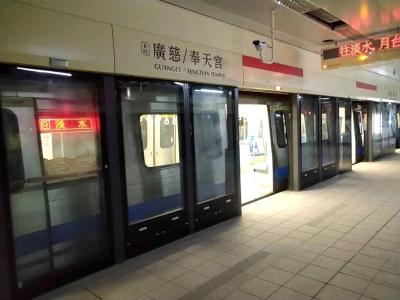
The eastern extension of the Taipei MRT Red Line could begin operations as early as late June, the Taipei Department of Rapid Transit Systems said yesterday. Taipei Rapid Transit Corp said it is considering offering one month of free rides on the new section to mark its opening. Construction progress on the 1.4km extension, which is to run from the current terminal Xiangshan Station to a new eastern terminal, Guangci/Fengtian Temple Station, was 90.6 percent complete by the end of last month, the department said in a report to the Taipei City Council's Transportation Committee. While construction began in October 2016 with an
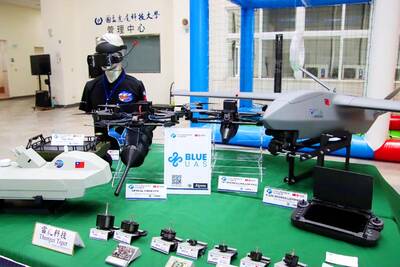
NON-RED SUPPLY: Boosting the nation’s drone industry is becoming increasingly urgent as China’s UAV dominance could become an issue in a crisis, an analyst said Taiwan’s drone exports to Europe grew 41.7-fold from 2024 to last year, with demand from Ukraine’s fight against Russian aggression the most likely driver of growth, a study showed. The Institute for Democracy, Society and Emerging Technology (DSET) in a statement on Wednesday said it found that many of Taiwan’s uncrewed aerial vehicle (UAV) sales were from Poland and the Czech Republic. These countries likely transferred the drones to Ukraine to aid it in its fight against the Russian invasion that started in 2022, it said. Despite the gains, Taiwan is not the dominant drone exporter to these markets, ranking second and fourth
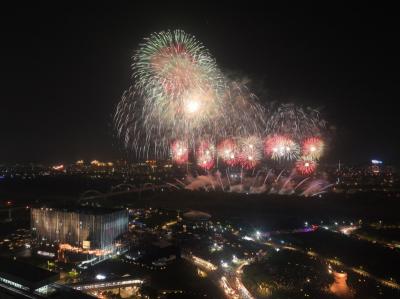
The New Taipei City Art Museum this weekend plans to celebrate its first anniversary with a two-day extravaganza featuring live concerts and a large-scale synchronized fireworks and drone display, the New Taipei City Cultural Affairs Department said. The two-day celebrations are to take place in the museum’s outdoor park, with markets and live performances by singers including Ann Bai (白安), Bii (畢書盡) and the Cosmos People (宇宙人), the department said. The highlight on both evenings would be the "Echoes of Light" show, an aerial spectacle combining fireworks and drone performances designed around the concept of "dual stages in the sky," it


 RSS
RSS