


The landslide victory by Japan’s Liberal Democratic Party (LDP) yesterday signals the collapse of the pro-China faction in Japanese politics, academics said today.
The LDP, led by Japanese Prime Minister Sanae Takaichi, secured 316 seats in Japan’s House of Representatives in yesterday’s election.
It was the first time since World War II that a party has won more than two-thirds of the seats in the 465-member house.
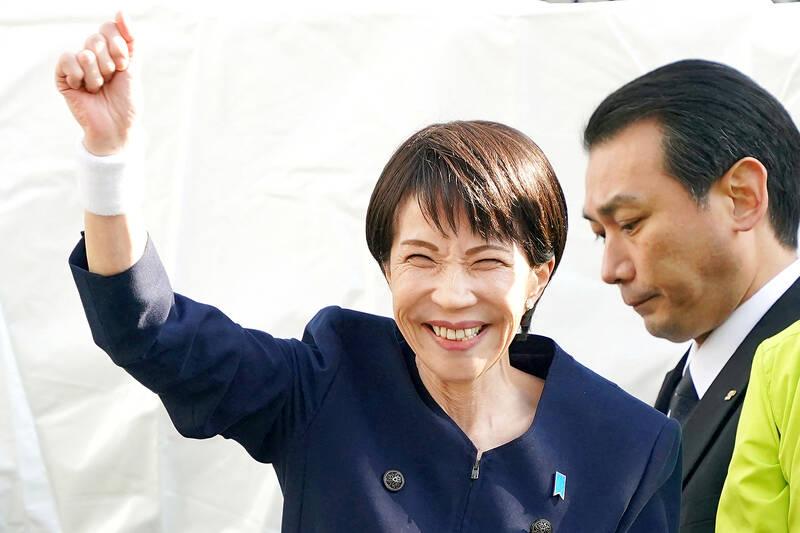
Photo: AFP
The Institute for National Policy Research and Taiwan Society of Japan Studies held a news conference today to discuss the results of the election and its impact.
Takaichi has been able to unite the LDP, showing that factional politics within the party are weakening, institute vice president Kuo Yu-jen (郭育仁) said.
While there has been speculation about Japan revising its constitution to change pacifist language, Kuo said it would still be difficult, as it would require two-thirds approval from Japan’s upper and lower houses of parliament followed by a national referendum.
The LDP-Japan Innovation Party coalition does not hold a majority in the House of Councillors, Japan’s upper house of parliament, Kuo said.
Yesterday’s election shows that there is no room for “vague centrist positions” in Japanese politics, Foundation of Asia-Pacific Peace Studies director Tung Li-wen (董立文) said.
Only clearly defined policies can meet voter and international expectations, and ensure the country’s development and survival, Tung said.
Japan would continue to strengthen itself and take pro-US, pro-Taiwan stances while maintaining a tough stance on China, he said.
Takaichi advocates for strengthening the state and has already broken out of the traditional framework of Japanese politics, Tung said.
Takaichi effectively saved the entire LDP, signaling that the party would follow her lead, he said, adding that Japan’s opposition parties would also move toward a “Takaichi-style” path.
While China tried to punish Takaichi and intimidate Japanese politicians after comments she made suggesting support for Taiwan last year, China’s actions failed and backfired, Tung said.
Moving forward, Japan-China relations would be “friendly at best, with no limit to how badly they can fall,” likely heading toward a path of cold confrontation, he added.

FUKUOKA SITUATION: Japanese media reported that the pathogen is expected to be identified by the summer, while the CDC downplayed the idea that it was hMPV A “mysterious cold-like illness” reported in Japan’s Fukuoka Prefecture does not seem to be a new disease, but Japanese authorities have been asked about the situation, the Centers for Disease Control (CDC) said yesterday. The Fukuoka Prefectural Medical Association on Wednesday told a news conference that a “mystery cold” that has become a hot topic on social media is “highly likely to be caused by some kind of viral infection,” Japan’s KBC News reported. “Many people are experiencing symptoms starting with a sore throat, followed by a runny nose, phlegm and a severe cough,” KBC News reported, citing association officials. Health authorities are

Nvidia Corp CEO Jensen Huang (黃仁勳) arrived in Taiwan yesterday ahead of upcoming AI and technology events, saying he plans to meet with clients and Taiwan Semiconductor Manufacturing Co Chairman C.C. Wei (魏哲家) during his visit. After landing at Taipei Songshan Airport, Huang posed for photos with fans and handed out Yakult drinks to reporters and supporters waiting at the scene, saying he has “a lot to do” during the trip. Asked about reports that Nvidia’s planned headquarters site in Taipei’s Beitou Shilin Technology Park could break ground on May 27, Huang said that if the company holds an event, he would

The Ministry of Finance this afternoon announced the winning numbers for the March-April uniform invoice lottery. The winning number for the NT$10 million (US$318,060) special prize is 19531471, and the winning number for the NT$2 million grand prize is 85941329. Three numbers were drawn for the NT$200,000 first prize: 07225810, 20231230 and 83518781. Those with receipts matching the last seven digits of any of the first-prize numbers will win the NT$40,000 second prize, while those matching the last six digits will win the NT$10,000 third prize. Those whose receipts match the last five digits of the first-prize numbers can claim the NT$4,000 fourth prize,

SIX SUBSIDIES: The monthly allowance for older farmers is to increase to NT$10,000, and NT$5,000 is to be given to homemakers under the national pension system, Lai said The government is to implement major welfare policies for disadvantaged groups, including raising the monthly allowance for older farmers to NT$10,000 and providing homemakers with NT$5,000 per month, President William Lai (賴清德) said yesterday. Lai made the remarks during a visit to Wangling Temple in Chiayi County, saying that the planned increases were being introduced amid economic growth and an increase in tax revenue. Touting a policy, in which the government plans to provide a monthly allowance of NT$5,000 for every child under the age of 18 in a bid to address Taiwan’s low birthrate, Lai said that if received for the


 RSS
RSS