


China is again playing the “Ryukyu card” to constrain Japan from “playing the Taiwan card,” attempting to make Tokyo think of its own backyard — Okinawa — when intervening in Taiwanese affairs, an academic said.
Japanese Prime Minister Sanae Takaichi told the National Diet last year that if a crisis were to occur in Taiwan, it could constitute a “survival-threatening situation” for Japan, triggering sharp tensions between Tokyo and Beijing.
In response, Chinese state media and pundits are playing the “Ryukyu card” with Kyodo News saying reports involving Ryukyu and Okinawa increased 20-fold.
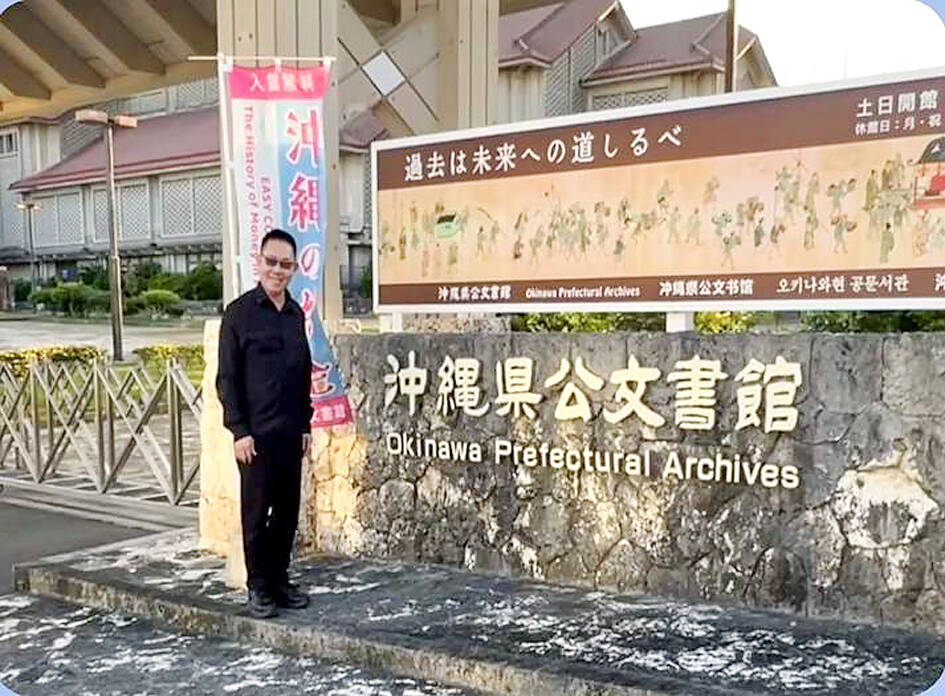
Photo courtesy of John Lin
That marked the third use of China’s “Ryukyu card” in the 21st century, University of Tokyo Institute for Advanced Studies on Asia project researcher John Lim (林泉忠) said.
Lim called the wave a “systematic discourse operation,” saying Chinese state media have published opinion pieces to set the tone, while regional research hubs and academic institutions have held seminars discussing the historical and legal basis of their narrative, and academics were questioning the legality of Japan’s claim over Ryukyu.
This wave is more aggressive than previous ones, going beyond questioning the US’ return of Okinawa to Japan in 1972 and emphasizing that it unilaterally annexed Ryukyu Kingdom by force in 1879, in an attempt to stain the legitimacy of Japan’s claim over Okinawa, he said.
Lim cited Okinawa Prefectural Government officials as saying that they were aware of the situation but they were not in a position to respond, as the effort is not officially backed by the Chinese Ministry of Foreign Affairs.
The officials said they would continue to monitor Chinese public opinion, Lim added.
Most of the people who live in Okinawa believe the status or future of the island should be decided by Okinawans, he said, adding that they feel discomfort and even displeasure toward China’s gamesmanship.
Lim also cited some Okinawan experts familiar with Sino-Ryukyuan history as saying they hoped China would gain a more objective understanding of Okinawan society and avoid making comments that are based on erroneous information.
No party in the Okinawa Prefectural Assembly advocates for independence and there is no widespread public debate in Okinawa about its status or secession, he said, and 60 to 70 percent of respondents opposed independence from Japan in research surveys he conducted.
The limited impact of the “Ryukyu card” is mainly due to its failure to win Okinawans’ support, Lim said.
While Okinawans are strongly dissatisfied with what they see as unfair treatment by the Japanese government regarding the US military presence, they are not inclined to accept external interference, he said.
Having lost one-quarter of their civilian population during World War II, Okinawans remain highly vigilant against any situation that could drag them into war or turn them into pawns in great power rivalry, he added.
China first used the “Ryukyu card” in 2013, when Japan nationalized the Senkaku Islands, known as the Diaoyutais (釣魚台列嶼) in Taiwan, which plunged Sino-Japanese relations into a deep freeze, Lim said.
China and Ryukyu had a tributary relationship for five centuries before the late Qing period. In 1879, Japan unilaterally annexed the Ryukyu Kingdom and renamed it “Okinawa Prefecture.”
Following Japan’s defeat in World War II, the US occupied and administered Okinawa before returning it to Japan in May 1972.
Since Beijing and Tokyo established diplomatic ties in 1972, China has never officially advanced a stance that Ryukyu’s status was undetermined, nor has the Chinese Ministry of Foreign Affairs ever formally questioned Japan’s sovereignty over Okinawa, Lim said.
Beijing is likely to continue efforts to constrain Japan’s involvement in Taiwan, but would remain cautious and is unlikely to formally assert that Ryukyu’s status is unresolved, he added.

Considering that most countries issue more than five denominations of banknotes, the central bank has decided to redesign all five denominations, the bank said as it prepares for the first major overhaul of the banknotes in more than 24 years. Central bank Governor Yang Chin-lung (楊金龍) is expected to report to the Legislative Yuan today on the bank’s operations and the redesign’s progress. The bank in a report sent to the legislature ahead of today’s meeting said it had commissioned a survey on the public’s preferences. Survey results showed that NT$100 and NT$1,000 banknotes are the most commonly used, while NT$200 and NT$2,000

The Centers for Disease Control (CDC) yesterday reported the first case of a new COVID-19 subvariant — BA.3.2 — in a 10-year-old Singaporean girl who had a fever upon arrival in Taiwan and tested positive for the disease. The girl left Taiwan on March 20 and the case did not have a direct impact on the local community, it said. The WHO added the BA.3.2 strain to its list of Variants Under Monitoring in December last year, but this was the first imported case of the COVID-19 variant in Taiwan, CDC Deputy Director-General Lin Ming-cheng (林明誠) said. The girl arrived in Taiwan on

South Korea is planning to revise its controversial electronic arrival card, a step Taiwanese officials said prompted them to hold off on planned retaliatory measures, a South Korean media report said yesterday. A Yonhap News Agency report said that the South Korean Ministry of Foreign Affairs is planning to remove the “previous departure place” and “next destination” fields from its e-arrival card system. The plan, reached after interagency consultations, is under review and aims to simplify entry procedures and align the electronic form with the paper version, a South Korean ministry official said. The fields — which appeared only on the electronic form

The Ministry of Foreign Affairs (MOFA) is suspending retaliation measures against South Korea that were set to take effect tomorrow, after Seoul said it is updating its e-arrival system, MOFA said today. The measures were to be a new round of retaliation after Taiwan on March 1 changed South Korea's designation on government-issued alien resident certificates held by South Korean nationals to "South Korea” from the "Republic of Korea," the country’s official name. The move came after months of protests to Seoul over its listing of Taiwan as "China (Taiwan)" in dropdown menus on its new online immigration entry system. MOFA last week


 RSS
RSS