


A passenger jet operated by South Korean low-cost carrier T’way Air lost a tire on landing at Taiwan Taoyuan International Airport yesterday afternoon, prompting the temporary closure of its north runway and disrupting 14 flights.
The T’way Air flight, arriving from Jeju Island, touched down on the north runway at 3:52pm, when its right main landing gear tire detached, Taoyuan International Airport Corp said.
The aircraft safely taxied to parking stand A2 and came to a stop at 3:54pm, with no injuries reported, the airport operator said.
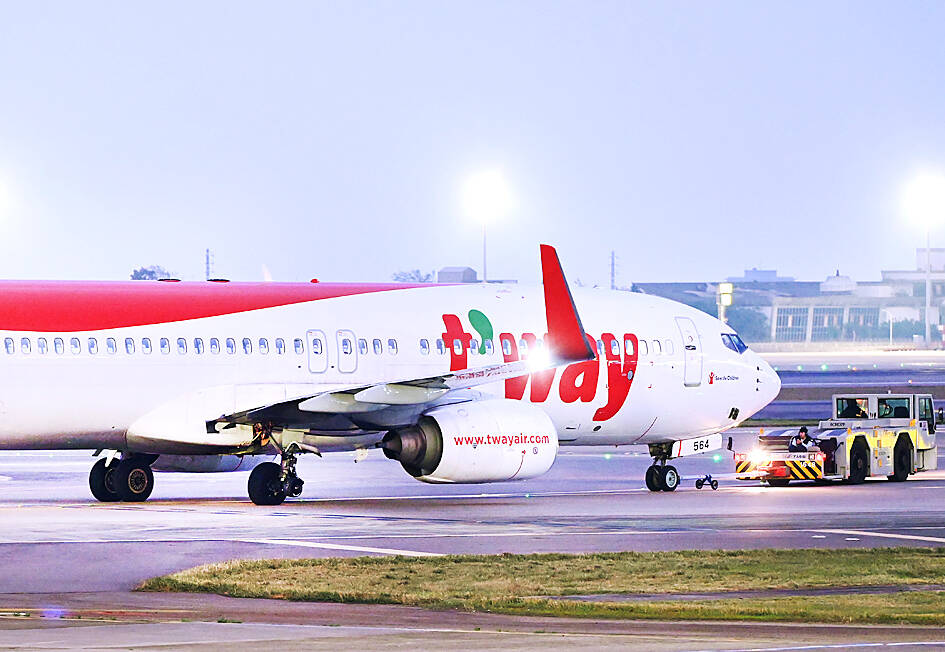
Photo: Chu Pei-hsiung, Taipei Times
Following the incident, the airport immediately suspended takeoffs and landings on the north runway and switched to single-runway operations to conduct safety inspections.
After foreign object debris (FOD), including aircraft components, was marked and removed, the north runway resumed normal operations at 5:35pm.
The incident occurred during a peak arrival period, affecting 14 flights, including eight arrivals and six departures.
Most delays were kept to within 20 minutes.
However, Japan Airlines flight JL8671, which landed shortly after the T’way Air jet, was delayed by about one hour while waiting on a taxiway for FOD clearance.
During the runway closure, air traffic controllers coordinated aircraft movements using the south runway.
The airport operator said it has notified the Civil Aviation Administration, the Ministry of Transportation and Communications and the Taiwan Transportation Safety Board in accordance with regulations governing aircraft incidents and major accidents.
Authorities said they would continue to cooperate with relevant agencies to determine the cause of the incident and would further strengthen runway inspections and FOD prevention measures.


Kenting National Park service technician Yang Jien-fon (楊政峰) won a silver award in World Grand Prix Photography Awards Spring Season for his photograph of two male rat snakes intertwined in combat. Yang’s colleagues at Kenting National Park said he is a master of nature photography who has been held back by his job in civil service. The awards accept entries in all four seasons across six categories: architectural and urban photography, black-and-white and fine art photography, commercial and fashion photography, documentary and people photography, nature and experimental photography, and mobile photography. Awards are ranked according to scores and divided into platinum, gold and
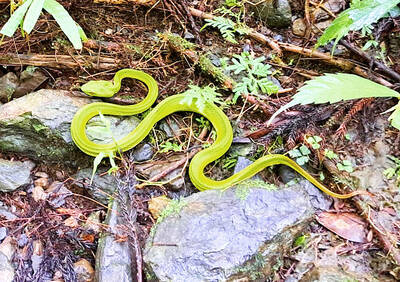
More than half of the bamboo vipers captured in Tainan in the past few years were found in the city’s Sinhua District (新化), while other districts had smaller catches or none at all. Every year, Tainan captures about 6,000 snakes which have made their way into people’s homes. Of the six major venomous snakes in Taiwan, the cobra, the many-banded krait, the brown-spotted pit viper and the bamboo viper are the most frequently captured. The high concentration of bamboo vipers captured in Sinhua District is puzzling. Tainan Agriculture Bureau Forestry and Nature Conservation Division head Chu Chien-ming (朱健明) earlier this week said that the
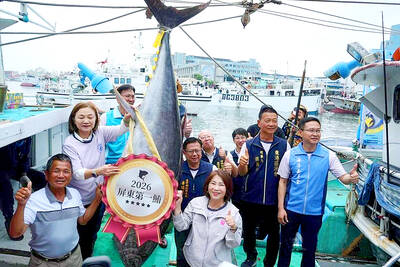
The first bluefin tuna of the season, brought to shore in Pingtung County and weighing 190kg, was yesterday auctioned for NT$10,600 (US$333.5) per kilogram, setting a record high for the local market. The auction was held at the fish market in Donggang Fishing Harbor, where the Siaoliouciou Island-registered fishing vessel Fu Yu Ching No. 2 delivered the “Pingtung First Tuna” it had caught for bidding. Bidding was intense, and the tuna was ultimately jointly purchased by a local restaurant and a local company for NT$10,600 per kilogram — NT$300 ,more than last year — for a total of NT$2.014 million. The 67-year-old skipper
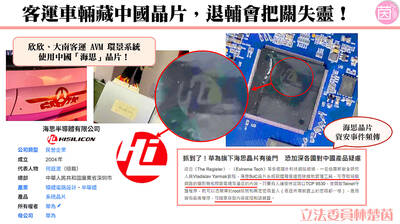
BREACH OF CONTRACT: The bus operators would seek compensation and have demanded that the manufacturer replace the chips with ones that meet regulations Two bus operators found to be using buses with China-made chips are to demand that the original manufacturers replace the systems and provide compensation for breach of contract, the Veterans Affairs Council said yesterday. Democratic Progressive Party Legislator Michelle Lin (林楚茵) yesterday said that Da Nan Bus Co and Shin-Shin Bus Co Ltd have fielded a total of 82 buses that are using Chinese chips. The bus models were made by Tron-E, while the systems provider was CYE Electronics, Lin said. Lin alleged that the buses were using chips manufactured by Huawei subsidiary HiSilicon Co, which presents a national security risk if the


 RSS
RSS