


Premier Cho Jung-tai (卓榮泰) yesterday said he would not countersign a bill to fund the relocation and redevelopment of a military dependents’ community in Taipei, saying it would benefit certain firms and people at public expense and against constitutional principles.
Amendments to the Act for Rebuilding Old Quarters for Military Dependents (國軍老舊眷村改建條例) were passed on Jan. 17 by the Chinese Nationalist Party (KMT) and the Taiwan People’s Party.
The amended act scrapped a provision that restricted eligibility for relocation or reconstruction to veterans’ villages built before the end of 1980, revising the cutoff to those established before the act was promulgated on Feb. 5, 1996.

Photo: Tu Chien-jung, Taipei Times
The legislation provides a legal basis for 50 households from Tsu Ren Eighth Village (慈仁八村) — a complex in Taipei’s Daan District (大安) commissioned in 1989 — to relocate to a dormitory managed by the Ministry of National Defense in Wenshan District’s (文山) Wanlung (萬隆).
Cho told reporters he would exercise the right granted to the premier under the Constitution not to countersign, “as the bill was intended for only a particular case.”
As such, it is an unfair use of state funds to redevelop several buildings to benefit only a small group of people, he said.
Laws must be generally applicable, Cho said, citing the principle of equality in Article 7 of the Constitution and the prohibition against case-specific legislation established in Judicial Yuan Interpretation No. 793.
It would also create a large financial burden on the special government fund designated for all military dependents’ villages across Taiwan, Cho said.
This is the second time Cho has refused to countersign a law passed by the legislature, following his refusal to sign opposition-backed amendments to the local revenue-sharing law in December last year.
The Economic Democratic Union said that in the bill’s expanded definition, the newly eligible villages are in the Taipei constituency of KMT Legislator Lo Chih-chiang (羅智強), whose constituents would be eligible to use state funds of about NT$200 billion (US$6.32 billion) to redevelop the complex into residential towers.
Under the new definition, the Cheng Kung Public Housing (成功國宅) and the Daan Public Housing (大安國宅) complexes would also be eligible for reconstruction, union convener Lai Chung-chiang (賴中強) said.
Lo blasted the Executive Yuan for unilaterally refusing to countersign legislation passed by the legislature, calling it an illegal breach of the Constitution and accusing the administration of being a “power-hungry monster.”
Lo justified his proposal by citing the high cost of maintaining the idle Wanlung complex and the deterioration of Tsu Ren Eighth Village — a situation exacerbated by the residents’ lack of property rights, which means they are legally barred from renovating their homes, according to his previous statements.
Lo also said that relocating the 50 households to the Wanlung complex would allow the government to revitalize the original site, thereby generating significant revenue for the national treasury.
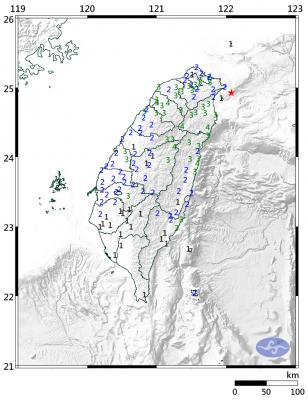
A magnitude 6.1 earthquake struck off the coast of Yilan County at 8:39pm tonight, the Central Weather Administration (CWA) said, with no immediate reports of damage or injuries. The epicenter was 38.7km east-northeast of Yilan County Hall at a focal depth of 98.3km, the CWA’s Seismological Center said. The quake’s maximum intensity, which gauges the actual physical effect of a seismic event, was a level 4 on Taiwan’s 7-tier intensity scale, the center said. That intensity level was recorded in Yilan County’s Nanao Township (南澳), Hsinchu County’s Guansi Township (關西), Nantou County’s Hehuanshan (合歡山) and Hualien County’s Yanliao (鹽寮). An intensity of 3 was
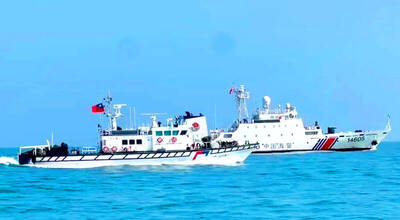
Instead of focusing solely on the threat of a full-scale military invasion, the US and its allies must prepare for a potential Chinese “quarantine” of Taiwan enforced through customs inspections, Stanford University Hoover fellow Eyck Freymann said in a Foreign Affairs article published on Wednesday. China could use various “gray zone” tactics in “reconfiguring the regional and ultimately the global economic order without a war,” said Freymann, who is also a nonresident research fellow at the US Naval War College. China might seize control of Taiwan’s links to the outside world by requiring all flights and ships entering or leaving Taiwan
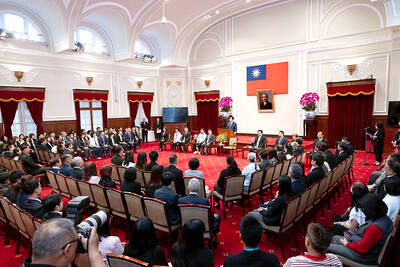
The next minimum wage hike is expected to exceed NT$30,000, President William Lai (賴清德) said yesterday during an award ceremony honoring “model workers,” including migrant workers, at the Presidential Office ahead of Workers’ Day today. Lai said he wished to thank the awardees on behalf of the nation and extend his most sincere respect for their hard work, on which Taiwan’s prosperity has been built. Lai specifically thanked 10 migrant workers selected for the award, saying that although they left their home countries to further their own goals, their efforts have benefited Taiwan as well. The nation’s industrial sector and small businesses lay
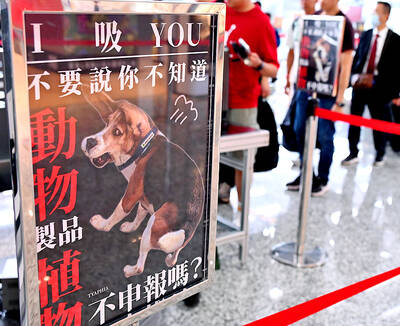
Quarantine awareness posters at Taiwan Taoyuan International Airport have gone viral for their use of wordplay. Issued by the airport branch of the Animal and Plant Health Inspection Agency, the posters feature sniffer dogs making a range of facial expressions, paired with advisory messages built around homophones. “We update the messages for holidays and campaign needs, periodically refreshing materials to attract people’s attention,” quarantine officials said. “The aim is to use the dogs’ appeal to draw focus to quarantine regulations.” A Japanese traveler visiting Taiwan has posted a photo on X of a poster showing a quarantine dog with a


 RSS
RSS