


Opponents of a plan to extend the high-speed rail (HSR) to Yilan County yesterday filed an administrative appeal against its environmental impact assessment (EIA) conclusion, while more than 200 supporters protested outside the Ministry of Environment.
The Alliance Overseeing the High Speed Rail Extension, the Yilan Environmental Protection Union and the Taiwan Railway Union (TRU) convened a news conference in front of the ministry building in Taipei along with Public Nudge and former minister of transportation and communications Hochen Tan (賀陳旦).
They questioned the rationality and legality of the EIA review while delivering a petition for an administrative appeal to the ministry.
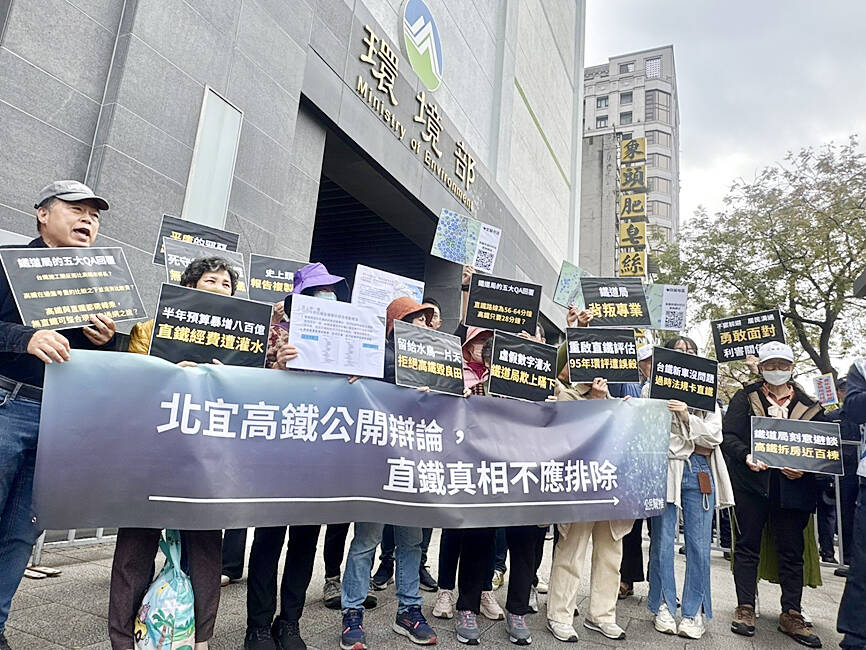
Photo: Huang Yi-ching, Taipei Times
Alliance convener Kang Fang-min (康芳銘) said the project is intertwined with the HSR Yilan Station District development plan, as potential economic benefits created by the development of the district justify the extension.
However, the EIA review failed to include the plan, even though an EIA committee member voiced concern about it, meaning that the conclusion was based on incomplete information, Kang said.
The project and the plan involve large-scale land expropriation in the county, including more than 400 hectares of farmland and demolition of more than 140 private residential buildings, but that issue was left out of the EIA report presented by the Railway Bureau, Kang said.
Construction could generate more than 9.6 million cubic meters of construction-surplus soil and stone, but the storage and disposal plan has caused doubts among at least four EIA committee members, he said.
TRU board director Chao Shang-che (趙尚?) urged the ministry to reconsider a proposal to build a straight railway connecting Taipei and Yilan, which was rejected by the EIA committee in 2006 due to its potential adverse environmental impact.
The proposal was dusted off in 2009, but was shelved due to backlash from the Taipei Feitsui Reservoir Administration, the county government and residents of Taipei’s Nangang District (南港) who were facing relocation.
Taiwan Railway Corp (TRC) employees’ labor rights and the company’s revenue could be affected by the HSR extension, which would marginalize railway development and undermine railway operations nationwide, Chao said.
On the other hand, more than 200 pro-extension local officials and residents held a rival news conference to voice discontent about the appeal, with Democratic Progressive Party Legislator Chen Chun-yu (陳俊宇) attending to express support.
“The land is worth NT$3 million [US$94,702] per ping here,” Jhuangwei Township (壯圍) Mayor Shen Ching-shan (沈清山) said while pointing at the ground in front of the ministry.
The value of farmland in the county ranges from NT$7,000 to NT$13,000 per ping, he said.
“Why can’t our land in Yilan be more valuable, while people in Taipei, Hsinchu County, Taoyuan or Miaoli County can have housing worth millions of dollars per ping?” Shen said.
The HSR extension would make more young people willing to stay and help attract more people to work in the county, he said.
TRC chairman James Jeng (鄭光遠) yesterday at a separate event said the TRC is optimistic about the HSR extension, although it is estimated to cause an annual NT$627 million decrease in TRC’s revenue.
The HSR was built for long-
distance transportation, while the TRC makes profits mostly through mid and short-distance services, he said, adding that the TRC expects its losses from the extension would be considered a policy-induced loss by the government.
TRC president Feng Hui-sheng (馮輝昇) said the HSR extension would compete with the TRC not only for passengers traveling between Taipei and Yilan, but for those traveling from Taichung, Chiayi County or Tainan to Yilan County.
That could mean an annual loss of NT$627 million for TRC, he said, adding that ridership is estimated to decline by 9,000 passengers per day on weekdays and 17,000 passengers per day on weekends by 2051.
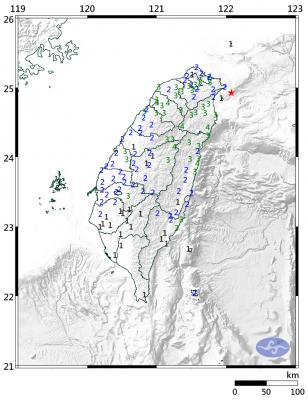
A magnitude 6.1 earthquake struck off the coast of Yilan County at 8:39pm tonight, the Central Weather Administration (CWA) said, with no immediate reports of damage or injuries. The epicenter was 38.7km east-northeast of Yilan County Hall at a focal depth of 98.3km, the CWA’s Seismological Center said. The quake’s maximum intensity, which gauges the actual physical effect of a seismic event, was a level 4 on Taiwan’s 7-tier intensity scale, the center said. That intensity level was recorded in Yilan County’s Nanao Township (南澳), Hsinchu County’s Guansi Township (關西), Nantou County’s Hehuanshan (合歡山) and Hualien County’s Yanliao (鹽寮). An intensity of 3 was

Instead of focusing solely on the threat of a full-scale military invasion, the US and its allies must prepare for a potential Chinese “quarantine” of Taiwan enforced through customs inspections, Stanford University Hoover fellow Eyck Freymann said in a Foreign Affairs article published on Wednesday. China could use various “gray zone” tactics in “reconfiguring the regional and ultimately the global economic order without a war,” said Freymann, who is also a nonresident research fellow at the US Naval War College. China might seize control of Taiwan’s links to the outside world by requiring all flights and ships entering or leaving Taiwan

The next minimum wage hike is expected to exceed NT$30,000, President William Lai (賴清德) said yesterday during an award ceremony honoring “model workers,” including migrant workers, at the Presidential Office ahead of Workers’ Day today. Lai said he wished to thank the awardees on behalf of the nation and extend his most sincere respect for their hard work, on which Taiwan’s prosperity has been built. Lai specifically thanked 10 migrant workers selected for the award, saying that although they left their home countries to further their own goals, their efforts have benefited Taiwan as well. The nation’s industrial sector and small businesses lay
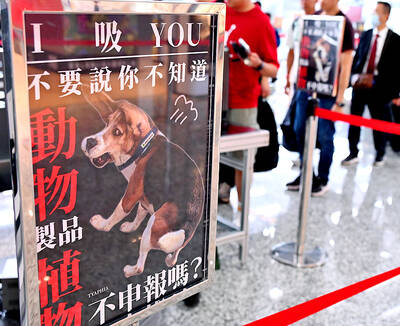
Quarantine awareness posters at Taiwan Taoyuan International Airport have gone viral for their use of wordplay. Issued by the airport branch of the Animal and Plant Health Inspection Agency, the posters feature sniffer dogs making a range of facial expressions, paired with advisory messages built around homophones. “We update the messages for holidays and campaign needs, periodically refreshing materials to attract people’s attention,” quarantine officials said. “The aim is to use the dogs’ appeal to draw focus to quarantine regulations.” A Japanese traveler visiting Taiwan has posted a photo on X of a poster showing a quarantine dog with a


 RSS
RSS