


A Formosan black bear was found trapped in a snare in Miaoli County, marking the first recorded appearance of the species in the area, the Forestry and Nature Conservation Agency's Hsinchu branch said today.
The bear was rescued on a downslope at the 19.5km mark of the Simaxian Forest Road in Taian Township (泰安), but its severely injured left forepaw had to be amputated, the branch said.
The agency dispatched rescue personnel after receiving a report and confirming the bear’s location on Wednesday afternoon, it said.
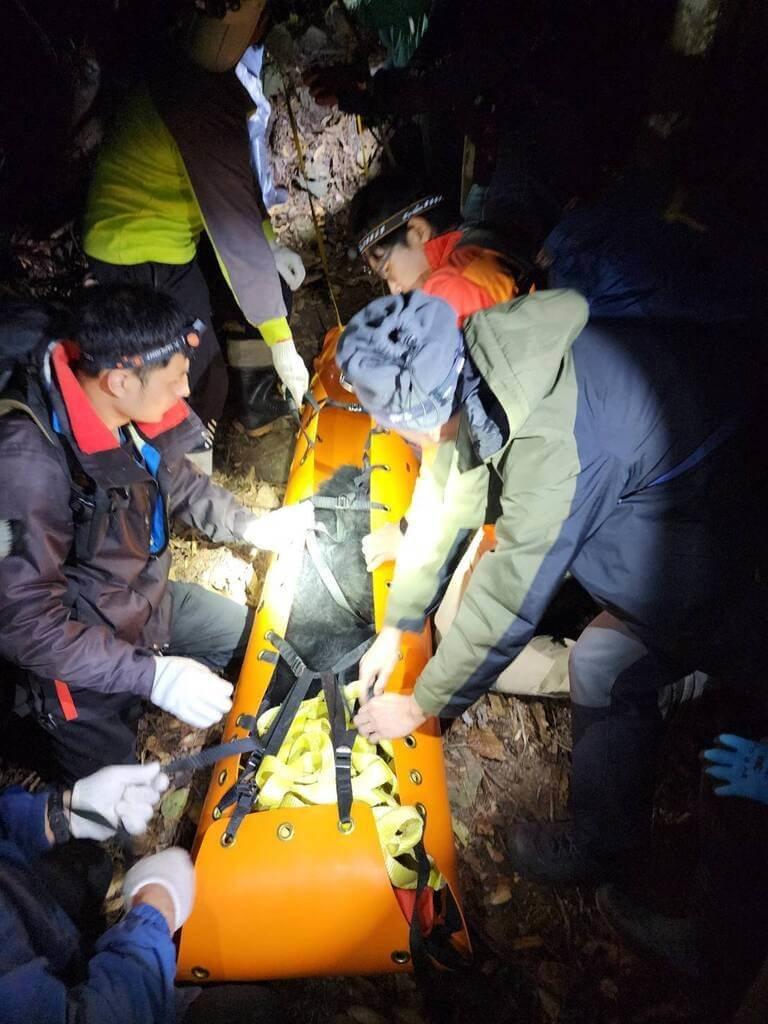
Photo courtesy of the Forestry and Nature Conservation Agency's Hsinchu branch
It was the first time that a Formosan black bear had been discovered in the Xuejian (雪見) area, while black bears have previously been spotted in areas such as Dasyueshan (大雪山) and Guanwu (觀霧), Shei-Pa National Park Headquarters Director Lin Wen-ho (林文和) said.
After the sighting was reported by a plumbing contractor, the agency’s Hsinchu branch said it launched a joint rescue operation with the park.
The team consisted of agency officials, national park staff, indigenous community members, veterinarians from the Taiwan Biodiversity Research Institute and consultants from the Formosan Wild Sound Conservation Science Center, it said.
The bear was anesthetized and given preliminary treatment before being transported to the Biodiversity Research Institute’s Wildlife First Aid Station in Nantou Count’s Jiji Township (集集), the branch said.
The bear, a sub-adult male weighing about 31kg with a severely injured left forepaw, yesterday underwent wound debridement and amputation, it said.
The bear was in a stable condition and would be evaluated for release back into the wild once it has recovered, it said.
The branch said it has conducted annual black bear rescue drills with local agencies and tribes since 2024 to ensure rapid response times.
The person who reported the incident would receive a reward in accordance with the agency’s ecological services payment program, it said.
The branch reminded the public that the black bear population is gradually expanding into low-elevation mountains closer to human settlements.
Residents and campsite operators are advised to manage food waste and trash carefully and to improve preventive measures for poultry and livestock facilities, it said.
Village inhabitants who need to prevent wildlife damage and indigenous residents who need to hunt can contact the agency’s work station to obtain improved hunting equipment free of charge to avoid accidentally catching non-target species, it added.

Considering that most countries issue more than five denominations of banknotes, the central bank has decided to redesign all five denominations, the bank said as it prepares for the first major overhaul of the banknotes in more than 24 years. Central bank Governor Yang Chin-lung (楊金龍) is expected to report to the Legislative Yuan today on the bank’s operations and the redesign’s progress. The bank in a report sent to the legislature ahead of today’s meeting said it had commissioned a survey on the public’s preferences. Survey results showed that NT$100 and NT$1,000 banknotes are the most commonly used, while NT$200 and NT$2,000

The Centers for Disease Control (CDC) yesterday reported the first case of a new COVID-19 subvariant — BA.3.2 — in a 10-year-old Singaporean girl who had a fever upon arrival in Taiwan and tested positive for the disease. The girl left Taiwan on March 20 and the case did not have a direct impact on the local community, it said. The WHO added the BA.3.2 strain to its list of Variants Under Monitoring in December last year, but this was the first imported case of the COVID-19 variant in Taiwan, CDC Deputy Director-General Lin Ming-cheng (林明誠) said. The girl arrived in Taiwan on

South Korea is planning to revise its controversial electronic arrival card, a step Taiwanese officials said prompted them to hold off on planned retaliatory measures, a South Korean media report said yesterday. A Yonhap News Agency report said that the South Korean Ministry of Foreign Affairs is planning to remove the “previous departure place” and “next destination” fields from its e-arrival card system. The plan, reached after interagency consultations, is under review and aims to simplify entry procedures and align the electronic form with the paper version, a South Korean ministry official said. The fields — which appeared only on the electronic form

The Ministry of Foreign Affairs (MOFA) is suspending retaliation measures against South Korea that were set to take effect tomorrow, after Seoul said it is updating its e-arrival system, MOFA said today. The measures were to be a new round of retaliation after Taiwan on March 1 changed South Korea's designation on government-issued alien resident certificates held by South Korean nationals to "South Korea” from the "Republic of Korea," the country’s official name. The move came after months of protests to Seoul over its listing of Taiwan as "China (Taiwan)" in dropdown menus on its new online immigration entry system. MOFA last week


 RSS
RSS