


More than 2,000 retired police officers and firefighters yesterday filed a class action lawsuit against the government after the Executive Yuan declined to earmark funds for a pension increase passed by the legislature.
The suit, to be reviewed by the Taipei High Administrative Court, names the Executive Yuan, the Ministry of the Interior and the Ministry of Civil Service as defendants.
The agencies failed to allocate funding for a pension increase for retired police officers and firefighters in accordance with amendments passed by opposition lawmakers in January last year and signed into law by President William Lai (賴清德), the suit says.
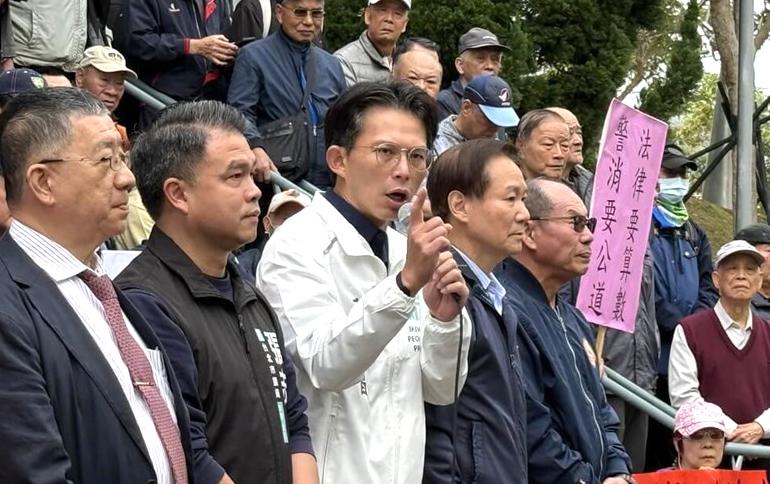
Photo: CNA
Citing constitutional concerns over legislative measures that increase government spending, the Executive Yuan has refused to implement the pension increase and petitioned the Constitutional Court for a provisional injunction and constitutional interpretation. Both petitions remain pending.
The lawsuit demonstrates retirees' determination to oppose “unfair reforms” and their trust in justice and the rule of law, former National Fire Agency deputy director-general Hsieh Ching-hsu (謝景旭) told a news conference outside the court.
Ensuring that retired police officers and firefighters receive the benefits they deserve and enjoy a reasonable, stable and dignified retirement is a responsibility the Lai administration cannot shirk, Hsieh said.
Former police officer Keng Chi-wen (耿繼文), head of a coalition of retired police associations, cited the Executive Yuan's plan to draft a proposal to raise pensions for retired farmers, saying that the government was applying a "double standard" and urging it to allocate funds for the police and firefighter pension increase as required by law.
Taiwan People's Party Chairman Huang Kuo-chang (黃國昌), who attended the event, criticized Lai for failing to implement the pension increase and said that the president was flouting the law.
The government has taken "good care" of civil servants, including retired police officers and firefighters, said Executive Yuan spokeswoman Michelle Lee (李慧芝), citing across-the-board pay raises totaling 14.7 percent from 2018 to last year.
However, the legislature exceeded its authority by formulating the pension increase, she said.
"We respect the right of members of the public to seek judicial remedies, but we must also stress that the legislature's role is to review the budget, not to draft it," Lee said.
If the Constitutional Court determines that the pension increase does not contravene the Constitution, the Executive Yuan would promptly make the necessary adjustments and issue retroactive payments to protect the rights and interests of affected personnel, she said.

Considering that most countries issue more than five denominations of banknotes, the central bank has decided to redesign all five denominations, the bank said as it prepares for the first major overhaul of the banknotes in more than 24 years. Central bank Governor Yang Chin-lung (楊金龍) is expected to report to the Legislative Yuan today on the bank’s operations and the redesign’s progress. The bank in a report sent to the legislature ahead of today’s meeting said it had commissioned a survey on the public’s preferences. Survey results showed that NT$100 and NT$1,000 banknotes are the most commonly used, while NT$200 and NT$2,000

The Centers for Disease Control (CDC) yesterday reported the first case of a new COVID-19 subvariant — BA.3.2 — in a 10-year-old Singaporean girl who had a fever upon arrival in Taiwan and tested positive for the disease. The girl left Taiwan on March 20 and the case did not have a direct impact on the local community, it said. The WHO added the BA.3.2 strain to its list of Variants Under Monitoring in December last year, but this was the first imported case of the COVID-19 variant in Taiwan, CDC Deputy Director-General Lin Ming-cheng (林明誠) said. The girl arrived in Taiwan on

South Korea is planning to revise its controversial electronic arrival card, a step Taiwanese officials said prompted them to hold off on planned retaliatory measures, a South Korean media report said yesterday. A Yonhap News Agency report said that the South Korean Ministry of Foreign Affairs is planning to remove the “previous departure place” and “next destination” fields from its e-arrival card system. The plan, reached after interagency consultations, is under review and aims to simplify entry procedures and align the electronic form with the paper version, a South Korean ministry official said. The fields — which appeared only on the electronic form

The Ministry of Foreign Affairs (MOFA) is suspending retaliation measures against South Korea that were set to take effect tomorrow, after Seoul said it is updating its e-arrival system, MOFA said today. The measures were to be a new round of retaliation after Taiwan on March 1 changed South Korea's designation on government-issued alien resident certificates held by South Korean nationals to "South Korea” from the "Republic of Korea," the country’s official name. The move came after months of protests to Seoul over its listing of Taiwan as "China (Taiwan)" in dropdown menus on its new online immigration entry system. MOFA last week


 RSS
RSS