


A new study showed that climate change could be more dangerous to species inhabiting hills and highlands than creatures on mountains, in a potential reversal of scientific wisdom.
The Science Media Center Taiwan made the comments in a statement about the publication of the study in the Journal of Thermal Biology earlier this month.
Moltrecht’s tree frogs, or Zhangixalus moltrechti, are a bellwether species for the impact of global warming, as their habitats range from mountains to lowlands, it said.
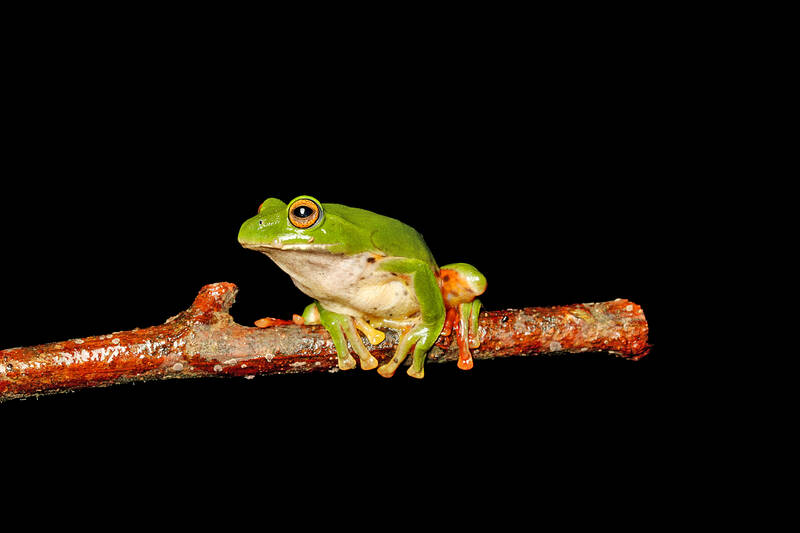
Photo courtesy of study lead author You Jh-yu
Lead author Chuang Ming-feng (莊銘豐), associate professor of life sciences at National Chung Hsing University, said that the team studied tree frog tadpoles in nine habitats of altitudes ranging between 474m and 2,020m.
The team found that tadpoles can adapt to cold depending on their birth habit, but can only tolerate warmth from 38°C to 40°C, imposing an upper limit on their climate resistance, he said.
This suggests the tree frogs have little to no buffer against global warming and face significant extinction risk if authorities fail to secure contiguous safe zones for the species, Chuang said.
Moltrecht’s tree frogs would likely require “heat sanctuaries” and “vertical corridors” to survive climate change, yet both have been compromised by urbanization that fragments habitats, he said.
The study is focused on immediate threats to the tree frog’s short-term survival and makes no assumptions about the species’ ability to evolve adaptations to changing conditions, Chuang said.
The team has not analyzed the species’ genetic makeup or capacity for adaptation over time and cannot explain whether the difference in tadpole resistance to cold is inherent or learned, he said.
Chen I-hsiu (陳怡秀), associate professor of climate change and sustainability at the National Taiwan University, said that species inhabiting highlands can adapt to warming by migrating to even higher altitudes.
However, creatures living in the plains or lowlands would not be able to use that strategy, as cities and towns often bar their way to safety, she said.
The government would need to ensure migration corridors for wildlife are preserved in urban development or risk causing harm to the ecosystem, she said.
Wu Chih-shiun (巫奇勳), associate professor of life science at Chinese Culture University, said the study might have discovered a blind spot in the mechanisms utilized to assess environmental risks.
Current practices assume that each species has a uniform resistance to temperature conditions within the population, but the research indicates that significant differences might exist, he said.
This means large swathes of a species could die off with climate change, with little chance of adapting to shifting conditions, he said.

FUKUOKA SITUATION: Japanese media reported that the pathogen is expected to be identified by the summer, while the CDC downplayed the idea that it was hMPV A “mysterious cold-like illness” reported in Japan’s Fukuoka Prefecture does not seem to be a new disease, but Japanese authorities have been asked about the situation, the Centers for Disease Control (CDC) said yesterday. The Fukuoka Prefectural Medical Association on Wednesday told a news conference that a “mystery cold” that has become a hot topic on social media is “highly likely to be caused by some kind of viral infection,” Japan’s KBC News reported. “Many people are experiencing symptoms starting with a sore throat, followed by a runny nose, phlegm and a severe cough,” KBC News reported, citing association officials. Health authorities are

Nvidia Corp CEO Jensen Huang (黃仁勳) arrived in Taiwan yesterday ahead of upcoming AI and technology events, saying he plans to meet with clients and Taiwan Semiconductor Manufacturing Co Chairman C.C. Wei (魏哲家) during his visit. After landing at Taipei Songshan Airport, Huang posed for photos with fans and handed out Yakult drinks to reporters and supporters waiting at the scene, saying he has “a lot to do” during the trip. Asked about reports that Nvidia’s planned headquarters site in Taipei’s Beitou Shilin Technology Park could break ground on May 27, Huang said that if the company holds an event, he would

Carrefour Taiwan is to begin using a new name from the start of July, but it cannot divulge the name until then, the chairman of the supermarket chain's parent company said today. President Chain Store Co chairman Lo Chih-hsien (羅智先) was asked by reporters after a shareholders' meeting to confirm whether the company has settled on a new name for the supermarket brand. In March, the government-registered name of two Carrefour Taiwan branches was quietly changed to "Le Chia Kang" (樂家康) in Chinese, raising speculation that has been selected as the name. Lo said that because of local regulations and contractual obligations, the

The Philippines would likely be involved in any conflict over Taiwan due to its proximity to the democracy claimed by China, President Ferdinand Marcos Jr said, reiterating a stance that risks angering Beijing. “In the Philippines, we do not have a choice because Taiwan is so close to the Philippines and we have almost 200,000 Filipino nationals living and working in Taiwan,” Marcos said in an interview with Japanese media in Manila on Monday. The Philippine leader’s comments come ahead of a state visit to Japan next week, where he is to meet with Japanese Prime Minister Sanae Takaichi to discuss security


 RSS
RSS