


US policy regarding Taiwan has not changed, a US official said following yesterday’s phone call between US President Donald Trump and Chinese President Xi Jinping (習近平), in which they mentioned Taiwan.
"The US One China policy, as our cross-Strait policies are collectively known, is based on the Taiwan Relations Act, the Three US-PRC [People’s Republic of China] Joint Communiques, and the six assurances to Taiwan," an unnamed official said, in response to a request for comment on the issue.
"There is no change to our policy with respect to Taiwan," they said.
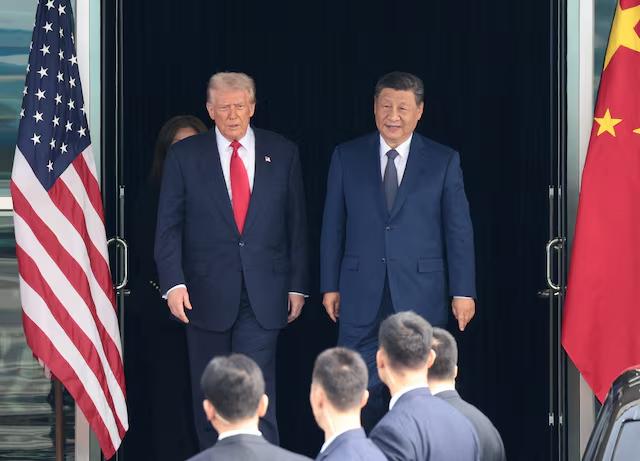
Photo: Reuters
The US administration would continue to cooperate with both sides of the Taiwan Strait, as it did during Trump’s first presidential term, the official said.
Yesterday’s call was the two leaders’ first since November and was held just hours after Xi’s virtual meeting with Russian President Vladimir Putin.
Trump did not say what was discussed in relation to Taiwan, though he write on Truth Social that the call was "all very positive," that his relationship with Xi is "extremely good" and that "we both realize how important it is to keep it that way."
Meanwhile, an official Chinese government account said that Xi had said: “I attach great importance to Sino-US relations.”
The US must handle the issue of arms sales to Taiwan with prudence, Xi was quoted as saying by Chinese state news agency Xinhua.
He called the “Taiwan question” the most important issue in China-US relations, Xinhua said.
“Taiwan will never be allowed to separate from China,” a Chinese government statement said.
Trump said that he recognizes China’s marked interest in Taiwan, although wishes to maintain stable relations between the two nations, the statement said.
Xi's focus on arms sales followed Washington's approval in December last year of a record US$11.1 billion arms package to Taiwan that includes medium-range missiles, howitzers and drones.
Just 11 days after the deal was announced, China launched its “Justice Mission 2025” military drills on Dec. 30, as the state-run China Daily published a video in English saying: “More arms sales, more danger.”
One month earlier, Trump and Xi also had a phone conversation, but Trump did not say afterward whether Taiwan had been discussed.
However, Xi said he had reiterated Beijing's position on the “Taiwan question,” underscoring that Taiwan's return to China was "an integral part of the post-war international order," a Xinhua report said at the time.
The Taiwan Relations Act was promulgated in 1979 after the US ended formal diplomatic ties with Taiwan and was drafted to help maintain peace, security and stability in the Western Pacific.
It authorized the continuation of informal relations between the two nations, from security and arms deals to trade and cultural exchanges.
Meanwhile, the “six assurances,” agreed to by former US President Ronald Reagan in 1982, consolidate the US’ position on cross-strait relations and arms sales to Taiwan.
They state that the US would not set a date for ending arms sales to the Republic of China (ROC, Taiwan); not hold prior consultations with the People’s Republic of China regarding arms sales to the ROC; not play a mediation role between the PRC and the ROC; not revise its Taiwan Relations Act; not alter its position regarding sovereignty over Taiwan; and not pressure Taiwan to enter into negotiations with the PRC.
The Three Joint Communiques, signed in 1972, 1979 and 1982, broadly affirm US acknowledgement of Beijing’s “one China” principle and recognize the PRC as the only legitimate government of China.
Additional reporting by Reuters and AP

FUKUOKA SITUATION: Japanese media reported that the pathogen is expected to be identified by the summer, while the CDC downplayed the idea that it was hMPV A “mysterious cold-like illness” reported in Japan’s Fukuoka Prefecture does not seem to be a new disease, but Japanese authorities have been asked about the situation, the Centers for Disease Control (CDC) said yesterday. The Fukuoka Prefectural Medical Association on Wednesday told a news conference that a “mystery cold” that has become a hot topic on social media is “highly likely to be caused by some kind of viral infection,” Japan’s KBC News reported. “Many people are experiencing symptoms starting with a sore throat, followed by a runny nose, phlegm and a severe cough,” KBC News reported, citing association officials. Health authorities are

Nvidia Corp CEO Jensen Huang (黃仁勳) arrived in Taiwan yesterday ahead of upcoming AI and technology events, saying he plans to meet with clients and Taiwan Semiconductor Manufacturing Co Chairman C.C. Wei (魏哲家) during his visit. After landing at Taipei Songshan Airport, Huang posed for photos with fans and handed out Yakult drinks to reporters and supporters waiting at the scene, saying he has “a lot to do” during the trip. Asked about reports that Nvidia’s planned headquarters site in Taipei’s Beitou Shilin Technology Park could break ground on May 27, Huang said that if the company holds an event, he would

Carrefour Taiwan is to begin using a new name from the start of July, but it cannot divulge the name until then, the chairman of the supermarket chain's parent company said today. President Chain Store Co chairman Lo Chih-hsien (羅智先) was asked by reporters after a shareholders' meeting to confirm whether the company has settled on a new name for the supermarket brand. In March, the government-registered name of two Carrefour Taiwan branches was quietly changed to "Le Chia Kang" (樂家康) in Chinese, raising speculation that has been selected as the name. Lo said that because of local regulations and contractual obligations, the
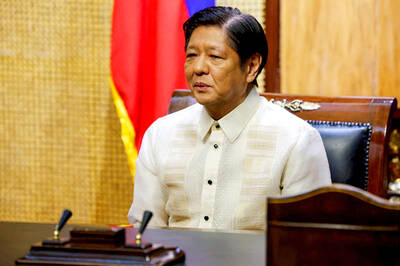
The Philippines would likely be involved in any conflict over Taiwan due to its proximity to the democracy claimed by China, President Ferdinand Marcos Jr said, reiterating a stance that risks angering Beijing. “In the Philippines, we do not have a choice because Taiwan is so close to the Philippines and we have almost 200,000 Filipino nationals living and working in Taiwan,” Marcos said in an interview with Japanese media in Manila on Monday. The Philippine leader’s comments come ahead of a state visit to Japan next week, where he is to meet with Japanese Prime Minister Sanae Takaichi to discuss security


 RSS
RSS