


Cabin motorcycles would soon be allowed in Taiwan after an amendment to the Road Traffic Safety Rules (道路交通安全規則) is completed, the Ministry of Transportation and Communications said yesterday.
The proposed amendment is open to public comment for 60 days and could be implemented in the second half of this year.
The announcement came as RideRoid Lean 3, a compact urban electric three-wheeler developed by Lean Mobile — a Taipei-based start-up founded by former Toyota Motor chief engineer Akihiro Yanak — completes trials on real roads.
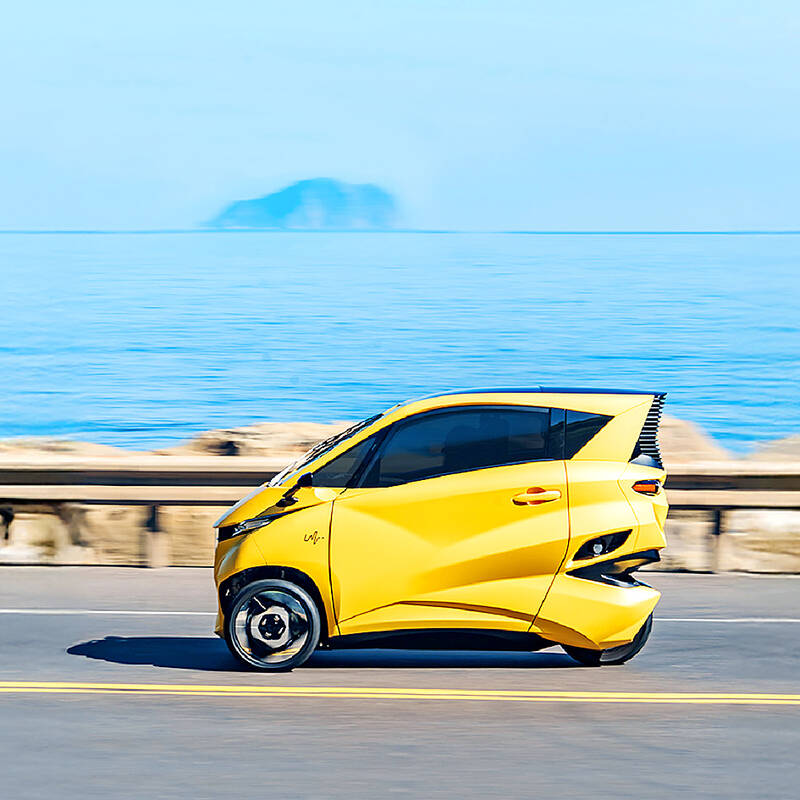
Photo: Screen grab from leanmobilitytw’s Facebook page
The vehicle features a two-seater, full-view, enclosed cabin with air-conditioning. It is 2.47m long and 0.97m wide, with a top speed of 80kph and an operating range of up to 100km.
“Given that these three-wheeled motorcycles have already been officially licensed and are operating on roads in Taiwan, and that their body features a safer enclosed design, we decided to allow these vehicles by proposing an amendment to the Road Traffic Safety Rules following consultations with multiple stakeholders,” the ministry said, adding that it hopes to further solicit input from the public on this matter.
With a relatively small body, the vehicle offers another high-mobility option for the public, it added.
The amendment stipulates that such vehicles would be called cabin motorcycles, which refer to three-wheeled motorcycles equipped with an enclosed passenger compartment and a steering wheel, and would be granted license plates designated for motorcycles.
However, considering that the cabin motorcycles have a user interface similar to that of a car — with a steering wheel, gas and brake pedals, and manual gearbox — the ministry said that cabin motorcycle riders should have a car license, including driver’s licenses for small passenger cars, heavy trucks, buses or tractor-trailers.
Those who have only licenses for motorcycles are prohibited from operating electric three-wheelers, according to the proposed amendment.
Japan implements a similar regulation, the ministry said.
Meanwhile, the amendment would ban cabin motorcycle riders from driving on freeways and expressways, and riders and passengers must have their seatbelts fastened, but do not need to wear helmets.
Riders are entitled to park their vehicles in spaces designated for car drivers, the amendment says.
To ensure that the steering wheel, windows, seatbelts and windshield wipers function normally, cabin motorcycle riders are required to have their vehicles inspected.
Vehicles between five and 10 years old must be inspected at least once a year, while those more than 10 years old must undergo at least two inspections per year.
They must also comply with new window tint standards for motor vehicles, with the tint films applied on the front windshields having a visibility light transmission (VLT) of at least 70 percent and at least 40 percent for side windows.
Cabin motorcycle riders would face a fine of NT$6,000 to NT$12,000 if they have only a motorcycle license, as per the Road Traffic Management and Penalty Act (道路交通管理處罰條例).
Driving a cabin motorcycle without a license would incur a fine of NT$6,000 to NT$36,000.

FUKUOKA SITUATION: Japanese media reported that the pathogen is expected to be identified by the summer, while the CDC downplayed the idea that it was hMPV A “mysterious cold-like illness” reported in Japan’s Fukuoka Prefecture does not seem to be a new disease, but Japanese authorities have been asked about the situation, the Centers for Disease Control (CDC) said yesterday. The Fukuoka Prefectural Medical Association on Wednesday told a news conference that a “mystery cold” that has become a hot topic on social media is “highly likely to be caused by some kind of viral infection,” Japan’s KBC News reported. “Many people are experiencing symptoms starting with a sore throat, followed by a runny nose, phlegm and a severe cough,” KBC News reported, citing association officials. Health authorities are

Nvidia Corp CEO Jensen Huang (黃仁勳) arrived in Taiwan yesterday ahead of upcoming AI and technology events, saying he plans to meet with clients and Taiwan Semiconductor Manufacturing Co Chairman C.C. Wei (魏哲家) during his visit. After landing at Taipei Songshan Airport, Huang posed for photos with fans and handed out Yakult drinks to reporters and supporters waiting at the scene, saying he has “a lot to do” during the trip. Asked about reports that Nvidia’s planned headquarters site in Taipei’s Beitou Shilin Technology Park could break ground on May 27, Huang said that if the company holds an event, he would

The Ministry of Finance this afternoon announced the winning numbers for the March-April uniform invoice lottery. The winning number for the NT$10 million (US$318,060) special prize is 19531471, and the winning number for the NT$2 million grand prize is 85941329. Three numbers were drawn for the NT$200,000 first prize: 07225810, 20231230 and 83518781. Those with receipts matching the last seven digits of any of the first-prize numbers will win the NT$40,000 second prize, while those matching the last six digits will win the NT$10,000 third prize. Those whose receipts match the last five digits of the first-prize numbers can claim the NT$4,000 fourth prize,

SIX SUBSIDIES: The monthly allowance for older farmers is to increase to NT$10,000, and NT$5,000 is to be given to homemakers under the national pension system, Lai said The government is to implement major welfare policies for disadvantaged groups, including raising the monthly allowance for older farmers to NT$10,000 and providing homemakers with NT$5,000 per month, President William Lai (賴清德) said yesterday. Lai made the remarks during a visit to Wangling Temple in Chiayi County, saying that the planned increases were being introduced amid economic growth and an increase in tax revenue. Touting a policy, in which the government plans to provide a monthly allowance of NT$5,000 for every child under the age of 18 in a bid to address Taiwan’s low birthrate, Lai said that if received for the


 RSS
RSS