


Mainland Affairs Council (MAC) Minister Chiu Chui-cheng (邱垂正) yesterday said the government will not accept the “15 shared recommendations” by the Chinese Nationalist Party’s (KMT) and the Chinese Communist Party’s (CCP) think tanks.
The text is full of condemnation of the government for “obstructing” cross-strait exchanges and hindering Chinese tourists, which completely reversed the cause and effect, he said.
The KMT and CCP think tanks on Tuesday met in Beijing, after which both think tanks arrived at 15 points of consensus across five topics: the normalization of cross-strait travel, stepping up collaboration for emerging industries across the strait, exploring collaboration on cross-strait medicine, deepening cross-strait environmental protection collaborations and strengthening cross-strait disaster prevention collaborations.
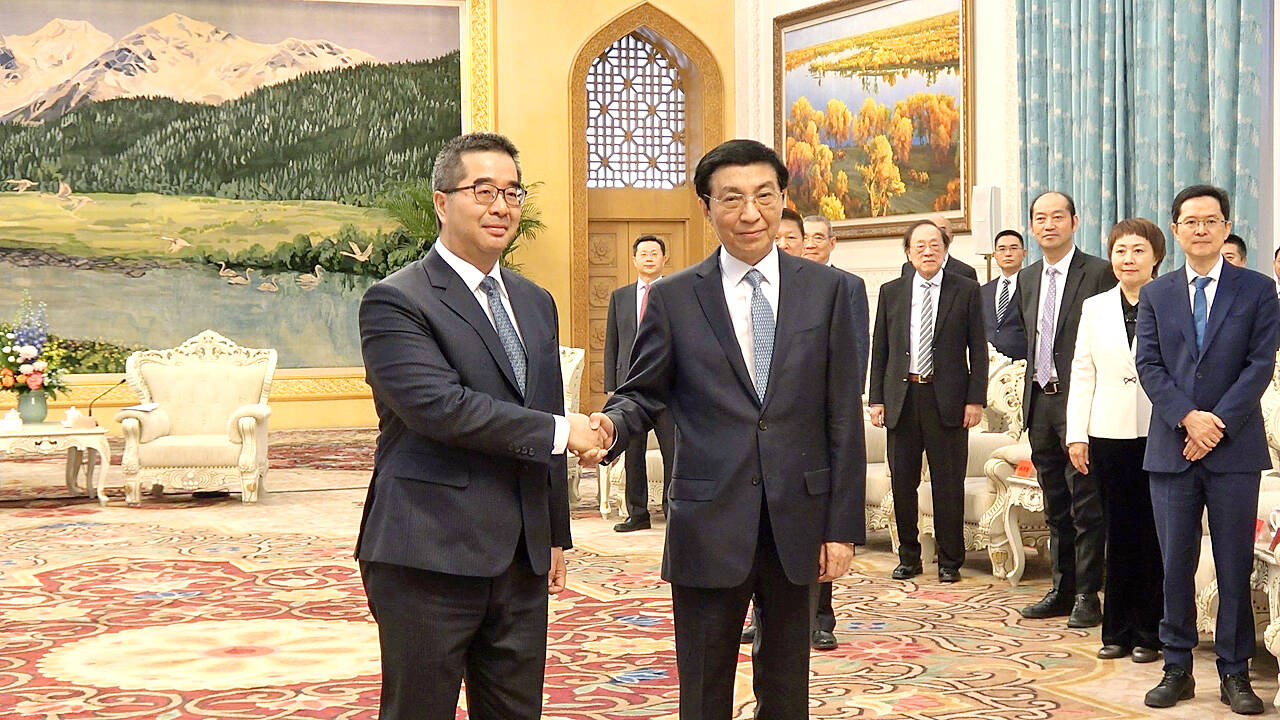
Photo: CNA
Chiu in an online interview said that the MAC’s primary concern regarding the KMT’s trip is that the current cross-strait landscape differs significantly from that of a decade ago.
Since 2019, Chinese President Xi Jinping’s (習近平) “five points” have redefined the so-called “1992 consensus,” and the CCP views the consensus as “both sides belonging to one China, working together toward national unification under one country, two systems,” he said.
The so-called “1992 consensus,” a term former Mainland Affairs Council chairman Su Chi (蘇起) in 2006 admitted making up in 2000, refers to a tacit understanding between the KMT and the CCP that both sides of the Strait acknowledge there is “one China,” with each side having its own interpretation of what “China” means.
Since Xi’s five points were presented, the “one-China principle,” the “1992 consensus,” and “one country, two systems” have become the “trinity” of Beijing’s policy toward Taiwan, leaving absolutely no room for the existence of the Republic of China (ROC), Chiu said.
“Cross-strait relations has turned the page on [former president] Ma Ying-jeou’s (馬英九) era following Xi’s five points,” he said, adding that there is no longer any room for “respective interpretations,” and that China’s “one country, two systems” formula for Taiwan is a scheme designed to eliminate the ROC and annex Taiwan.
The “15 shared recommendations” are filled with condemnations of the current administration for obstructing cross-strait exchanges and blocking mainland tourists, he said.
It is a complete reversal of cause and effect, and the government will not accept it, he said, questioning how normal exchange could occur if China continues its military provocations and ongoing transnational repression, showing that there is simply no goodwill.
“Why does the KMT consistently overlook these risks and China’s hostility, only to claim that the CCP is full of ‘goodwill and sincerity?’ This clearly demonstrates that the CCP’s united front work has been highly effective,” Chiu said.
The KMT yesterday said that the MAC is shirking its duties of liaising between Taiwan and China, standing as the true blocking stone of cross-strait interaction and a “troublemaker” sabotaging cross-strait peace.
The Democratic Progressive Party (DPP) is oblivious to Taiwan’s economy, in which only 12 percent of the public in the high-tech industries and people purchasing high-tech industry stocks are well-off, while other sectors are doing poorly, the KMT said.
Taiwan’s tourism deficit climbed to NT$700 billion (US$22.17 billion) last year, and if the government allowed Chinese tourists to visit Taiwan, the deficit could shrink by NT$100 billion to NT$200 billion, benefiting the travel sector, the hotel industry, restaurants and souvenir shops, it said.
Cross-strait tensions are running high, because the DPP has been enacting policies and issuing rhetoric in support of its “Taiwanese independence” ideology, prompting China to resort to military threats, it added.
Cross-strait communication would be better than war, the KMT said, adding that the DPP’s governance and increases to the national defense budget are taking the nation to the brink of war.

FUKUOKA SITUATION: Japanese media reported that the pathogen is expected to be identified by the summer, while the CDC downplayed the idea that it was hMPV A “mysterious cold-like illness” reported in Japan’s Fukuoka Prefecture does not seem to be a new disease, but Japanese authorities have been asked about the situation, the Centers for Disease Control (CDC) said yesterday. The Fukuoka Prefectural Medical Association on Wednesday told a news conference that a “mystery cold” that has become a hot topic on social media is “highly likely to be caused by some kind of viral infection,” Japan’s KBC News reported. “Many people are experiencing symptoms starting with a sore throat, followed by a runny nose, phlegm and a severe cough,” KBC News reported, citing association officials. Health authorities are

Nvidia Corp CEO Jensen Huang (黃仁勳) arrived in Taiwan yesterday ahead of upcoming AI and technology events, saying he plans to meet with clients and Taiwan Semiconductor Manufacturing Co Chairman C.C. Wei (魏哲家) during his visit. After landing at Taipei Songshan Airport, Huang posed for photos with fans and handed out Yakult drinks to reporters and supporters waiting at the scene, saying he has “a lot to do” during the trip. Asked about reports that Nvidia’s planned headquarters site in Taipei’s Beitou Shilin Technology Park could break ground on May 27, Huang said that if the company holds an event, he would

The Ministry of Finance this afternoon announced the winning numbers for the March-April uniform invoice lottery. The winning number for the NT$10 million (US$318,060) special prize is 19531471, and the winning number for the NT$2 million grand prize is 85941329. Three numbers were drawn for the NT$200,000 first prize: 07225810, 20231230 and 83518781. Those with receipts matching the last seven digits of any of the first-prize numbers will win the NT$40,000 second prize, while those matching the last six digits will win the NT$10,000 third prize. Those whose receipts match the last five digits of the first-prize numbers can claim the NT$4,000 fourth prize,
Taiwan Travelogue (臺灣漫遊錄), which earlier this week became the first Taiwanese novel to win the International Booker Prize, is to be adapted into a television series through a Taiwan-Japan coproduction, producer Chang Chen-yu (張辰漁) said yesterday. Chang, a producer at World Softest Production Film Co, wrote on Facebook that the company had been searching for projects with international appeal that retain a strong Taiwanese identity after colleagues and Japanese partners strongly recommended the novel. After reading the book, Chang said he immediately decided to pursue the screen rights. “A great story has the power to transcend time and borders, and connect countless people,”


 RSS
RSS