


The American Institute in Taiwan (AIT) yesterday said it respects Taiwan’s political procedures and looks forward to seeing the Legislative Yuan hold sincere deliberation on how to support the nation in bolstering its self-defense capabilities.
An AIT spokesperson made the remark in response to media inquiries about Taiwan People’s Party (TPP) Chairman Huang Kuo-chang’s (黃國昌) comments in an interview with the United Daily News on Tuesday.
Huang criticized AIT Director Raymond Greene of being “too involved in Taiwan’s internal affairs,” saying that if the US and Taiwan are truly partners sharing the same values, then Washington should respect Taiwan’s democratic procedures, just as Taiwan respects those of the US.

Photo: Tien Yu-hua, Taipei Times
The opposition has repeatedly blocked the Executive Yuan’s eight-year special defense budget.
The US Department of State has said multiple times that it welcomes the NT$1.25 trillion (US$39.59 billion) special defense budget, the AIT said yesterday.
Separately, Democratic US Senator Ruben Gallego yesterday wrote on social media: “Now is not the time to weaken Taiwan’s defenses. Cutting their defense budget undermines investments in essential weapons systems as China’s threats are intensifying. Taiwan’s parliament [legislature] should reconsider this move.”
Gallego’s remark came after US Senator Roger Wicker, a Republican who chairs the US Senate Armed Forces Committee, on Tuesday said: “I am disappointed to see Taiwan’s opposition parties in parliament slash President [William] Lai’s (賴清德) defense budget so dramatically.”
“The original proposal funded urgently needed weapons systems. Taiwan’s parliament should reconsider — especially with rising Chinese threats,” he added.
Taiwan National Security Institute deputy secretary-general Ho Cheng-hui (何澄輝) said the comments from Republican and Democratic US lawmakers show that, while the two parties have their differences, they agree on the US stance on China and on security across the Taiwan Strait.
The comments were a “severe warning” from the US to the Taiwanese opposition that Washington and its allies would not tolerate the opposition placing party interests above the nation’s security, Ho said.
US President Donald Trump has been adamant that US allies “share the responsibility” for their own defense, and if Taiwan cannot demonstrate its resolve to bolster self-defense by passing the budget, Washington might see it unnecessary to continue supporting the nation, he said.
The opposition’s claims that the defense budget is opaque have no basis, he said.
Washington is extremely familiar with Taiwanese politics, and the opposition should not take it for a fool, he added.

Fast food chain McDonald's is to raise prices by up to NT$5 on some products at its restaurants across Taiwan, starting on Wednesday next week, the company announced today. The prices of all extra value meals and sharing boxes are to increase by NT$5, while breakfast combos and creamy corn soup would go up by NT$3, the company said in a statement. The price of the main items of those meals, if ordered individually, would remain the same. Meanwhile, the price of a medium-sized lemon iced tea and hot cappuccino would rise by NT$3, extra dipping sauces for chicken nuggets would go up
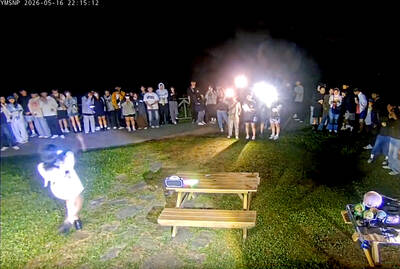
Yangmingshan National Park’s Qingtiangang (擎天崗) nature area has gone viral after a park livestream camera observed a couple in the throes of intimate congress, which was broadcast live on YouTube, drawing large late-night crowds and sparking a backlash over noise, bright lights and disruption to wildlife habitat. The area’s livestream footage appeared to show a couple engaging in sexual activity on a picnic table in the park on Friday last week, with the uncensored footage streamed publicly online. The footage quickly spread across social media, prompting a tide of visitors to travel to the site to “check in” and recreate the
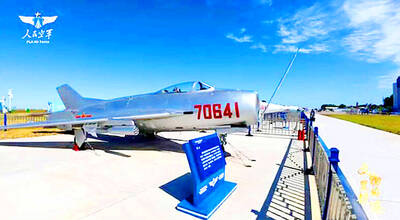
GROUNDED: A KMT lawmaker proposed eliminating drone development programs and freezing funding for counterdrone systems, despite China’s adoption of the technology China has deployed attack drones at air bases near the Taiwan Strait in a strategy aimed at overwhelming Taiwan’s air defense systems through saturation attacks, the Mainland Affairs Council (MAC) said. The council’s latest quarterly report on China said that satellite imagery and open-source intelligence indicate that the Chinese People’s Liberation Army (PLA) had converted retired J-6 fighter jets into J-6W drones, which the PLA has stationed at six air bases near Taiwan, five in China’s Fujian Province and one in Guangdong Province. The report cited J. Michael Dahm, a senior fellow at the US-based Mitchell Institute, as saying that China has

Carrefour Taiwan is to begin using a new name from the start of July, but it cannot divulge the name until then, the chairman of the supermarket chain's parent company said today. President Chain Store Co chairman Lo Chih-hsien (羅智先) was asked by reporters after a shareholders' meeting to confirm whether the company has settled on a new name for the supermarket brand. In March, the government-registered name of two Carrefour Taiwan branches was quietly changed to "Le Chia Kang" (樂家康) in Chinese, raising speculation that has been selected as the name. Lo said that because of local regulations and contractual obligations, the


 RSS
RSS