


Taipower Co said it might seek financial compensation from a Kaohsiung man whose botched attempt to capture an iguana sparked a power outage and left the lizard bounty hunter covered in second-degree burns.
The 22-year-old man, surnamed Chou (周), and another person were filmed attempting to capture an iguana near Kaohsiung’s Linyuan Industrial Park (林園工業區) on Saturday.
In the video, which was widely circulated online, Chou stands on what appear to be pipes below power lines near a drainage ditch and lifts a pole with a snare attached to it to capture the lizard.
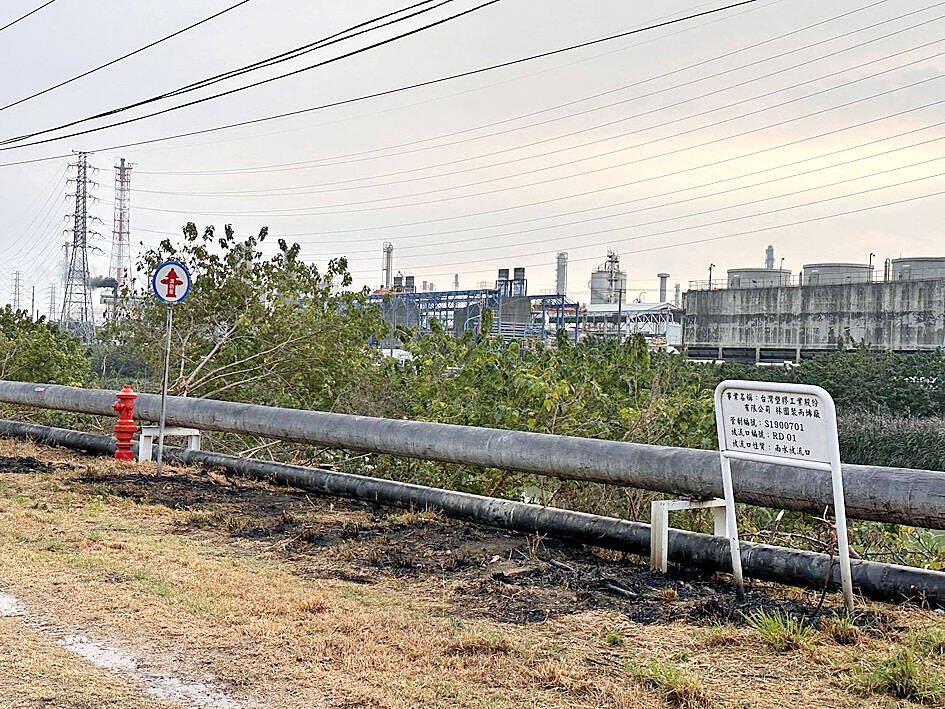
Photo courtesy of a reader
When the pole makes contact with the power lines, Chou bursts into flames and collapses, while his friend quickly attempts to put out the fire with a piece of clothing. Others nearby called for help.
A firefighter said that when his unit arrived, they found Chou in a serious condition, and rushed him to a hospital.
Although he had second-degree burns over more than 40 percent of his body, Chou was stable and conscious, the firefighter said.
They also extinguished a small fire caused by the incident, he added.
Firefighters confirmed that Chou was an “iguana bounty hunter” who had planned to capture the reptile, enticed by the local government’s NT$250 payout per iguana.
Taipower officials said the incident caused a power outage at the industrial park, affecting three petrochemical plants for more than four hours and another facility for more than five hours, leading to work stoppages and financial losses.
“These are large petrochemical plants at the industrial park, which have high power demands, requiring high-voltage electricity wires. We had set up a special grid line to support 69,000 volts into the Linyuan Industrial Park, but now it has been damaged, and we have to repair it,” Taipower said in a statement.
Taipower officials said they are considering seeking compensation from Chou for financial losses to the plants and damage to its power lines.
Green iguanas, native to Central and South America, damage crops and upset the local ecology. Their importation was banned in 2015 and they were declared an invasive species in 2020.
The Kaohsiung Agriculture Bureau said that local governments have offered NT$250 to NT$300 per iguana captured to control the reptiles’ population.
While the bounties have enticed many to try their hand at capturing the lizards, bureau official said they must first undergo training and obtain certification to hunt iguanas.

Considering that most countries issue more than five denominations of banknotes, the central bank has decided to redesign all five denominations, the bank said as it prepares for the first major overhaul of the banknotes in more than 24 years. Central bank Governor Yang Chin-lung (楊金龍) is expected to report to the Legislative Yuan today on the bank’s operations and the redesign’s progress. The bank in a report sent to the legislature ahead of today’s meeting said it had commissioned a survey on the public’s preferences. Survey results showed that NT$100 and NT$1,000 banknotes are the most commonly used, while NT$200 and NT$2,000

The Centers for Disease Control (CDC) yesterday reported the first case of a new COVID-19 subvariant — BA.3.2 — in a 10-year-old Singaporean girl who had a fever upon arrival in Taiwan and tested positive for the disease. The girl left Taiwan on March 20 and the case did not have a direct impact on the local community, it said. The WHO added the BA.3.2 strain to its list of Variants Under Monitoring in December last year, but this was the first imported case of the COVID-19 variant in Taiwan, CDC Deputy Director-General Lin Ming-cheng (林明誠) said. The girl arrived in Taiwan on

ANNUAL EVENT: Two massive Pokemon balloons are to be set up in Daan Park, with an event zone operating from 10am to 6pm This year’s Taipei Floral Picnic is to be held at Daan Park today and tomorrow, featuring an exclusive Pokemon Go event, a themed food market, a coffee rave picnic area and stage performances, the Taipei Department of Information and Tourism said yesterday. Two massive Pokemon balloons are to be set up in the park as attractions, with an exclusive event zone operating from 10am to 6pm, it said. Participants who complete designated tasks on-site would have a chance to receive limited-edition souvenirs, it added. People could also try the newly launched game Pokemon Pokopia in the trial area, the department said. Three PokeStops are

South Korea is planning to revise its controversial electronic arrival card, a step Taiwanese officials said prompted them to hold off on planned retaliatory measures, a South Korean media report said yesterday. A Yonhap News Agency report said that the South Korean Ministry of Foreign Affairs is planning to remove the “previous departure place” and “next destination” fields from its e-arrival card system. The plan, reached after interagency consultations, is under review and aims to simplify entry procedures and align the electronic form with the paper version, a South Korean ministry official said. The fields — which appeared only on the electronic form


 RSS
RSS