

The government’s “health coin” system, to be launched this year for people to accumulate and spend on healthy food, products and services, would be integrated with government health apps, Deputy Minister of Health and Welfare Chuang Jen-hsiang (莊人祥) said yesterday.
Minister of Health and Welfare Shih Chung-liang (石崇良) in October last year announced the program aimed at raising health awareness.
The tokens could be earned by getting vaccinations, health checkups or cancer screenings, and used for discounts on healthcare-related services or products, Shih said at the time.

Photo: Tien Yu-hua, Taipei Times
On the sidelines of a news conference by the Hope Foundation for Cancer Care in Taipei, Chung said the ministry is planning to integrate the “coins” into its existing National Health Insurance Mobile Easy Access (全民健保行動快易通) app, also known as “My Health Bank” (健康存摺).
The app would have a designated “health coins” section, he said.
The vaccination, health checkup or cancer screening items eligible for collecting tokens would be listed in the app, and people who have completed the items would earn the corresponding number of “coins,” he said.
People can spend them at contracted businesses and healthcare facilities on products like non-sweetened beverages, healthy meals or fitness courses, Chuang said.
Many businesses have expressed willingness to participate in the program, including insurance companies, convenience stores, health management apps and sports brands, he added.
Regarding concerns that people who are less familiar with digital services might find it difficult to redeem the “coins” through the app, Chuang said that the ministry will ensure that the “health coin” system is designed to be user-friendly, adding that personal health data need to be well protected, and the app has secure identity authentication and data protection mechanisms.
As for when the program would be launched — Shih had originally said April — Chuang said the minister would make an official announcement later.
Separately, to commemorate World Cancer Day on Feb. 4 each year, the Hope Foundation for Cancer Care yesterday launched a three-day cycling ride from Taipei to Kaohsiung, with dozens of healthcare workers and volunteers participating to raise cancer awareness and to encourage prevention, detection and treatment.
A total of 400 foreign “high- level” professionals have been naturalized as Republic of China (Taiwan) citizens over the past decade as the government has eased nationality rules to attract talent from a wider range of fields, the Ministry of the Interior said yesterday. The 400th high-level professional, who works in the electronics industry, was approved for ROC citizenship on Aug. 26, the MOI said. The MOI quoted the newly naturalized citizen as saying that Taiwan is a leader in fields such as semiconductors, electronics manufacturing, artificial intelligence development and energy technology. He also said

A Chinese military drone was spotted conducting reconnaissance off Taitung County as President William Lai (賴清德) visited Pingtung County this morning to inspect a drill of the armed forces’ precision-strike capabilities, prompting the military to closely monitor its actions. Today was the final day of a three-day military exercise at Jioupeng Base (九鵬基地) to test the joint combat capabilities of the armed forces and coast guard. The exercise began on Wednesday simulating air defense interception and yesterday tested long-range strike capabilities and new air defense weapons. This morning, the military conducted a final exercise involving air defense, anti-ship and drone operations. Military sources said

OCT. 31: The antiviral drugs Tamiflu and Eraflu have been distributed to about 4,000 medical facilities nationwide for people in seven groups who develop flu-like symptoms As the domestic influenza epidemic enters its peak season and continues to escalate, the Centers for Disease Control (CDC) yesterday announced that publicly funded influenza antiviral drugs for seven eligible groups have been extended to Oct. 31, allowing those who develop flu-like symptoms to receive the medication without undergoing a rapid influenza test. The CDC has extended the expanded use of flu antiviral drugs to seven groups: healthcare and influenza-prevention personnel; residents and staff at nursing homes, long-term care facilities and similar institutions; kindergarten and daycare workers and home-based caregivers; students from kindergarten through high school, vocational high school and the
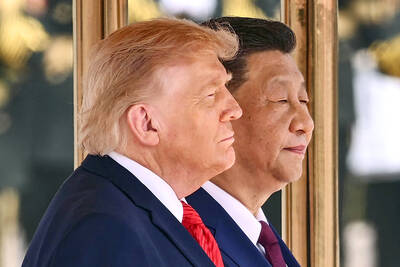
China has warned that it could cancel a planned US-China leaders’ summit if Washington approves new arms sales to Taiwan, a Japanese media outlet quoted sources as saying yesterday. US President Donald Trump, “apparently eager to showcase some diplomatic achievements ahead of November’s midterm congressional elections, places great importance on holding the summit with Chinese President Xi Jinping (習近平),” Japan’s Kyodo News reported. “While preparing for Xi’s upcoming trip, China has restated its position that the Taiwan issue is a ‘red line’ in bilateral relations,” the report said. The report said that when Xi met with Trump in Beijing in May, Xi said


 RSS
RSS