


Taiwan aims to create NT$15 trillion (US$474.8 billion) in production value by 2040 through the 10 major artificial intelligence (AI) projects launched last year, President William Lai (賴清德) said yesterday at a meeting with the winners of the Asia-Pacific ICT Alliance (APICTA) Awards.
The APICTA Awards, which were again held in Taiwan in December after nine years, are widely regarded as the Oscars of the information and communications technology (ICT) sector in the Asia-Pacific region, Lai said at the Presidential Office in Taipei.
The competition attracted 256 entries from 13 Indo-Pacific economies, with Team Taiwan collecting a record 10 golds, eight silvers and six bronzes, he said.
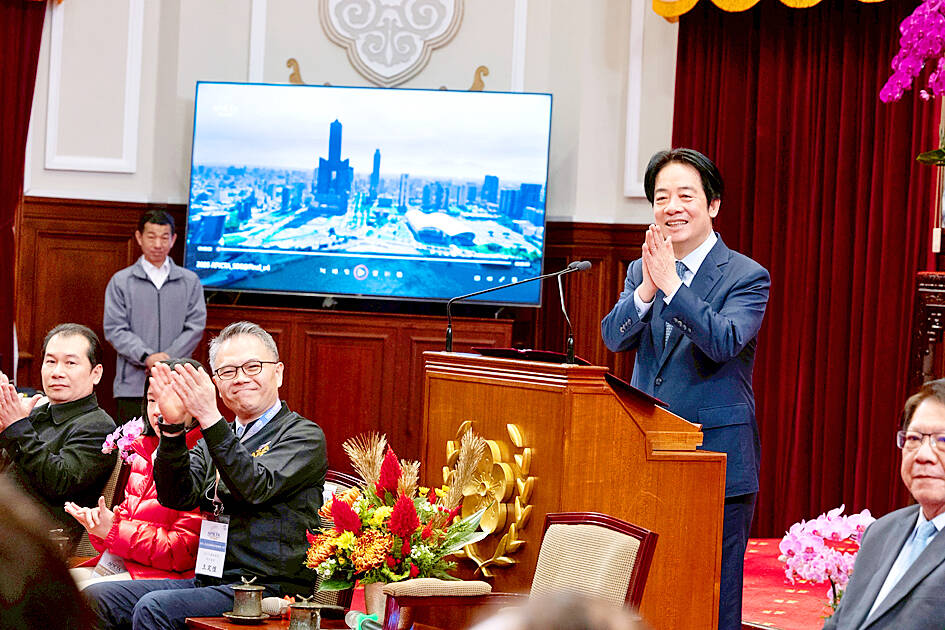
Photo: Screen grab from the Presidential Office’s Flickr page
The Taiwanese team participated in the consumer, inclusions and community services, industrial, business services, public sector and government, and student categories, demonstrating the participants’ commitment to research and development and robust achievements in ICT development and innovation on the global stage, he said.
AI changes the world “in the present continuous tense rather than in the future tense,” and Taiwan must accelerate its pace and plan ahead to ensure that the younger generation remain globally competitive, he said.
The government launched the 10 major AI projects last year with a projected investment of NT$1.5 trillion, the president said.
The investment is expected to support 500,000 people specializing in AI applications and create NT$15 trillion in output by 2040, he added.
The government is also planning to develop three other critical technologies — quantum technology, silicon photonics and robotics — to bolster Taiwan’s competitiveness in the long run, Lai said.
Efforts would be made to promote progress in computing power, data, talent, marketing and funding, thereby building inclusive, forward-looking technological environments in line with the goal of creating an “innovative economy, smart nation,” he said.
The real value of technology lies in solving problems and improving people’s lives, Lai said.
The government will continue to develop vibrant, inclusive AI innovative ecosystems that benefit all people, he said.
AI would become the engine of upgrading and transformation across micro, small and medium-sized enterprises, meaning not a single industry, company or group of people would be left out of the transition to AI, he added.
Each contestant represents a fresh force that is transforming Taiwan into a “smart nation,” he said.
The competition is expected to help initiate more exchanges and cooperation with Indo-Pacific partners to expand Taiwan’s international influence, he said, adding that he expected more students, industry players and innovation teams to capitalize on it.
That would create a better, smarter and more inclusive digital future not only for Taiwan, but also for the Indo-Pacific region as well, he added.

FUKUOKA SITUATION: Japanese media reported that the pathogen is expected to be identified by the summer, while the CDC downplayed the idea that it was hMPV A “mysterious cold-like illness” reported in Japan’s Fukuoka Prefecture does not seem to be a new disease, but Japanese authorities have been asked about the situation, the Centers for Disease Control (CDC) said yesterday. The Fukuoka Prefectural Medical Association on Wednesday told a news conference that a “mystery cold” that has become a hot topic on social media is “highly likely to be caused by some kind of viral infection,” Japan’s KBC News reported. “Many people are experiencing symptoms starting with a sore throat, followed by a runny nose, phlegm and a severe cough,” KBC News reported, citing association officials. Health authorities are

Nvidia Corp CEO Jensen Huang (黃仁勳) arrived in Taiwan yesterday ahead of upcoming AI and technology events, saying he plans to meet with clients and Taiwan Semiconductor Manufacturing Co Chairman C.C. Wei (魏哲家) during his visit. After landing at Taipei Songshan Airport, Huang posed for photos with fans and handed out Yakult drinks to reporters and supporters waiting at the scene, saying he has “a lot to do” during the trip. Asked about reports that Nvidia’s planned headquarters site in Taipei’s Beitou Shilin Technology Park could break ground on May 27, Huang said that if the company holds an event, he would

Carrefour Taiwan is to begin using a new name from the start of July, but it cannot divulge the name until then, the chairman of the supermarket chain's parent company said today. President Chain Store Co chairman Lo Chih-hsien (羅智先) was asked by reporters after a shareholders' meeting to confirm whether the company has settled on a new name for the supermarket brand. In March, the government-registered name of two Carrefour Taiwan branches was quietly changed to "Le Chia Kang" (樂家康) in Chinese, raising speculation that has been selected as the name. Lo said that because of local regulations and contractual obligations, the
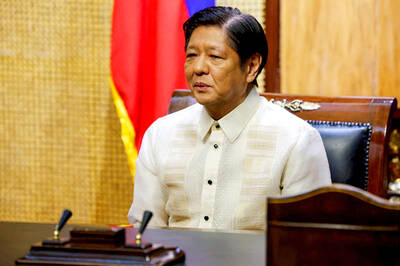
The Philippines would likely be involved in any conflict over Taiwan due to its proximity to the democracy claimed by China, President Ferdinand Marcos Jr said, reiterating a stance that risks angering Beijing. “In the Philippines, we do not have a choice because Taiwan is so close to the Philippines and we have almost 200,000 Filipino nationals living and working in Taiwan,” Marcos said in an interview with Japanese media in Manila on Monday. The Philippine leader’s comments come ahead of a state visit to Japan next week, where he is to meet with Japanese Prime Minister Sanae Takaichi to discuss security


 RSS
RSS