


President William Lai (賴清德) yesterday urged unity in the face of what he called external hostile forces.
He made the remarks when he presented a posthumous presidential citation to Liu Chin-shih (劉金獅), former chairperson of the Formosa Political Prisoners Association (FPPA), in remembrance of his lifelong struggle for democracy, freedom and human rights in Taiwan.
While Liu’s generation fought against the Chinese Nationalist Party’s (KMT) autocracy in pursuit of democracy, today’s generation must stand together firmly with more solidarity, because they face threats from an external force, Lai said at Liu’s memorial service at Che-lam Presbyterian Church (濟南教會) in Taipei.
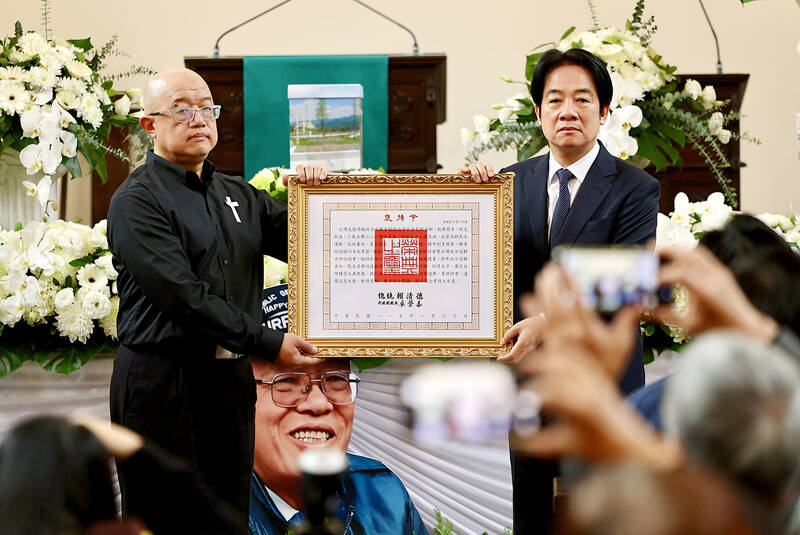
Photo: CNA
Lai said Liu’s life mirrors the scripture from 2 Timothy 4:7 in the Bible: “I have fought the good fight, I have finished the race, I have kept the faith,” and he prays that Liu would rest in the arms of God, free from all earthly suffering.
Born in Yilan County’s Suao Township (蘇澳), Liu was only 12 years old when he and his father witnessed then-Taiwan governor Chen Yi’s (陳儀) troops shooting civilians, Lai said.
Having seen the horrors of the 228 Massacre, the conviction that Taiwan must be independent was planted in Liu’s heart at that moment, Lai said.
He said Liu was arrested in 1962 on charges of participating in the pro-Taiwanese independence “Hsing-tai Association” (興台會), and was sentenced to 10 years in prison, and that despite enduring great suffering and hardship, his commitment to fight for Taiwan had never wavered.
“Whether participating in democratic movements or street petition drives, Liu dedicated his entire life to the fight for Taiwan’s democracy, freedom and human rights — his heart was always filled with a profound love for this land,” Lai said.
After Liu was released from prison, he and fellow survivors established the FPPA, Taiwan’s first association of political prisoners for supporting the families of the persecuted, which was a deeply moving effort, Lai said.
Although Liu has passed away, the groundwork he laid for Taiwan’s democracy will last for generations, Lai said, adding that he hopes that people would inherit Liu’s spirit and continue to keep working hard for the future of Taiwan.

Considering that most countries issue more than five denominations of banknotes, the central bank has decided to redesign all five denominations, the bank said as it prepares for the first major overhaul of the banknotes in more than 24 years. Central bank Governor Yang Chin-lung (楊金龍) is expected to report to the Legislative Yuan today on the bank’s operations and the redesign’s progress. The bank in a report sent to the legislature ahead of today’s meeting said it had commissioned a survey on the public’s preferences. Survey results showed that NT$100 and NT$1,000 banknotes are the most commonly used, while NT$200 and NT$2,000

The Centers for Disease Control (CDC) yesterday reported the first case of a new COVID-19 subvariant — BA.3.2 — in a 10-year-old Singaporean girl who had a fever upon arrival in Taiwan and tested positive for the disease. The girl left Taiwan on March 20 and the case did not have a direct impact on the local community, it said. The WHO added the BA.3.2 strain to its list of Variants Under Monitoring in December last year, but this was the first imported case of the COVID-19 variant in Taiwan, CDC Deputy Director-General Lin Ming-cheng (林明誠) said. The girl arrived in Taiwan on

ANNUAL EVENT: Two massive Pokemon balloons are to be set up in Daan Park, with an event zone operating from 10am to 6pm This year’s Taipei Floral Picnic is to be held at Daan Park today and tomorrow, featuring an exclusive Pokemon Go event, a themed food market, a coffee rave picnic area and stage performances, the Taipei Department of Information and Tourism said yesterday. Two massive Pokemon balloons are to be set up in the park as attractions, with an exclusive event zone operating from 10am to 6pm, it said. Participants who complete designated tasks on-site would have a chance to receive limited-edition souvenirs, it added. People could also try the newly launched game Pokemon Pokopia in the trial area, the department said. Three PokeStops are

South Korea is planning to revise its controversial electronic arrival card, a step Taiwanese officials said prompted them to hold off on planned retaliatory measures, a South Korean media report said yesterday. A Yonhap News Agency report said that the South Korean Ministry of Foreign Affairs is planning to remove the “previous departure place” and “next destination” fields from its e-arrival card system. The plan, reached after interagency consultations, is under review and aims to simplify entry procedures and align the electronic form with the paper version, a South Korean ministry official said. The fields — which appeared only on the electronic form


 RSS
RSS