


The Hai Kun (海鯤) prototype submarine on Friday conducted “shallow-water submerged tests” following its first submerged test a day earlier, which CSBC Corp, Taiwan, the primary contractor of the indigenous defense program, said was successful.
CSBC did not disclose the depths to which the submarine descended, although sources said that the operations took the vessel to 50m on Thursday and 100m on Friday.
“The successful submerged sea trials of the Hai Kun are an important milestone in the navy’s history of autonomous shipbuilding,” President William Lai (賴清德) wrote on social media on Friday.
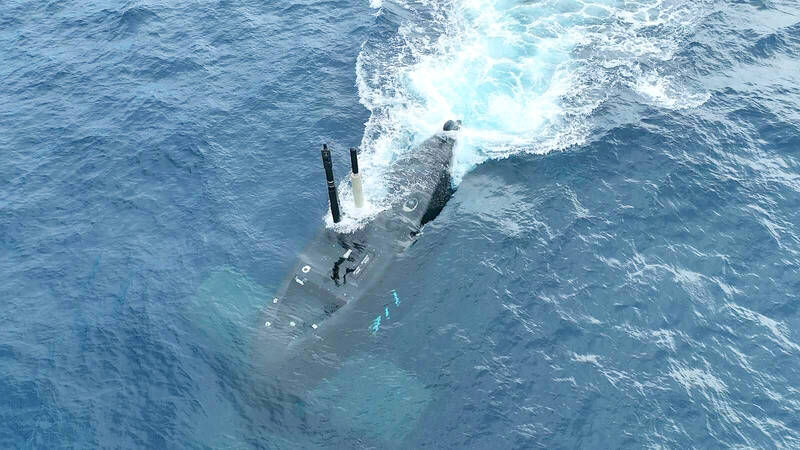
Photo: Screen grab from Joseph Wu’s X account
“Despite the challenges, the navy, CSBC and other companies involved in building the submarine have resolved issues and completed what others had described as mission impossible,” Lai said.
“The success in building the Hai Kun means that Taiwan is now among the few countries in the world that can autonomously build submarines,” he said, adding that the efficiency with which Taiwan built the vessel was commendable.
National Security Council Secretary-General Joseph Wu (吳釗燮) yesterday wrote on X that the successful tests were “a major step forward for our deterrence capabilities.”
It has been more than four years since the keel of the Hai Kun, or Narwhal in English, was laid in November 2021.
CSBC said that the construction timeline was faster than for submarines built by other governments, such as the UK’s Upholder-class and South Korea’s KSS-II-class vessels, which took six-and-a-half and five years respectively.
The cost of the Hai Kun — NT$37.9 billion (US$1.2 billion), excluding torpedoes and storage facilities — is also moderate compared with foreign diesel-electric submarine programs, with South Korea’s Jang Bogo-class submarines costing the equivalent of NT$78.4 billion and Germany’s Type 214s costing NT$95.9 billion, it said.
The Hai Kun was originally scheduled to complete sea trials by November last year, but the schedule was pushed back as it underwent final adjustments ahead of the submergence tests.
Completion of the sea trials is crucial to the indigenous defense program, as it would trigger the release of NT$1 billion for seven subsequent submarines.
The legislature froze the funds last year.
With the Hai Kun undergoing submergence tests, a major component of Taiwan’s defense infrastructure is nearing completion.
However, a senior defense official on Friday said that if the legislature in 2005 had not blocked critical funding for submarine procurement, eight submarines Taiwan was to purchase from the US would have been delivered that year.
That would have made it much harder for the Chinese People’s Liberation Army Navy to pressure Taiwan in the Taiwan Strait, significantly altering the security dynamics in the first island chain, they said.
In 2001, the administration of then-US president George W. Bush announced plans to sell eight diesel-electric submarines to Taiwan, alongside Patriot missile systems and P-3C anti-submarine aircraft.
However, due to political gridlock at the time, the budget for the submarines was blocked 69 times in legislature’s Procedure Committee, ultimately causing the deal to fall through, the official said.
Additional reporting by Hung Chen-hung and CNA

FUKUOKA SITUATION: Japanese media reported that the pathogen is expected to be identified by the summer, while the CDC downplayed the idea that it was hMPV A “mysterious cold-like illness” reported in Japan’s Fukuoka Prefecture does not seem to be a new disease, but Japanese authorities have been asked about the situation, the Centers for Disease Control (CDC) said yesterday. The Fukuoka Prefectural Medical Association on Wednesday told a news conference that a “mystery cold” that has become a hot topic on social media is “highly likely to be caused by some kind of viral infection,” Japan’s KBC News reported. “Many people are experiencing symptoms starting with a sore throat, followed by a runny nose, phlegm and a severe cough,” KBC News reported, citing association officials. Health authorities are

Nvidia Corp CEO Jensen Huang (黃仁勳) arrived in Taiwan yesterday ahead of upcoming AI and technology events, saying he plans to meet with clients and Taiwan Semiconductor Manufacturing Co Chairman C.C. Wei (魏哲家) during his visit. After landing at Taipei Songshan Airport, Huang posed for photos with fans and handed out Yakult drinks to reporters and supporters waiting at the scene, saying he has “a lot to do” during the trip. Asked about reports that Nvidia’s planned headquarters site in Taipei’s Beitou Shilin Technology Park could break ground on May 27, Huang said that if the company holds an event, he would

The Ministry of Finance this afternoon announced the winning numbers for the March-April uniform invoice lottery. The winning number for the NT$10 million (US$318,060) special prize is 19531471, and the winning number for the NT$2 million grand prize is 85941329. Three numbers were drawn for the NT$200,000 first prize: 07225810, 20231230 and 83518781. Those with receipts matching the last seven digits of any of the first-prize numbers will win the NT$40,000 second prize, while those matching the last six digits will win the NT$10,000 third prize. Those whose receipts match the last five digits of the first-prize numbers can claim the NT$4,000 fourth prize,
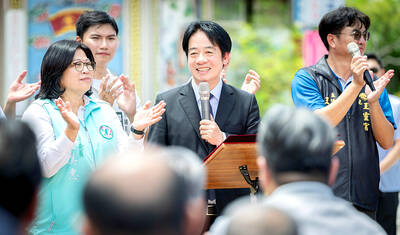
SIX SUBSIDIES: The monthly allowance for older farmers is to increase to NT$10,000, and NT$5,000 is to be given to homemakers under the national pension system, Lai said The government is to implement major welfare policies for disadvantaged groups, including raising the monthly allowance for older farmers to NT$10,000 and providing homemakers with NT$5,000 per month, President William Lai (賴清德) said yesterday. Lai made the remarks during a visit to Wangling Temple in Chiayi County, saying that the planned increases were being introduced amid economic growth and an increase in tax revenue. Touting a policy, in which the government plans to provide a monthly allowance of NT$5,000 for every child under the age of 18 in a bid to address Taiwan’s low birthrate, Lai said that if received for the


 RSS
RSS