


Former minister of transportation and communications Hochen Tan (賀陳旦) yesterday said he is willing to debate transportation officials over the necessity of building a high-speed rail (HSR) extension to Yilan County, adding that they deliberately excluded the proposal of building a straight railway connecting Taipei’s Nangang District (南港) and Yilan County.
Currently, the railway between Taipei and Yilan runs along the northeast coast.
The ministry initially planned to shorten the Taipei-Yilan route by building a straight railway line, to be operated by Taiwan Railway Corp (TRC).
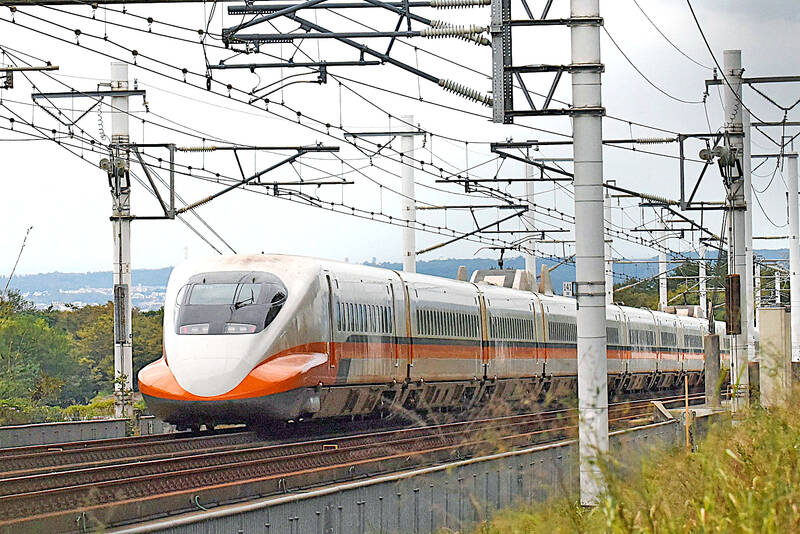
Photo: Wu Liang-yi, Taipei Times
However, the bureau later said the railway would pass through the Feitsui Reservoir (翡翠水庫) watershed, the main water supply for residents in the greater Taipei area, and would only slightly reduce travel time.
The Railway Bureau abandoned the plan in 2019 and advocated to have a HSR extension built instead, saying that it would reduce the travel time to 28 minutes and avoid the watershed.
The decision triggered criticism from transportation experts and civic groups.
“Our purpose is not to wage a war against the ministry. We hope that subsequent discussions over the issue would shed light on the right direction of how this project should proceed,” Hochen told a news conference in Taipei.
Discussions should focus on which system would deliver greatest benefits when constructed within the same corridor, Hochen said.
Instead, the bureau compared the HSR extension with a slightly meandering railway route that the bureau chose 10 years ago, which was unfair, he said.
“The HSR proposal only surfaced 20 years after the nation considered whether the straight railway line should be built,” Hochen said.
“Within these 20 years, we have seen many changes, including the improvement of TRC services. Even the bureau said in 2019 that the best route would be one that is built parallel to the Chiang Wei-shui Freeway [Freeway No. 5]. However, all these considerations were nowhere to be found in the bureau’s deliberations over the HSR extension,” he said.
The bureau’s assessment reports on the cost of building the HSR and straight railway line — published in April and October last year — were filled with unanswered questions, he said.
The cost of building the straight railway line increased by NT$86 billion (US$2.75 billion), while the HSR extension decreased by NT$12.6 billion, he said.
The bureau also initially estimated that 140 houses would have to be relocated to build the HSR, but the finalized assessment showed that only 96 houses would be expropriated, he said.
Former Taipei Department of Transportation director David Poo (濮大威) said that the bureau’s assessment lacked comprehensive strategic considerations.
It is unclear why the bureau thought that the net profits would be greater than that of building a straight railway line, he said.
“What we saw instead was that they drove up the costs of building a straight railway line and claimed that TRC trains would be unable to climb slopes,” Poo said.
Taiwan Railway Union chairwoman Tsao Chia-chun (曹嘉君) said that the ministry has allocated a budget for TRC to acquire 1,080 new trains capable of climbing gradients of 3.5 percent.
“TRC estimated the HSR extension to Yilan, once in operation, would result in a ticket revenue shortfall of NT$800 million per year, expanding to NT$58 billion in the next 30 years if the potentially unreceived benefits were taken into account,” Tsao said, adding that it would worsen the financial situation of the state-run firm.
Former Yilan County Economic Affairs Department director Lin Wang-ken (林旺根) said that the straight railway line would seamlessly connect to 12 railway stations in Yilan, which could reach all major suburban areas in the county.
“The biggest problem with the HSR extension is its failure to consider costs of transferring to different transportation systems once you arrive in Yilan,” Lin said.
Minister of Transportation and Communications Chen Shih-kai (陳世凱) said the figures cited were incorrect.
Transportation planning involves highly professional analysis and evaluation, and the government would not spend public funds recklessly, Chen said.

FUKUOKA SITUATION: Japanese media reported that the pathogen is expected to be identified by the summer, while the CDC downplayed the idea that it was hMPV A “mysterious cold-like illness” reported in Japan’s Fukuoka Prefecture does not seem to be a new disease, but Japanese authorities have been asked about the situation, the Centers for Disease Control (CDC) said yesterday. The Fukuoka Prefectural Medical Association on Wednesday told a news conference that a “mystery cold” that has become a hot topic on social media is “highly likely to be caused by some kind of viral infection,” Japan’s KBC News reported. “Many people are experiencing symptoms starting with a sore throat, followed by a runny nose, phlegm and a severe cough,” KBC News reported, citing association officials. Health authorities are

Nvidia Corp CEO Jensen Huang (黃仁勳) arrived in Taiwan yesterday ahead of upcoming AI and technology events, saying he plans to meet with clients and Taiwan Semiconductor Manufacturing Co Chairman C.C. Wei (魏哲家) during his visit. After landing at Taipei Songshan Airport, Huang posed for photos with fans and handed out Yakult drinks to reporters and supporters waiting at the scene, saying he has “a lot to do” during the trip. Asked about reports that Nvidia’s planned headquarters site in Taipei’s Beitou Shilin Technology Park could break ground on May 27, Huang said that if the company holds an event, he would

The Ministry of Finance this afternoon announced the winning numbers for the March-April uniform invoice lottery. The winning number for the NT$10 million (US$318,060) special prize is 19531471, and the winning number for the NT$2 million grand prize is 85941329. Three numbers were drawn for the NT$200,000 first prize: 07225810, 20231230 and 83518781. Those with receipts matching the last seven digits of any of the first-prize numbers will win the NT$40,000 second prize, while those matching the last six digits will win the NT$10,000 third prize. Those whose receipts match the last five digits of the first-prize numbers can claim the NT$4,000 fourth prize,

SIX SUBSIDIES: The monthly allowance for older farmers is to increase to NT$10,000, and NT$5,000 is to be given to homemakers under the national pension system, Lai said The government is to implement major welfare policies for disadvantaged groups, including raising the monthly allowance for older farmers to NT$10,000 and providing homemakers with NT$5,000 per month, President William Lai (賴清德) said yesterday. Lai made the remarks during a visit to Wangling Temple in Chiayi County, saying that the planned increases were being introduced amid economic growth and an increase in tax revenue. Touting a policy, in which the government plans to provide a monthly allowance of NT$5,000 for every child under the age of 18 in a bid to address Taiwan’s low birthrate, Lai said that if received for the


 RSS
RSS