


Chinese President Xi Jinping’s (習近平) removal of senior military leaders might disrupt the Chinese People’s Liberation Army’s (PLA) capability to wage war against Taiwan in the immediate future, Taiwanese defense experts said yesterday.
The Chinese Ministry of National Defense on Saturday announced that Zhang Youxia (張又俠), a member of the Chinese Communist Party’s (CCP) politburo and vice chairman of the Central Military Commission, and Liu Zhenli (劉振立), chief of the commission’s Joint Staff Department, are under investigation for suspected disciplinary and legal violations.
With the removal of Zhang and Liu, five of the seven members of the 20th Central Military Commission formed in 2022 have now been removed, leaving only its chairman, Xi, and its vice chairman, Zhang Shengmin (張升民).
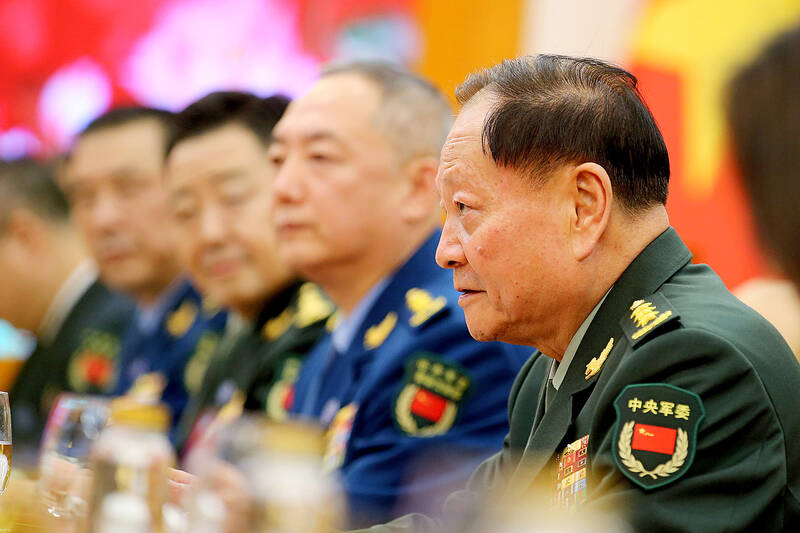
Photo: EPA-EFE
Tsai Wen-hsuan (蔡文宣), a research fellow in Academia Sinica’s Institute of Political Science, said that the negative effect on military capabilities stemming from the dismissals would benefit Taiwan in the short run.
Weakening the PLA’s war potential is an acceptable risk to Xi, as he likely does not have any plans to take action against Taiwan until he secures a fourth presidential term at the 21st National Congress of the CCP next year, Tsai said.
Chieh Chung (揭仲), an associate research fellow at the state-run Institute for National Defense and Security Research, said that frequent purges dilute the experience of China’s top generals, impeding the modernization of its military.
Although turnover of top generals is not likely to adversely affect the PLA’s ability to conduct routine military affairs, the loss of experience is sure to create a bottleneck in Chinese efforts to develop new military capabilities, Chieh said.
There would be a significant downside for the PLA capabilities if Xi’s purges spread to lower-ranking generals, he added.
Chaos in the Chinese military’s upper echelons also increases the risks of miscalculation by removing leaders capable of handling large-scale crises, he said, adding that major generals do not have training or experience regarding strategic matters.
As Xi hollows out the commission, fear of contradicting the Chinese leader could stifle the honest exchange of opinions necessary for Beijing to manage contingencies, Chieh said.
The dismissals would have little to no effect on the frequency of China’s provocative military drills around Taiwan proper, which are conducted by the PLA Eastern Theater Command as a matter of routine, he said.
Tristan Tang (湯廣正), an associate fellow at the Taoyuan-based Secure Taiwan Associate, said that military indicators show Zhang and Liu lost influence as their war preparation efforts failed to meet expectations.
Official briefings accused the two generals of causing “severe damage to combat capability development,” a charge not seen in an earlier case involving former commission vice chairman He Weidong (何衛東), Tang said.
Publicly available information suggests that Zhang and Liu might not have met Xi’s “requirements for force building related to a Taiwan invasion, and may even have engaged in open disagreement or defiance within the PLA,” he said.
Although China’s military is unlikely to attack Taiwan in the near term, training activities and military drills might become more aggressive and frequent under successors willing to implement Xi’s military blueprint, he added.
Neil Thomas, a fellow at the Washington-based Asia Society Policy Institute’s Center for China Analysis, said the latest purge “makes China’s threat toward Taiwan weaker in the short term, but stronger in the long term.”
It would make a military escalation riskier in the immediate term because of “a high command in disarray,” but in the long term would mean the army has a more loyal and less corrupt leadership with more military capabilities, Thomas said.
Additional reporting by AP

FUKUOKA SITUATION: Japanese media reported that the pathogen is expected to be identified by the summer, while the CDC downplayed the idea that it was hMPV A “mysterious cold-like illness” reported in Japan’s Fukuoka Prefecture does not seem to be a new disease, but Japanese authorities have been asked about the situation, the Centers for Disease Control (CDC) said yesterday. The Fukuoka Prefectural Medical Association on Wednesday told a news conference that a “mystery cold” that has become a hot topic on social media is “highly likely to be caused by some kind of viral infection,” Japan’s KBC News reported. “Many people are experiencing symptoms starting with a sore throat, followed by a runny nose, phlegm and a severe cough,” KBC News reported, citing association officials. Health authorities are

Nvidia Corp CEO Jensen Huang (黃仁勳) arrived in Taiwan yesterday ahead of upcoming AI and technology events, saying he plans to meet with clients and Taiwan Semiconductor Manufacturing Co Chairman C.C. Wei (魏哲家) during his visit. After landing at Taipei Songshan Airport, Huang posed for photos with fans and handed out Yakult drinks to reporters and supporters waiting at the scene, saying he has “a lot to do” during the trip. Asked about reports that Nvidia’s planned headquarters site in Taipei’s Beitou Shilin Technology Park could break ground on May 27, Huang said that if the company holds an event, he would

The Ministry of Finance this afternoon announced the winning numbers for the March-April uniform invoice lottery. The winning number for the NT$10 million (US$318,060) special prize is 19531471, and the winning number for the NT$2 million grand prize is 85941329. Three numbers were drawn for the NT$200,000 first prize: 07225810, 20231230 and 83518781. Those with receipts matching the last seven digits of any of the first-prize numbers will win the NT$40,000 second prize, while those matching the last six digits will win the NT$10,000 third prize. Those whose receipts match the last five digits of the first-prize numbers can claim the NT$4,000 fourth prize,

SIX SUBSIDIES: The monthly allowance for older farmers is to increase to NT$10,000, and NT$5,000 is to be given to homemakers under the national pension system, Lai said The government is to implement major welfare policies for disadvantaged groups, including raising the monthly allowance for older farmers to NT$10,000 and providing homemakers with NT$5,000 per month, President William Lai (賴清德) said yesterday. Lai made the remarks during a visit to Wangling Temple in Chiayi County, saying that the planned increases were being introduced amid economic growth and an increase in tax revenue. Touting a policy, in which the government plans to provide a monthly allowance of NT$5,000 for every child under the age of 18 in a bid to address Taiwan’s low birthrate, Lai said that if received for the


 RSS
RSS