


The High Court’s Taichung branch has upheld a lower court sentencing which had ordered the employees of a cosmetic surgery clinic to pay NT$33.48 million (US$1.06 million) to Taiwan Power (Taipower) after they were found guilty of stealing electricity to mine cryptocurrency.
An investigation found that the clinic’s owners, a man surnamed Cheng (鄭) and his wife, surnamed Su (蘇), had since 2021 been renting rooms in commercial buildings and private residences in Taichung, launched eight stations, and purchased about 800 computer units to run around the clock in their cryptomining operation, court documents showed.
Cheng and Su had acquired 27 bitcoins, worth about NT$25 million in total, but stole about NT$76 million in electricity, according to court filings.
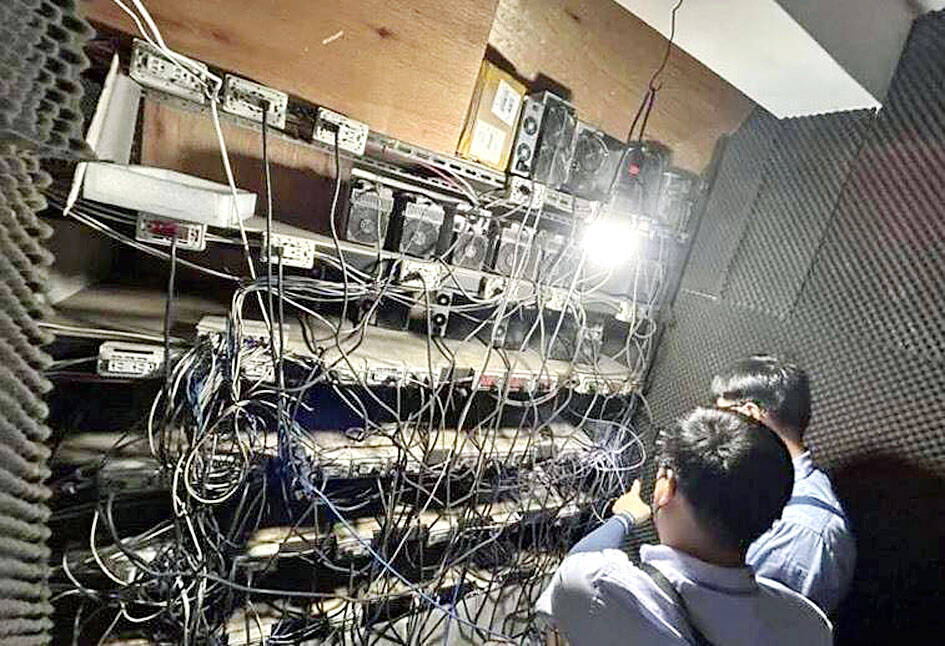
Photo: Taipei Times
The couple hired two employees, surnamed Hsu (徐) and Huang (黃), to monitor the eight stations, the filings showed.
When investigators raided two of the stations, they found wires partially melted due to constant power consumption, posing a fire hazard — one in a building also housing a cram school — and prosecutors called the two stations “ticking time bombs,” they showed.
The defendants appealed a lower court’s ruling that found them guilty of several offenses.
The High Court upheld the decision, finding the four guilty of theft and other offenses, and sentenced them to prison terms ranging from one year and six months to two years.
Taipower filed a separate civil claim and, after deducting what Cheng and Su had already paid, sought NT$33.48 million in compensation from the two employees.
During the court proceedings, Hsu said he was merely a regular employee and denied any involvement in the electricity theft, adding that the responsibility should lie with the employer.
Huang said he was also just a worker and initially unaware of the electricity theft, adding that after finding out about it, he resigned and exposed the operation.
The High Court branch said that even if the two employees were initially unaware of the nature of their duties when they were first employed, they monitored the mining operation for more than six months and did not immediately stop their involvement after discovering it, therefore it rejected their appeal.
The ruling can be appealed.

Considering that most countries issue more than five denominations of banknotes, the central bank has decided to redesign all five denominations, the bank said as it prepares for the first major overhaul of the banknotes in more than 24 years. Central bank Governor Yang Chin-lung (楊金龍) is expected to report to the Legislative Yuan today on the bank’s operations and the redesign’s progress. The bank in a report sent to the legislature ahead of today’s meeting said it had commissioned a survey on the public’s preferences. Survey results showed that NT$100 and NT$1,000 banknotes are the most commonly used, while NT$200 and NT$2,000

The Centers for Disease Control (CDC) yesterday reported the first case of a new COVID-19 subvariant — BA.3.2 — in a 10-year-old Singaporean girl who had a fever upon arrival in Taiwan and tested positive for the disease. The girl left Taiwan on March 20 and the case did not have a direct impact on the local community, it said. The WHO added the BA.3.2 strain to its list of Variants Under Monitoring in December last year, but this was the first imported case of the COVID-19 variant in Taiwan, CDC Deputy Director-General Lin Ming-cheng (林明誠) said. The girl arrived in Taiwan on

South Korea is planning to revise its controversial electronic arrival card, a step Taiwanese officials said prompted them to hold off on planned retaliatory measures, a South Korean media report said yesterday. A Yonhap News Agency report said that the South Korean Ministry of Foreign Affairs is planning to remove the “previous departure place” and “next destination” fields from its e-arrival card system. The plan, reached after interagency consultations, is under review and aims to simplify entry procedures and align the electronic form with the paper version, a South Korean ministry official said. The fields — which appeared only on the electronic form

The Ministry of Foreign Affairs (MOFA) is suspending retaliation measures against South Korea that were set to take effect tomorrow, after Seoul said it is updating its e-arrival system, MOFA said today. The measures were to be a new round of retaliation after Taiwan on March 1 changed South Korea's designation on government-issued alien resident certificates held by South Korean nationals to "South Korea” from the "Republic of Korea," the country’s official name. The move came after months of protests to Seoul over its listing of Taiwan as "China (Taiwan)" in dropdown menus on its new online immigration entry system. MOFA last week


 RSS
RSS