


Taiwan People’s Party (TPP) caucus whip and party Chairman Huang Kuo-chang (黃國昌) yesterday announced the TPP’s version of a special national defense bill, which would allocate NT$400 billion (US$12.7 billion) for various weapons systems.
The announcement comes amid an impasse over a special defense budget introduced by the Executive Yuan in November last year totaling NT$1.25 trillion, which the opposition TPP and Chinese Nationalist Party (KMT) have repeatedly refused to review at the legislature.
The TPP version of the bill would limit purchases to 60 M109A self-propelled howitzers, 82 HIMARS multiple rocket launcher systems, 70 Javelin anti-tank missile systems, 24 TOW-2B anti-tank missile systems and anti-armor uncrewed aerial vehicle missile systems.
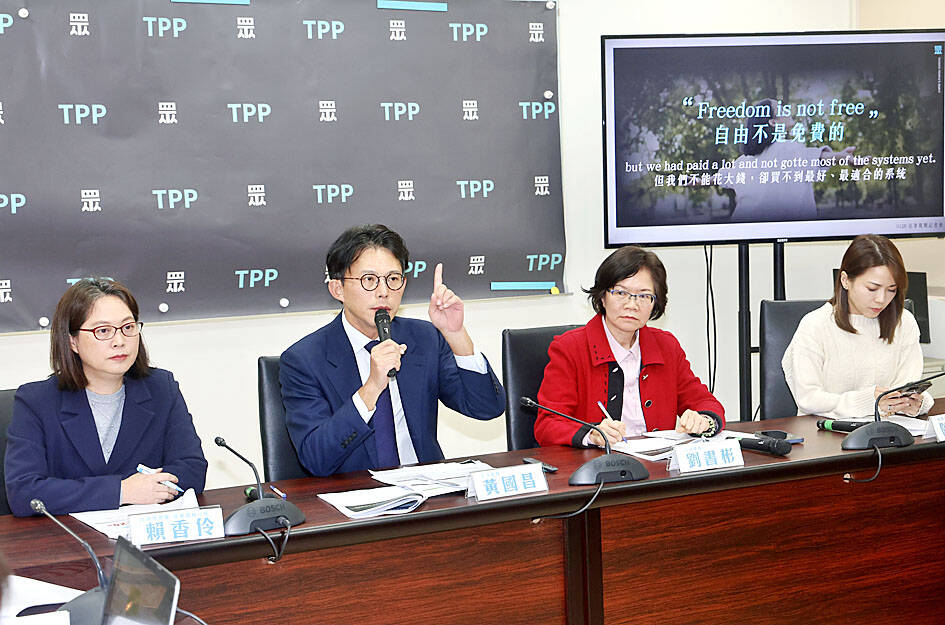
Photo: CNA
Within the NT$400 billion ceiling, the TPP proposal includes an additional NT$88.1 billion to address government assessments of urgent needs to rapidly enhance combat capabilities, which could be used upon obtaining consent from foreign governments.
TPP caucus director Vicky Chen (陳智菡) said the proposal focuses on clearly itemizing procurement categories, quantities and amounts, rationalizing the scale of the budget, shifting to annual appropriations and requiring regular special reports on procurement progress to enhance oversight and transparency.
“Taiwanese have never regarded freedom as free, but how could national security be strengthened if defense budgets are allocated and paid for while equipment fails to arrive on schedule?” Huang said.
During former president Tsai Ing-wen’s (蔡英文) administration, two special military bills were proposed, including a NT$247.2 billion special budget for F-16V jets, of which NT$143.4 billion was spent but “zero” aircraft were delivered, he said.
“Budget figures alone do not guarantee improvements in combat capability. Arms procurement should be handled in a strategic and militarily professional way to ensure stable policy direction and force development,” Huang said.
Security conditions in the Taiwan Strait have deteriorated in the past few years, with China continuing to exert institutionalized and routine military pressure on Taiwan through joint exercises, live-fire drills and “gray zone” operations, he said.
“In the face of complex threats, building a defense system with effective deterrence, dispersed survivability and sustainable combat capabilities has become an urgent task for Taiwan’s defense policy,” Huang said.
The TPP proposal seeks to ensure that every dollar of defense spending aligns with strategic objectives, effectiveness assessments and democratic deliberation, he said.
Democratic Progressive Party (DPP) caucus chief executive Chung Chia-pin (鍾佳濱) yesterday said that defense procurement is a highly classified administrative process that must be led through negotiations among executive agencies.
As such, it is essentially impossible for any political party or the legislature to independently propose a special military procurement budget, he said, adding that the DPP caucus believes deliberations should be based on the Executive Yuan’s version and subjected to legislative scrutiny.
Separately, the Institute for National Defense and Security Research’s Division of Defense Strategy and Resources director Su Tzu-yun (蘇紫雲) said lawmakers have the right to express differing views, but those views must be grounded in fact.
The NT$1.25 trillion special defense budget proposed by the Ministry of National Defense and the Executive Yuan was calculated through discussions with the US Defense Security Cooperation Agency and falls under the Monterey Strategic Dialogue framework, he said.
The opposition party’s proposal was relatively rough, and not coordinated with the US executive branch, he said, adding that it should be regarded only as reference material or expressions of opinion.
Additional reporting by Lin Che-yuan and Chen Yu-fu

Yangmingshan National Park authorities yesterday urged visitors to respect public spaces and obey the law after a couple was caught on a camera livestream having sex at the park’s Qingtiangang (擎天崗) earlier in the day. The Shilin Police Precinct in Taipei said it has identified a suspect and his vehicle registration number, and would summon him for questioning. The case would be handled in accordance with public indecency charges, it added. The couple entered the park at about 11pm on Thursday and began fooling around by 1am yesterday, the police said, adding that the two were unaware of the park’s all-day live
Fast food chain McDonald's is to raise prices by up to NT$5 on some products at its restaurants across Taiwan, starting on Wednesday next week, the company announced today. The prices of all extra value meals and sharing boxes are to increase by NT$5, while breakfast combos and creamy corn soup would go up by NT$3, the company said in a statement. The price of the main items of those meals, if ordered individually, would remain the same. Meanwhile, the price of a medium-sized lemon iced tea and hot cappuccino would rise by NT$3, extra dipping sauces for chicken nuggets would go up

Yangmingshan National Park’s Qingtiangang (擎天崗) nature area has gone viral after a park livestream camera observed a couple in the throes of intimate congress, which was broadcast live on YouTube, drawing large late-night crowds and sparking a backlash over noise, bright lights and disruption to wildlife habitat. The area’s livestream footage appeared to show a couple engaging in sexual activity on a picnic table in the park on Friday last week, with the uncensored footage streamed publicly online. The footage quickly spread across social media, prompting a tide of visitors to travel to the site to “check in” and recreate the

Minister of Digital Affairs Lin Yi-ching (林宜敬) yesterday cited regulatory issues and national security concerns as an expert said that Taiwan is among the few Asian regions without Starlink. Lin made the remarks on Facebook after funP Innovation Group chief executive officer Nathan Chiu (邱繼弘) on Friday said Taiwan and four other countries in Asia — China, North Korea, Afghanistan and Syria — have no access to Starlink. Starlink has become available in 166 countries worldwide, including Ukraine, Malaysia, the Philippines and Vietnam, in the six years since it became commercial, he said. While China and North Korea block Starlink, Syria is not


 RSS
RSS