


The High Prosecutors' Office today indicted retired Cabinet official Hu Peng-nien (胡鵬年) and businessman Cheng Ming-chia (鄭明嘉) for cooperating with the Chinese Communist Party’s (CCP) United Front Work Department to establish organizations in Taiwan.
The Taiwan High Court ruled to continue holding the two incommunicado, after they were first detained in late September last year.
The office after completing its investigation indicted the two for contravening the National Security Act (國家安全法) by developing organizations for China.
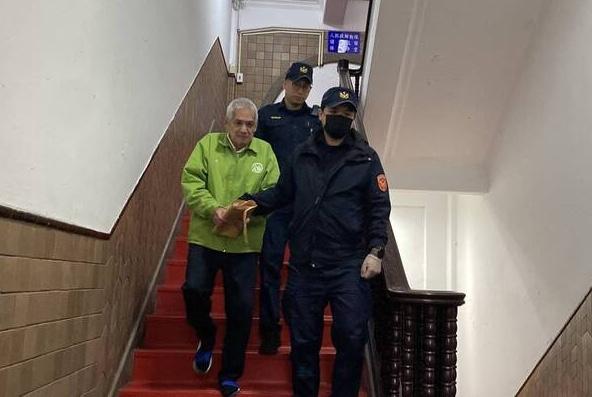
Photo: Yang Hsin-huei, Taipei Times
Prosecutors said they are recommending a heavier sentencing of at least 10 years in prison for Cheng, who has denied all wrongdoing, while seeking a lighter sentence for Hu, who has confessed to the crimes.
Cheng, who has long conducted business in China, previously held a key position in an organization affiliated with the CCP’s United Front Work Department, they said.
He was also a former non-voting attendee of the Guangzhou Municipal Committee of the Chinese People’s Political Consultative Conference, a political advisory body of the CCP, they said.
To protect the interests of his businesses in China, Cheng recruited Hu, who had taken a teaching position in China in 2021, to receive instructions directly from CCP Taiwan-affairs personnel to recruit targets in Taiwan, they added.
Hu and Cheng allegedly attempted to recruit active and retired military personnel and political figures to obtain classified military information, they said.
Hu further targeted young political figures across party lines, seeking to obtain internal and confidential information from government agencies and representative bodies, the investigation found.
The case shows the CCP’s intelligence-gathering operations have expanded from military personnel to the next generation of politicians, with methods continuing to evolve, the Ministry of Justice’s Investigation Bureau said.
Prosecutors and investigators launched multiple search operations and summons beginning in September last year, detaining Hu and Cheng incommunicado.
Cheng and Hu repeatedly returned to Taiwan to develop their espionage network, contacting village chiefs, retired civil servants and defense contractors, the investigation found.
They arranged for those people to travel to China for vetting purposes and to be assigned tasks by the CCP, it found.
Although most of their recruitment attempts proved unsuccessful, they still posed a serious threat to national security, prosecutors said.

SECURITY: Starlink owner Elon Musk has taken pro-Beijing positions, and allowing pro-China companies to control Taiwan’s critical infrastructure is risky, a legislator said Starlink was reluctant to offer services in Taiwan because of the nation’s extremely high penetration rates in 4G and 5G services, the Ministry of Digital Affairs said yesterday. The ministry made the comments at a meeting of the legislature’s Transportation Committee, which reviewed amendments to Article 36 of the Telecommunications Management Act (電信管理法). Article 36 bans foreigners from holding more than 49 percent of shares in public telecommunications networks, while shares foreigners directly and indirectly hold are also capped at 60 percent of the total, unless specified otherwise by law. The amendments, sponsored by Chinese Nationalist Party (KMT) Legislator Ko

The eastern extension of the Taipei MRT Red Line could begin operations as early as late June, the Taipei Department of Rapid Transit Systems said yesterday. Taipei Rapid Transit Corp said it is considering offering one month of free rides on the new section to mark its opening. Construction progress on the 1.4km extension, which is to run from the current terminal Xiangshan Station to a new eastern terminal, Guangci/Fengtian Temple Station, was 90.6 percent complete by the end of last month, the department said in a report to the Taipei City Council's Transportation Committee. While construction began in October 2016 with an
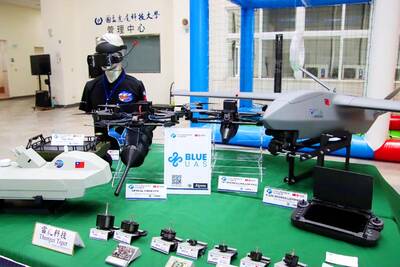
NON-RED SUPPLY: Boosting the nation’s drone industry is becoming increasingly urgent as China’s UAV dominance could become an issue in a crisis, an analyst said Taiwan’s drone exports to Europe grew 41.7-fold from 2024 to last year, with demand from Ukraine’s fight against Russian aggression the most likely driver of growth, a study showed. The Institute for Democracy, Society and Emerging Technology (DSET) in a statement on Wednesday said it found that many of Taiwan’s uncrewed aerial vehicle (UAV) sales were from Poland and the Czech Republic. These countries likely transferred the drones to Ukraine to aid it in its fight against the Russian invasion that started in 2022, it said. Despite the gains, Taiwan is not the dominant drone exporter to these markets, ranking second and fourth

The military has spotted two Chinese warships operating in waters near Penghu County in the Taiwan Strait and sent its own naval and air forces to monitor the vessels, the Ministry of National Defense (MND) said. Beijing sends warships and warplanes into the waters and skies around Taiwan on an almost daily basis, drawing condemnation from Taipei. While the ministry offers daily updates on the locations of Chinese military aircraft, it only rarely gives details of where Chinese warships are operating, generally only when it detects aircraft carriers, as happened last week. A Chinese destroyer and a frigate entered waters to the southwest


 RSS
RSS