


The nation’s first cable-stayed aqueduct bridge has been constructed over the Beigang River (北港溪). It is expected to provide 70 million tonnes of water for irrigation each year by integrating the separate irrigation networks in Yunlin and Chiayi counties and Tainan.
The bridge is the Ministry of Agriculture’s largest construction project in the past five decades, Irrigation Agency Deputy Director Chen Yen-yuan (陳衍源) said yesterday.
It is intended to revitalize the irrigation network across Yunlin County in the north and Chiayi County and Tainan in the south by conveying water between the Jhuoshuei River (濁水溪) and the Zengwen (曾文) and Wushantou (烏山頭) reservoirs — the longest river and the largest reservoir system of Taiwan, he said.
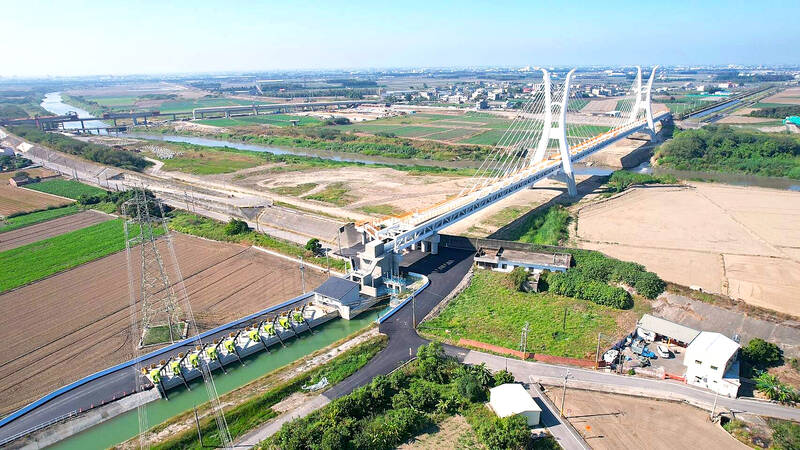
Photo courtesy of the Ministry of Agriculture’s Irrigation Agency
The bridge was constructed to replace an inverted siphon, a
tunnel built beneath the riverbed as part of the Chianan Irrigation Canal (嘉南大圳) system by Japanese civic engineer Yoichi Hatta during the Japanese colonial era, Chen said.
The inverted siphon conveyed water between northern and southern parts of the Chianan Plain, but collapsed from repeated natural disasters, he said.
The agency decided to replace the inverted siphon with an aqueduct bridge, Chen said.
Given that the Beigang River is wide and the water flow could damage a structure, it is designed with only two piers to minimize exposure to floodwaters, with the cable-stay system chosen to provide load distribution and support, he said.
The agency built different segments of the bridge simultaneously and completed the project in only two years, 10 months despite several typhoons, well ahead of the initial projected completion time of five years, Chen said.
The bridge has entered the testing phase and would open once its safety is verified, he said.
“The bridge, along with
surrounding water storage and irrigation facilities, would boost the overall water resource resilience across Yunlin and Chiayi counties and Tainan, as it creates two-way water conveyance,” Chen said.
Water from the Jhuoshuei River could be pumped up to the bridge during the high-flow season and channeled to irrigate southern farmlands on the Chianan Plain (嘉南平原), he said.
Data from the agency showed that the bridge can convey up to 345,000 tonnes of water per day for agricultural use.
The bridge can carry 70 million tonnes of water per year in
conjunction with the belt of retention basins in Yunlin County and the irrigation systems in Chiayi County and Tainan, the agency said.
That significantly reduces irrigation outage risk for about 74,500 hectares of farmland, it said.
The bridge spans 465m across the Beigang River, making it the longest aqueduct bridge in Taiwan, the agency said.
The bridge has bike path connecting to the 105km-long Canal Greenway (水圳綠道), the longest bike trail in Taiwan, allowing people to enjoy the scenery of the plain from the aqueduct bridge, it said.

The military has spotted two Chinese warships operating in waters near Penghu County in the Taiwan Strait and sent its own naval and air forces to monitor the vessels, the Ministry of National Defense (MND) said. Beijing sends warships and warplanes into the waters and skies around Taiwan on an almost daily basis, drawing condemnation from Taipei. While the ministry offers daily updates on the locations of Chinese military aircraft, it only rarely gives details of where Chinese warships are operating, generally only when it detects aircraft carriers, as happened last week. A Chinese destroyer and a frigate entered waters to the southwest

A magnitude 6.1 earthquake struck off the coast of Yilan County at 8:39pm tonight, the Central Weather Administration (CWA) said, with no immediate reports of damage or injuries. The epicenter was 38.7km east-northeast of Yilan County Hall at a focal depth of 98.3km, the CWA’s Seismological Center said. The quake’s maximum intensity, which gauges the actual physical effect of a seismic event, was a level 4 on Taiwan’s 7-tier intensity scale, the center said. That intensity level was recorded in Yilan County’s Nanao Township (南澳), Hsinchu County’s Guansi Township (關西), Nantou County’s Hehuanshan (合歡山) and Hualien County’s Yanliao (鹽寮). An intensity of 3 was

Japanese Prime Minister Sanae Takaichi’s comment last year on Tokyo’s potential reaction to a Taiwan-China conflict has forced Beijing to rewrite its invasion plans, a retired Japanese general said. Takaichi told the Diet on Nov. 7 last year that a Chinese naval blockade or military attack on Taiwan could constitute a “survival-threatening situation” for Japan, potentially allowing Tokyo to exercise its right to collective self-defense. Former Japan Ground Self-Defense Force general Kiyofumi Ogawa said in a recent speech that the remark has been interpreted as meaning Japan could intervene in the early stages of a Taiwan Strait conflict, undermining China’s previous assumptions
Taiwan Railways Corp (TRC) today announced that Shin Kong Mitsukoshi has been selected as the preferred bidder to operate the Taipei Railway Station shopping mall, replacing the current operator, Breeze Development Co Ltd. Among eight qualified firms that delivered presentations and were evaluated by a review committee, Shin Kong Mitsukoshi was ranked first, while Breeze was named the runner-up, the rail company said in a statement. Contract negotiations are to proceed in accordance with regulations, it said, adding that if negotiations with the top bidder fail, it could invite the second-ranked applicant to enter talks. Breeze in a statement today expressed doubts over


 RSS
RSS