


The Legislative Yuan yesterday blocked the review of a Cabinet-proposed NT$1.25 trillion (US$39.6 billion) special defense budget.
An agenda proposed by the ruling Democratic Progressive Party (DPP) caucus containing a special provision on the legal parameters of the budget was voted down by lawmakers from the Chinese Nationalist Party (KMT) and Taiwan People’s Party (TPP), who hold a combined majority in the legislature.
It marked the eighth time that the legislature voted down a motion to review the special budget since President William Lai (賴清德) unveiled it in November.
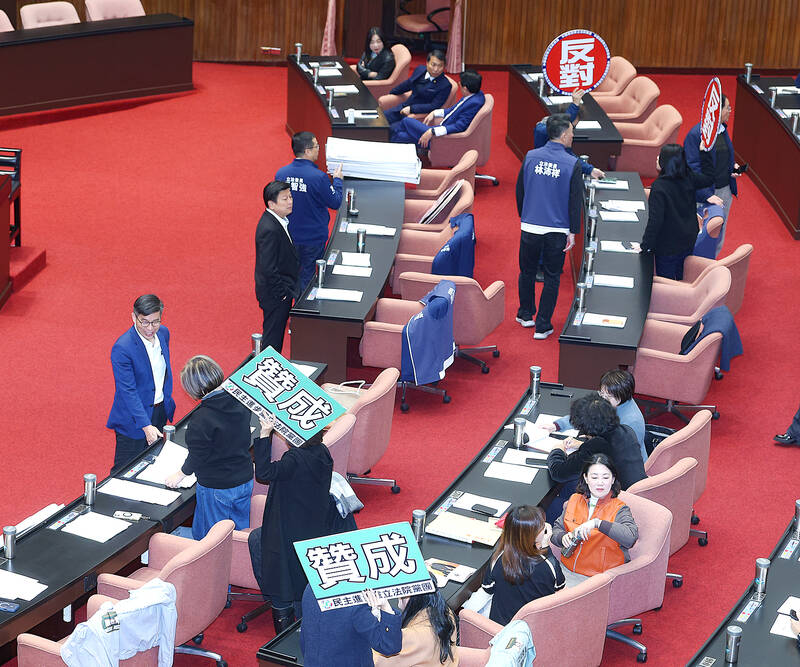
Photo: CNA
The legislature also voted in favor of a motion “advising” Lai to appear before it to address the special defense budget and arms procurement packages, as well as respond to lawmakers’ inquiries.
This would be in line with Lai’s campaign promise that “every president is obligated to deliver state of the nation addresses at the legislature and respond to lawmakers’ inquiries,” a motion submitted by the opposition parties said.
Opposition lawmakers have repeatedly said they would not vote to begin a review of the spending plans until Lai briefs the legislature and responds to inquiries.
The president has rejected the demand, citing an October 2024 Constitutional Court judgement that declared an opposition-backed legal revision mandating the president provide real-time responses to lawmakers’ questions unconstitutional.
At a speech at the government-funded Institute for National Defense and Security Research on Thursday, American Institute in Taiwan Director Raymond Greene invoked the adage that “freedom is not free” when highlighting steps taken by US President Donald Trump’s administration to bolster Taiwan’s defense posture.
“America can only help our friends as much as they help themselves,” Greene said, in an apparent reference to the stalemate over the special budget.
Asked about Greene’s comments, Lai yesterday said that faced with threats posed by China, support for Taiwan’s military is critical, and there is no better support than passing the special defense budget.
“To do a job well, one must first have the right tools,” Lai said, citing a Chinese proverb, urging opposition lawmakers to swiftly vote in favor of initiating proceedings to review the budget.
Responding to Greene’s remarks, KMT caucus secretary-general Lo Chih-chiang (羅智強) said his caucus still wants Lai to first brief the legislature on the “largest-ever” special budget.
TPP Chairman Huang Kuo-chang (黃國昌) said he agreed with Greene’s remarks, adding that this was precisely why Taiwan has committed significant resources to purchasing weapons from the US.
However, spending alone would not strengthen Taiwan’s defense “if the weapons ordered are not delivered,” he said.
The government has rebutted claims that none of the weapons Taiwan has ordered have been delivered.
DPP Secretary-General Hsu Kuo-yung (徐國勇) also reiterated that “freedom is not free” and urged the opposition parties to act as “loyal opposition” so that defense-related budgets could be quickly sent to committee review and discussion.
TPP Secretary-General Chou Yu-hsiu (周榆修) said that “freedom is not free — but neither is it a ‘get-out-of-jail-free card’ that the DPP can price at NT$1.25 trillion with just two A4 pages.”
As an opposition party, the TPP is loyal to the people of Taiwan, he said, adding that if what Hsu meant by “loyal opposition” is giving up oversight and rubber-stamping bloated or inflated budgets, that would be “loyalty to the DPP and to Lai, not loyalty to the nation or the people of Taiwan.”
The TPP supports strengthening national defense and improving military capabilities, but the Lai administration must make its budget transparent and provide a detailed list, he said.
As long as Lai engages in open public debate and convinces most Taiwanese, “the TPP will absolutely support the Executive Yuan’s version of the proposal,” he said.
The DPP has said that transparency and discussion of the budget have been stalled by the opposition’s repeated refusals to include the proposal on the legislative agenda and forward it to committee review.
Additional reporting by Lee Wen-hsin
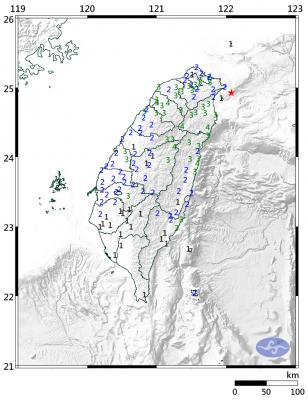
A magnitude 6.1 earthquake struck off the coast of Yilan County at 8:39pm tonight, the Central Weather Administration (CWA) said, with no immediate reports of damage or injuries. The epicenter was 38.7km east-northeast of Yilan County Hall at a focal depth of 98.3km, the CWA’s Seismological Center said. The quake’s maximum intensity, which gauges the actual physical effect of a seismic event, was a level 4 on Taiwan’s 7-tier intensity scale, the center said. That intensity level was recorded in Yilan County’s Nanao Township (南澳), Hsinchu County’s Guansi Township (關西), Nantou County’s Hehuanshan (合歡山) and Hualien County’s Yanliao (鹽寮). An intensity of 3 was
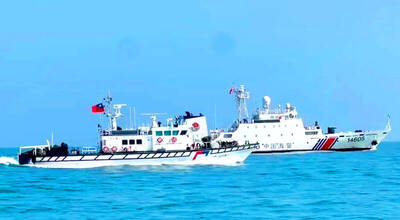
Instead of focusing solely on the threat of a full-scale military invasion, the US and its allies must prepare for a potential Chinese “quarantine” of Taiwan enforced through customs inspections, Stanford University Hoover fellow Eyck Freymann said in a Foreign Affairs article published on Wednesday. China could use various “gray zone” tactics in “reconfiguring the regional and ultimately the global economic order without a war,” said Freymann, who is also a nonresident research fellow at the US Naval War College. China might seize control of Taiwan’s links to the outside world by requiring all flights and ships entering or leaving Taiwan
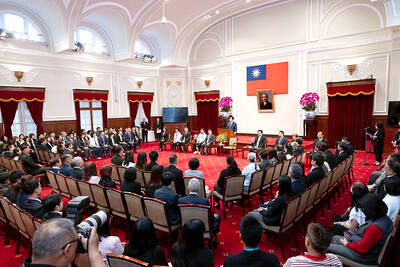
The next minimum wage hike is expected to exceed NT$30,000, President William Lai (賴清德) said yesterday during an award ceremony honoring “model workers,” including migrant workers, at the Presidential Office ahead of Workers’ Day today. Lai said he wished to thank the awardees on behalf of the nation and extend his most sincere respect for their hard work, on which Taiwan’s prosperity has been built. Lai specifically thanked 10 migrant workers selected for the award, saying that although they left their home countries to further their own goals, their efforts have benefited Taiwan as well. The nation’s industrial sector and small businesses lay
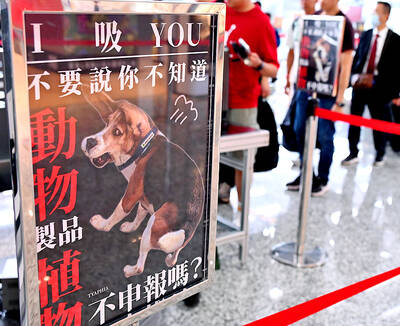
Quarantine awareness posters at Taiwan Taoyuan International Airport have gone viral for their use of wordplay. Issued by the airport branch of the Animal and Plant Health Inspection Agency, the posters feature sniffer dogs making a range of facial expressions, paired with advisory messages built around homophones. “We update the messages for holidays and campaign needs, periodically refreshing materials to attract people’s attention,” quarantine officials said. “The aim is to use the dogs’ appeal to draw focus to quarantine regulations.” A Japanese traveler visiting Taiwan has posted a photo on X of a poster showing a quarantine dog with a


 RSS
RSS