


This year could see the People’s Liberation Army (PLA) undertaking “more aggressive, ambitious operations around Taiwan,” in preparation for Chinese President Xi Jinping’s (習近平) stated goal of the PLA having the capability to take Taiwan by next year, Global Taiwan Institute (GTI) director John Dotson said yesterday.
It is thus the last year for the PRC to reach that capability, said Ann Kowalewski, a senior non-resident fellow at the Washington-based GTI.
The institute yesterday held a panel discussion titled “Looking Ahead for Taiwan Policy in 2026.”
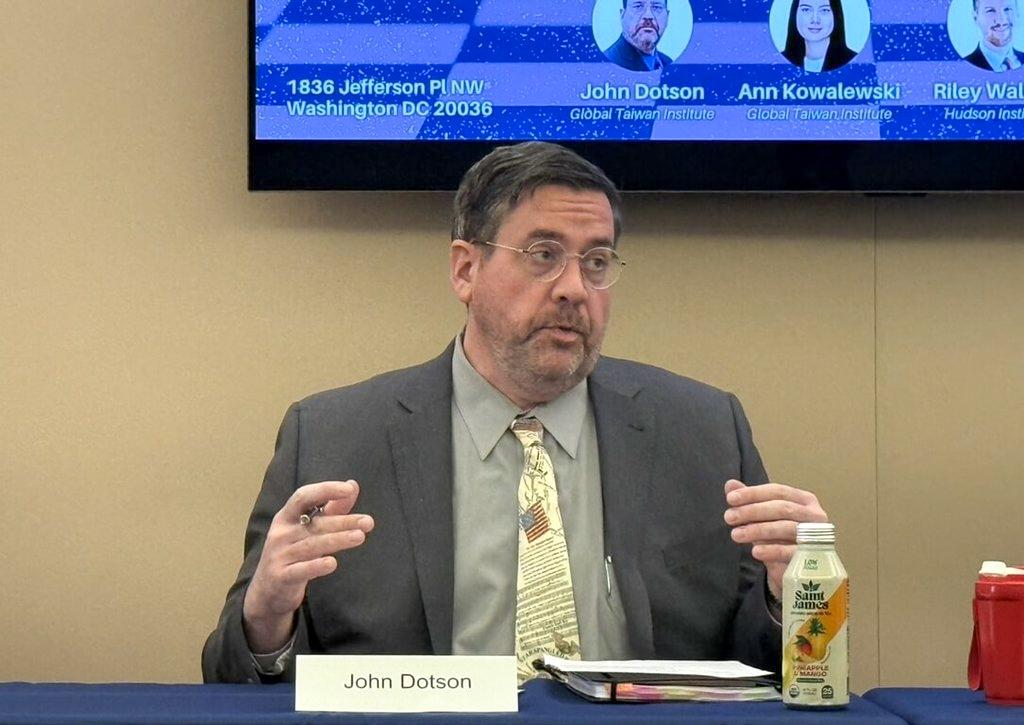
Photo courtesy of the Global Taiwan Institute
Last year saw a mounting escalation in pressure from the People’s Republic of China (PRC) against Taiwan, including the PLA’s “Justice Mission 2025” military exercises conducted around Taiwan in December, the GTI said.
Analysts expect next year to be a flash point in cross-strait relations, after then-US Indo-Pacific Command Admiral Philip Davidson in 2021 warned that Xi had instructed the PLA to be ready to invade Taiwan by 2027.
However, substantial political analysis shows that they are “not quite there yet,” Kowalewski said.
“What we might see is a massive ramp-up this year in PRC military capability,” she said.
It remains unclear whether Taiwan and the US would increase their military capabilities or think through unique postures to ensure they can asymmetrically keep the balance of power in a relatively stable area, she said.
Conversely, at the end of the year, the PRC might have complete military dominance, she added.
An increase in military activity this year by the PLA might try to signal to Xi: “Hey boss, we got the message and look at the cool stuff we can do now,” Dotson said.
Dotson noted last year’s two PLA military exercises, held in April and December, which were conducted toward the south and southeast of Taiwan, in closer and closer proximity to the nation’s main island, and featured more aggressive use of the China Coast Guard.
Deploying the coast guard serves China’s narrative as it can be explained away as law enforcement patrols rather than military incursions, he said.
China gives a “narrative justification” for each of its military exercises, such as blaming a speech by President William Lai (賴清德) on policies to target Chinese infiltration in March or an arms sale package with Washington last month, Dotson said.
He added that he recommends “skepticism” around these narratives, as large-scale exercises are planned out far in advance, but might have their exact dates adjusted to coincide with key events.
Meanwhile, Taiwan has maintained dialogue with Japan and the Philippines, and there is now “more of an opening on [South] Korea-Taiwan than we have seen previously,” Kowalewski said, adding that Seoul “may not want to fight, may not want to get involved in Taiwan.”
However, even if South Korea does not get involved militarily at the outset, its economy would be greatly affected if the waterways around Taiwan become a war zone, so it might have to get involved for its own national security reasons, she said.
Dotson is a former US Navy officer and was a staff member of the US-China Economic and Security Review Commission under the US Congress.
Kowalewski formerly led the Indo-Pacific portfolio as a senior professional staff member of the US House of Representatives Committee on Foreign Affairs.
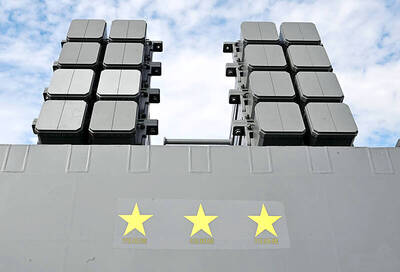
UPGRADE: The Kang Ding-class frigate is replacing its Chaparall missiles with Tien Chien II and Hua Yang VLS, which would provide it with long-range, 360° air defense Taiwan plans to produce 1,200 to 1,376 Hai Chien II missiles (海劍二, Sea Sword II) — also known as TC-2N — to serve as the standard air defense system of the navy’s surface combatant fleet, a source said yesterday. Last week, the Hai Chien II, the naval version of the Tien Kung II missile (天劍二, Sky Sword II), completed a live-fire test in waters off the National Chungshan Institute of Science and Technology’s Jiupeng facility (九鵬) in Pingtung County’s Manjhou Township (滿州). The MIM72 Chaparral and other dated air defense missiles that currently arm Taiwanese ships have inadequate range to combat Chinese

REASONS FOR TRAVEL: An assistant professor said that proposed amendments to penalize drivers if they used drugs overseas would not deter people from traveling People who operate a motor vehicle under the influence of marijuana would have their driver’s license revoked, even if they used the substance while overseas, the Ministry of Transportation and Communications said yesterday, citing proposed amendments to the Road Traffic Management and Penalty Act (道路交通管理處罰條例). The amendments would also authorize the government to revoke the licenses of people determined to have used Category 1 or Category 2 narcotics, even if they were not operating a vehicle while under the influence of drugs, as well as ban them from taking the license test for three years, the ministry said. People aged 18 or

HEAVY WEATHER: Typhoon Jangmi is due to crash straight into the Ryukyus as airlines look to shift flights to larger aircraft or cancel flights to Okinawa entirely Taiwan’s international air carriers announced flight adjustments over the weekend as Typhoon Jangmi is forecast to hit the Ryukyu Islands today and tomorrow. The Central Weather Administration (CWA) upgraded Jangmi from a tropical storm to a typhoon at 8am yesterday, with the eye located 580km south of Naha city. It was moving north at 19kph. Today, China Airlines’ CI-120, CI-121, CI-122 and CI-123 flights between Taoyuan and Naha, Okinawa, have been canceled as well as CI-132 and CI-133 between Kaohsiung and Naha. EVA Air’s BR-112, BR-113, BR-186 and BR-185 flights between Taoyuan and Naha are also canceled. Low-cost carrier Tigerair Taiwan canceled IT-230,
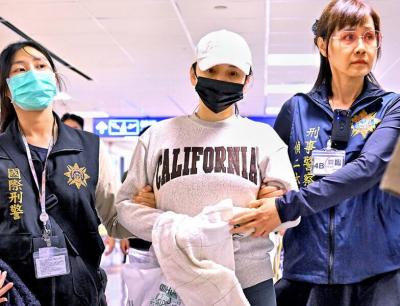
Johanne Liou (劉喬安), a Taiwanese woman who shot to unwanted fame during the Sunflower movement protests in 2014, returned to Taiwan last night after being deported from the US. She is to stand trial in Taiwan for charges involving embezzlement, fraud and drug crimes. The Criminal Investigation Bureau (CIB) said it took her into custody at Taiwan Taoyuan International Airport and would first question her before transferring her to the New Taipei District Prosecutors’ Office. She was arrested upon disembarking a flight from San Francisco that landed shortly before 7pm. Liou absconded to the US in 2019 after jumping bail


 RSS
RSS