


President William Lai (賴清德) today offered talks with Ukraine aimed at cracking down on sanctions-busting activities after Ukrainian President Volodymyr Zelenskiy name-checked Taiwan as a source of illicit missile components.
Since Russia invaded Ukraine in 2022, Taiwan, a global semiconductor powerhouse, has successively updated export controls to stop high-tech goods being used for military purposes and has joined in wide-ranging Western-led sanctions against Moscow.
Speaking in Davos, Switzerland, Zelenskiy yesterday said that Russia would not be able to produce missiles without "critical components sourced from China, Europe, the United States, and Taiwan," excerpts published on the Ukrainian president's Web site showed.
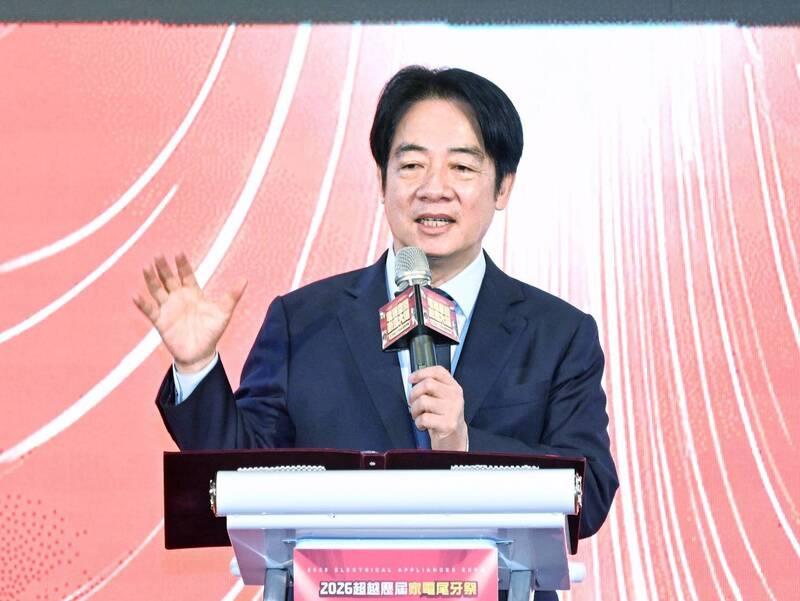
Photo: Fang Pin-chao, Taipei Times
Responding on X in English, Lai said that Taiwan has long worked with global partners to "staunchly support Ukraine through humanitarian aid & coordinated sanctions."
"We welcome further exchanges of information with President @ZelenskyyUa to further clamp down on illegal 3rd country transshipment & concealed end-use," he said, posting a picture of orchids in the color of Ukraine's flag.
"There have been young Taiwanese who have sacrificed their lives to defend freedom in Ukraine," Lai said, referring to volunteer soldiers who have died fighting against Russia.
"We remain clear: any assistance to the aggressor or violations of int'l embargoes & export control regulations are unacceptable. We pray for peace to be restored to Ukraine soon," he said.
Lai today told reporters in Taipei that he welcomed Zelenskiy to pass on any information to Taiwan about sanctions-busting activities.
"We are willing to strengthen controls on goods that are routed through third countries while concealing their final destination, to prevent them from entering Russia and to protect Ukraine," Lai said.
Reuters could not reach the Office of the President of Ukraine for comment outside of office hours.
In November last year, Taiwan said that it was revising export controls to comply with the Wassenaar Arrangement, an international agreement aimed at preventing weapons proliferation, although Taiwan is not a signatory.
While senior Taiwanese officials have spoken directly with some Ukrainian city mayors, there has been no publicly acknowledged direct contact between the two governments.
Taiwan and Ukraine do not have de facto embassies in each other's capitals, and Taiwanese humanitarian aid to Ukraine has mostly been coordinated by Taiwan's diplomatic offices in central and eastern Europe.
Taiwan has compared the Russian invasion of Ukraine to China's military threat against it.
Late last year, a senior Taiwanese military officer told a forum in Poland that if Russia defeats Ukraine it would embolden China in its behavior toward Taiwan and that Taipei hoped Kyiv would emerge victorious.
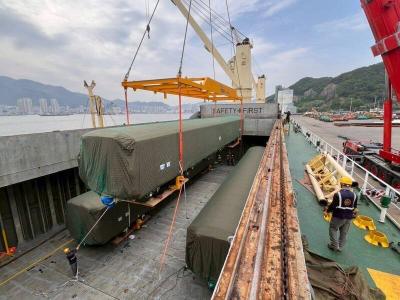
The first of 10 new high-capacity trains purchased from South Korea’s Hyundai Rotem arrived at the Port of Taipei yesterday to meet the demands of an expanding metro network, Taipei Rapid Transit Corp (TRTC) said yesterday. The train completed a three-day, 1,200km voyage from the Port of Masan in South Korea, the company said. Costing NT$590 million (US$18.79 million) each, the new six-carriage trains feature a redesigned interior based on "human-centric" transportation concepts, TRTC said. The design utilizes continuous longitudinal seating to widen the aisles and optimize passenger flow, while also upgrading passenger information displays and driving control systems for a more comfortable
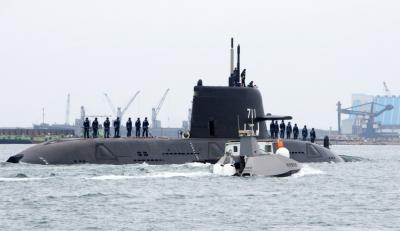
Taiwan's first indigenous defense submarine, the SS-711 Hai Kun (海鯤, or Narwhal), departed for its 13th sea trial at 7am today, marking its seventh submerged test, with delivery to the navy scheduled for July. The outing also marked its first sea deployment since President William Lai (賴清德) boarded the submarine for an inspection on March 19, drawing a crowd of military enthusiasts who gathered to show support. The submarine this morning departed port accompanied by CSBC Corp’s Endeavor Manta (奮進魔鬼魚號) uncrewed surface vessel and a navy M109 assault boat. Amid public interest in key milestones such as torpedo-launching operations and overnight submerged trials,
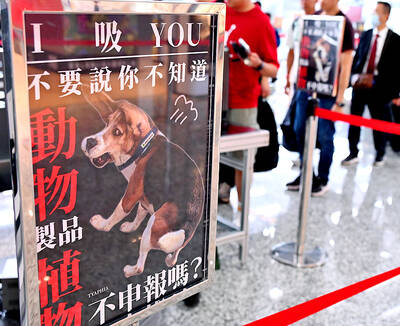
Quarantine awareness posters at Taiwan Taoyuan International Airport have gone viral for their use of wordplay. Issued by the airport branch of the Animal and Plant Health Inspection Agency, the posters feature sniffer dogs making a range of facial expressions, paired with advisory messages built around homophones. “We update the messages for holidays and campaign needs, periodically refreshing materials to attract people’s attention,” quarantine officials said. “The aim is to use the dogs’ appeal to draw focus to quarantine regulations.” A Japanese traveler visiting Taiwan has posted a photo on X of a poster showing a quarantine dog with a
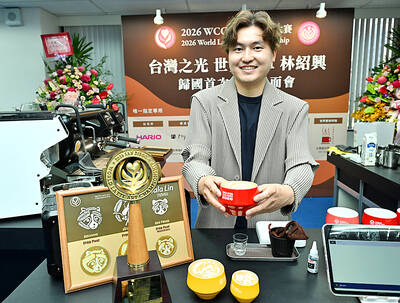
Taiwan’s coffee community has launched a “one-person-one-e-mail” campaign, calling for people to send a protest-e-mail to the World Coffee Championships (WCC) urging it to redesignate Taiwanese competitors as from “Taiwan,” rather than “Chinese Taipei.” The call followed sudden action last week after the WCC changed all references to Taiwanese competitors from “Taiwan” to “Chinese Taipei,” including recent World Latte Art champion Bala (林紹興), who won the World Latte Art Championship in San Diego earlier this month. When Bala received the trophy, he was referred to as representing Taiwan, as well as in the announcement on the WCC’s Web site, until it


 RSS
RSS