


US defense company Northrop Grumman has installed a medium caliber ammunition test range in Taiwan, enabling the Ministry of National Defense to test ammunition to global industry standards, American Institute in Taiwan (AIT) Director Raymond Greene said today.
Greene gave a speech at the Institute for National Defense and Security Research’s “Strengthening Resilience: Defense as the Engine of Development” seminar, titled “Investing Together and a Secure and Prosperous Future.”
The new project would enable advancement of indigenous development projects through the transfer of technology, proprietary procedures and expert training, he said.
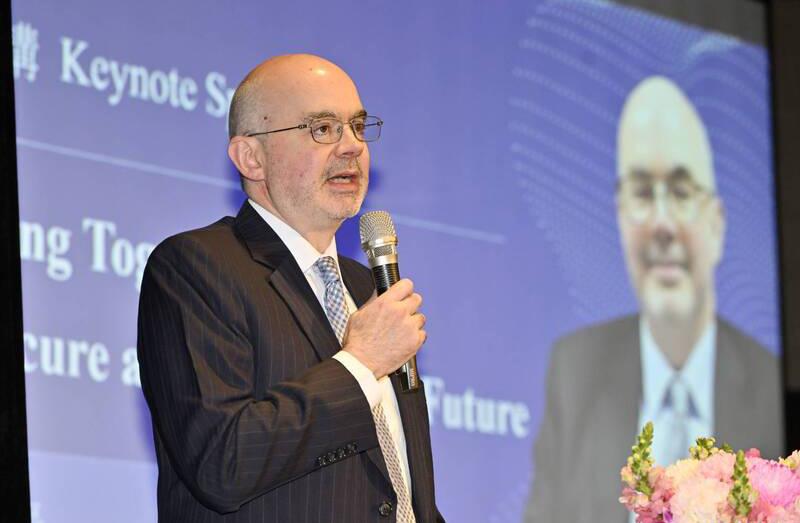
Photo: Tien Yu-hua, Taipei Times
Meanwhile, Anduril Industries has implemented a strategic supply chain initiative in Taiwan to find multi-source suppliers for key components, he said.
That would enhance global supply chain resilience across products such as the Ghost-X UAS, which is sold to the US and international partners, he said.
Shield AI has also invested heavily in Taiwan’s supply chain, buying and utilizing tens of millions of Taiwanese components and products, and has formally teamed up with Aerospace Industrial Development Corp, Taiwan’s largest prime contractor, he added.
Greene highlighted the US President Donald Trump administration’s contributions to Taiwan’s defense efforts, including the establishment of supply chains for drones and autonomous systems, offers of security assistance and the expansion of domestic defense industrial bases.
“We will steadfastly stand by our allies and partners to protect their freedom and promote their security,” he said, “However, freedom is not free. America can only help our friends as much as they help themselves.”
Although Trump’s National Security Strategy assures the US “is committed to maintaining the military capacity to deny aggression anywhere in the first island chain,” the US “should not bear this burden alone,” Greene said.
In the field of artificial intelligence (AI), the US is the world leader in research and development, innovation and applications, while Taiwan provides the manufacturing and hardware backbone, he said.
Combining the two complementary capabilities would develop edge computing and embodied AI applications for drones, command and control, air defense and other platforms that can further revolutionize deterrence, he said.
Greene also noted Taiwan’s most recent contributions to its own defense, including President William Lai’s (賴清德) NT$1.25 trillion (US$39.5 billion) special defense budget and his pledge to increase defense spending to 5 percent of GDP by 2030.
He referenced last summer’s Han Kuang drills, an extension in compulsory military service from four months to 12 months and the implementation of Lai’s whole-of-society resilience strategy.
Greene also spoke of the commitment of Taiwanese to preserving peace and preparing for conflict, showcased in last year’s urban resilience drills and by the tens of thousands of volunteers who helped communities in Hualien affected by floods last year.
Moreover, polls show that more of the Taiwanese public says they are willing to defend their homeland today than Ukrainians did when asked before February 2022, Greene said.
“Working together, I am confident [Taiwan-US] collaboration will benefit the people of the United States, Taiwan and the rest of the world,” he said.
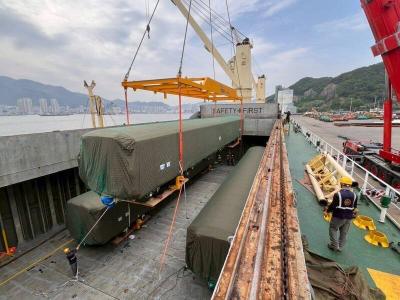
The first of 10 new high-capacity trains purchased from South Korea’s Hyundai Rotem arrived at the Port of Taipei yesterday to meet the demands of an expanding metro network, Taipei Rapid Transit Corp (TRTC) said yesterday. The train completed a three-day, 1,200km voyage from the Port of Masan in South Korea, the company said. Costing NT$590 million (US$18.79 million) each, the new six-carriage trains feature a redesigned interior based on "human-centric" transportation concepts, TRTC said. The design utilizes continuous longitudinal seating to widen the aisles and optimize passenger flow, while also upgrading passenger information displays and driving control systems for a more comfortable
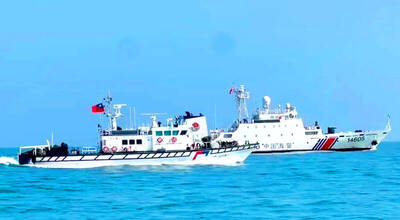
Instead of focusing solely on the threat of a full-scale military invasion, the US and its allies must prepare for a potential Chinese “quarantine” of Taiwan enforced through customs inspections, Stanford University Hoover fellow Eyck Freymann said in a Foreign Affairs article published on Wednesday. China could use various “gray zone” tactics in “reconfiguring the regional and ultimately the global economic order without a war,” said Freymann, who is also a nonresident research fellow at the US Naval War College. China might seize control of Taiwan’s links to the outside world by requiring all flights and ships entering or leaving Taiwan
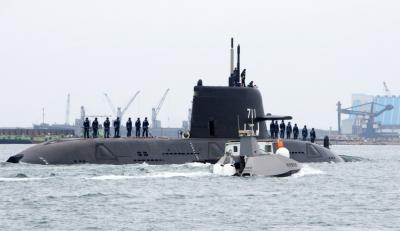
Taiwan's first indigenous defense submarine, the SS-711 Hai Kun (海鯤, or Narwhal), departed for its 13th sea trial at 7am today, marking its seventh submerged test, with delivery to the navy scheduled for July. The outing also marked its first sea deployment since President William Lai (賴清德) boarded the submarine for an inspection on March 19, drawing a crowd of military enthusiasts who gathered to show support. The submarine this morning departed port accompanied by CSBC Corp’s Endeavor Manta (奮進魔鬼魚號) uncrewed surface vessel and a navy M109 assault boat. Amid public interest in key milestones such as torpedo-launching operations and overnight submerged trials,
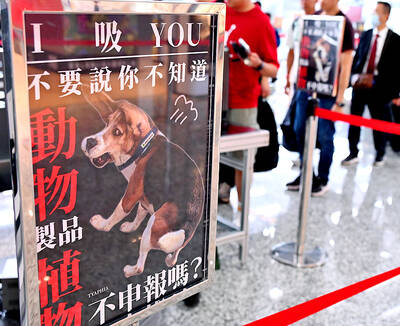
Quarantine awareness posters at Taiwan Taoyuan International Airport have gone viral for their use of wordplay. Issued by the airport branch of the Animal and Plant Health Inspection Agency, the posters feature sniffer dogs making a range of facial expressions, paired with advisory messages built around homophones. “We update the messages for holidays and campaign needs, periodically refreshing materials to attract people’s attention,” quarantine officials said. “The aim is to use the dogs’ appeal to draw focus to quarantine regulations.” A Japanese traveler visiting Taiwan has posted a photo on X of a poster showing a quarantine dog with a


 RSS
RSS