


The Central Weather Administration (CWA) today issued low-temperature alerts for 10 cities and counties across Taiwan amid a strong continental cold air mass that is to grip much of Taiwan through Friday.
The CWA issued an orange low-temperature alert for areas north of Hsinchu, including New Taipei City, Keelung, Taipei, Taoyuan and Hsinchu County, indicating that they could see sustained temperatures of about 10°C or lower.
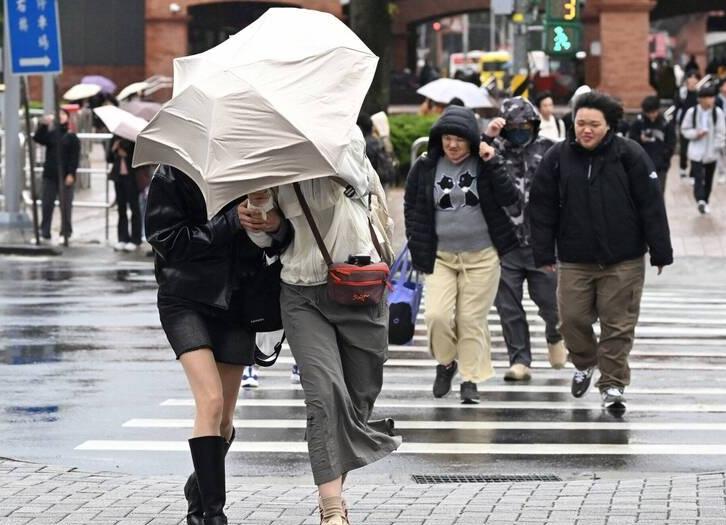
Photo: Taipei Times
A yellow alert was issued for Miaoli, Nantou, Yunlin and Chiayi counties and the outlying Kinmen County, indicating that temperatures in low-lying areas could dip below 10°C.
The lowest temperature recorded in low-lying areas of Taiwan (excluding its outlying counties) early today was 8.9°C in Gukeng Township (古坑) in Yunlin County, followed by 9.2°C in Shihmen District (石門) in New Taipei City, CWA data showed.
The CWA also issued a heavy rain advisory, saying localized heavy rainfall is likely along the Keelung coast and in mountainous parts of Taipei and New Taipei City through this evening due to prevailing northeasterly winds.
The agency warned of strong northeasterly winds from this morning through tomorrow in parts of western, southern and eastern Taiwan, with sustained winds of 41kph to 51kph or gusts of up to 63kph to 75kph.
Independent meteorologist Wu De-rong (吳德榮), an adjunct associate professor at National Central University's Department of Atmospheric Sciences, said the latest European model simulations show cold air is to dominate weather conditions until Friday.
Northern Taiwan would remain cold and damp today and tomorrow, with occasional rain, while snowfall is possible in mountainous areas above 2,000m, Wu said.
Conditions in northern Taiwan are expected to turn mostly cloudy starting on Friday, while eastern Taiwan may still see sporadic showers, Wu said.
Central and southern Taiwan would be partly cloudy to sunny through Friday, with cool daytime temperatures and cold mornings and evenings, Wu said, adding that the lowest temperatures in low-lying areas could drop to about 8°C.
Looking ahead, Wu said models indicate generally stable weather from Saturday to Tuesday next week, with temperatures gradually rising.
Weaker northeasterly winds would then move south from Tuesday to Friday, bringing cooler temperatures and rain to northern and eastern Taiwan, Wu said.

LOUD AND PROUD Taiwan might have taken a drubbing against Australia and Japan, but you might not know it from the enthusiasm and numbers of the fans Taiwan might not be expected to win the World Baseball Classic (WBC) but their fans are making their presence felt in Tokyo, with tens of thousands decked out in the team’s blue, blowing horns and singing songs. Taiwanese fans have packed out the Tokyo Dome for all three of their games so far and even threatened to drown out home team supporters when their team played Japan on Friday. They blew trumpets, chanted for their favorite players and had their own cheerleading squad who dance on a stage during the game. The team struggled to match that exuberance on the field, with

Taiwanese paleontologists have discovered fossil evidence that pythons up to 4m long inhabited Taiwan during the Pleistocene epoch, reporting their findings in the international scientific journal Historical Biology. National Taiwan University (NTU) Institute of Ecology and Evolutionary Biology associate professor Tsai Cheng-hsiu (蔡政修) led the team that discovered the largest snake fossil ever found in Taiwan. The single trunk vertebra was discovered in Tainan at the Chiting Formation, dated to between 400,000 and 800,000 years ago in the Middle Pleistocene, the paper said. The area also produced Taiwan’s first avian fossil, as well as crocodile, mammoth, saber-toothed cat and rhinoceros fossils, it said. Discoveries

Taiwanese paleontologists have discovered fossil evidence that pythons up to 4m long inhabited Taiwan during the Pleistocene epoch, reporting their findings in the international scientific journal Historical Biology. National Taiwan University (NTU) Institute of Ecology and Evolutionary Biology associate professor Tsai Cheng-hsiu (蔡政修) led the team that discovered the largest snake fossil ever found in Taiwan. A single trunk vertebra was discovered in Tainan at the Chiting Formation, dated to between 800,000 to 400,000 years ago in the Middle Pleistocene, the paper said. The area also produced Taiwan’s first avian fossil, as well as crocodile, mammoth, sabre-toothed cat and rhinoceros fossils, it said. Discoveries

Whether Japan would help defend Taiwan in case of a cross-strait conflict would depend on the US and the extent to which Japan would be allowed to act under the US-Japan Security Treaty, former Japanese minister of defense Satoshi Morimoto said. As China has not given up on the idea of invading Taiwan by force, to what extent Japan could support US military action would hinge on Washington’s intention and its negotiation with Tokyo, Morimoto said in an interview with the Liberty Times (sister paper of the Taipei Times) yesterday. There has to be sufficient mutual recognition of how Japan could provide


 RSS
RSS