


Media personality and politician Jaw Shaw-kong (趙少康) has been given a suspended sentence on charges related to his display of a marked ballot during a recall vote in July last year.
In a ruling issued this morning, the Taipei District Court sentenced Jaw to 55 days in prison, commutable to a fine and suspended for two years, for contraventions of the Public Officials Election and Recall Act (公職人員選舉罷免法).
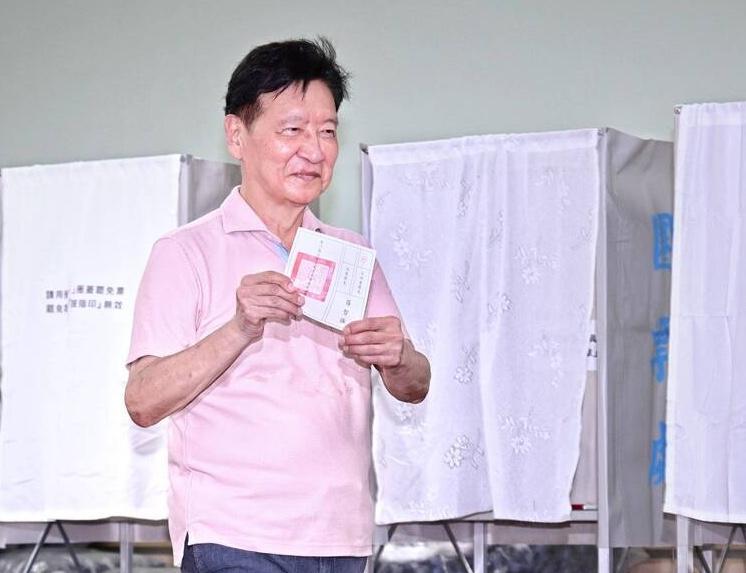
Photo: Taipei Times
Jaw must also pay a fine of NT$50,000 under the ruling, which can be appealed.
The court has yet to release the full ruling explaining how it determined Jaw's guilt and decided on a sentence.
Jaw, a former Chinese Nationalist Party (KMT) lawmaker and government minister, was indicted by Taipei prosecutors in November for displaying his marked ballot to reporters at a polling station in Taipei's Daan District (大安).
He was casting a ballot in one of several votes on July 26 last year that sought to recall various KMT lawmakers and one city mayor. None of the recall initiatives succeeded.
In the indictment, prosecutors said Jaw had been warned by election workers not to show his marked ballot, but he went ahead and displayed it briefly so it could be photographed by the media, before dropping it into the ballot box.
The public display of a marked ballot is a contravention of election laws and carries a maximum penalty of two years in prison or a fine of up to NT$200,000, prosecutors said, citing articles 88 and 105 of the Public Officials Election and Recall Act.
Jaw's actions at the polling station were reported to the police, and on Sept. 23, he was summoned for questioning.
He later apologized and told reporters that he had displayed his ballot merely to show that he had voted but not to display his vote.
He said the case was a needless hassle and a waste of judicial resources.
Jaw, a former chairman of the Broadcasting Corp of China, served as a KMT lawmaker and as environmental minister from the late 1980s to the early 1990s.
Over the years, he has remained a prominent voice in Taiwan's media and politics, and he ran unsuccessfully on the KMT ticket for vice president in 2024.

FUKUOKA SITUATION: Japanese media reported that the pathogen is expected to be identified by the summer, while the CDC downplayed the idea that it was hMPV A “mysterious cold-like illness” reported in Japan’s Fukuoka Prefecture does not seem to be a new disease, but Japanese authorities have been asked about the situation, the Centers for Disease Control (CDC) said yesterday. The Fukuoka Prefectural Medical Association on Wednesday told a news conference that a “mystery cold” that has become a hot topic on social media is “highly likely to be caused by some kind of viral infection,” Japan’s KBC News reported. “Many people are experiencing symptoms starting with a sore throat, followed by a runny nose, phlegm and a severe cough,” KBC News reported, citing association officials. Health authorities are

Nvidia Corp CEO Jensen Huang (黃仁勳) arrived in Taiwan yesterday ahead of upcoming AI and technology events, saying he plans to meet with clients and Taiwan Semiconductor Manufacturing Co Chairman C.C. Wei (魏哲家) during his visit. After landing at Taipei Songshan Airport, Huang posed for photos with fans and handed out Yakult drinks to reporters and supporters waiting at the scene, saying he has “a lot to do” during the trip. Asked about reports that Nvidia’s planned headquarters site in Taipei’s Beitou Shilin Technology Park could break ground on May 27, Huang said that if the company holds an event, he would

Carrefour Taiwan is to begin using a new name from the start of July, but it cannot divulge the name until then, the chairman of the supermarket chain's parent company said today. President Chain Store Co chairman Lo Chih-hsien (羅智先) was asked by reporters after a shareholders' meeting to confirm whether the company has settled on a new name for the supermarket brand. In March, the government-registered name of two Carrefour Taiwan branches was quietly changed to "Le Chia Kang" (樂家康) in Chinese, raising speculation that has been selected as the name. Lo said that because of local regulations and contractual obligations, the
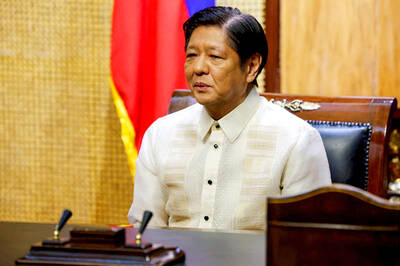
The Philippines would likely be involved in any conflict over Taiwan due to its proximity to the democracy claimed by China, President Ferdinand Marcos Jr said, reiterating a stance that risks angering Beijing. “In the Philippines, we do not have a choice because Taiwan is so close to the Philippines and we have almost 200,000 Filipino nationals living and working in Taiwan,” Marcos said in an interview with Japanese media in Manila on Monday. The Philippine leader’s comments come ahead of a state visit to Japan next week, where he is to meet with Japanese Prime Minister Sanae Takaichi to discuss security


 RSS
RSS