

Premier Cho Jung-tai (卓榮泰) yesterday greeted the nation’s US trade negotiation team when they arrived at Taiwan Taoyuan International Airport, commending them for the tariff reduction and investment agreements they reached with the US.
Led by Vice Premier Cheng Li-chiun (鄭麗君), and chief trade negotiator and Minister Without Portfolio Yang Jen-ni (楊珍妮), the team hashed out a “substantive” and “meaningful” deal with Washington, which was announced on Thursday, Cho told reporters at the airport.
Cheng said the trade agreement proved that “the hard work of the Taiwanese people, along with Taiwan’s technology and industries, had become a key force in the world,” and showed that the world needs Taiwan.
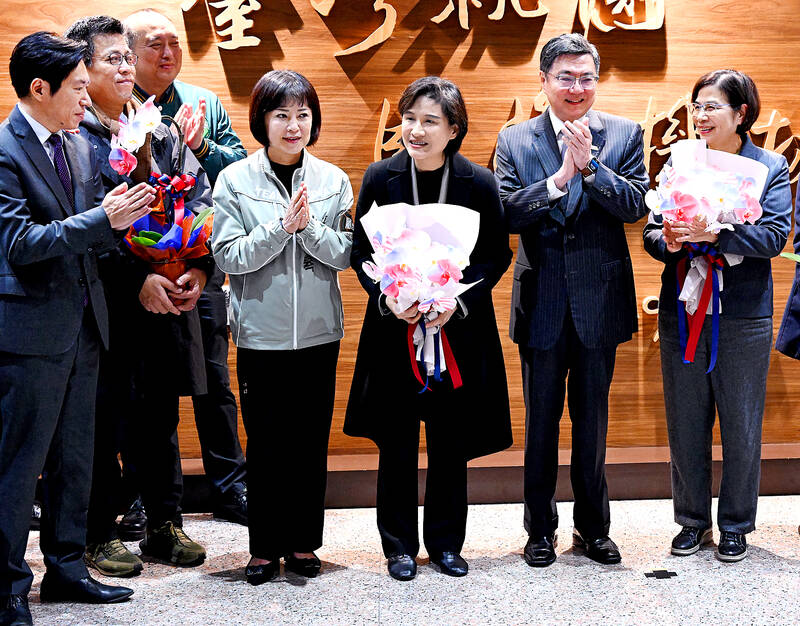
Photo: Chu Pei-hsiung, Taipei Times
The trade negotiation team returned after reaching a preliminary agreement with the US to reduce tariffs on Taiwanese goods to 15 percent, and a commitment that Taiwanese semiconductor and technology companies would invest at least US$250 billion in the US.
The figure includes a US$100 billion investment pledge by Taiwan Semiconductor Manufacturing Co (TSMC) last year, weeks after US President Donald Trump took office, US Secretary of Commerce Howard Lutnick said on Friday.
That implied that TSMC’s US$65 billion investment to build three advanced wafer fabs in Arizona prior to Trump’s return to office last year was not taken into account.
Taiwan has also agreed to provide up to US$250 billion in credit guarantees for financial institutions to support investments in the US market by the semiconductor industry, and the information and communication technology sector.
The terms of the agreement are to be signed in the coming weeks as part of a formal trade pact, which would require the approval of the Legislative Yuan.
Reactions to the agreement have been mixed, with some welcoming the tariff reduction from 20 percent to 15 percent — the same rate applied to Japan, South Korea and the EU. However, others — including members of the opposition — have raised concerns that the deal could force companies such as TSMC to move too much of their production abroad, effectively “hollowing out” Taiwan.
The agreement does not include a timetable for when Taiwan’s investments must be realized.
TSMC chief financial officer Wendell Huang (黃仁昭) said the company was accelerating its investments in Arizona because of high customer demand.
Even with its growing presence in the US, TSMC’s most cutting-edge technology would remain in Taiwan for “practical reasons,” Huang said, citing the intensive collaboration process between the company’s research and development team and operations units.
A total of 400 foreign “high- level” professionals have been naturalized as Republic of China (Taiwan) citizens over the past decade as the government has eased nationality rules to attract talent from a wider range of fields, the Ministry of the Interior said yesterday. The 400th high-level professional, who works in the electronics industry, was approved for ROC citizenship on Aug. 26, the MOI said. The MOI quoted the newly naturalized citizen as saying that Taiwan is a leader in fields such as semiconductors, electronics manufacturing, artificial intelligence development and energy technology. He also said
A Chinese military drone was spotted conducting reconnaissance off Taitung County as President William Lai (賴清德) visited Pingtung County this morning to inspect a drill of the armed forces’ precision-strike capabilities, prompting the military to closely monitor its actions. Today was the final day of a three-day military exercise at Jioupeng Base (九鵬基地) to test the joint combat capabilities of the armed forces and coast guard. The exercise began on Wednesday simulating air defense interception and yesterday tested long-range strike capabilities and new air defense weapons. This morning, the military conducted a final exercise involving air defense, anti-ship and drone operations. Military sources said

OCT. 31: The antiviral drugs Tamiflu and Eraflu have been distributed to about 4,000 medical facilities nationwide for people in seven groups who develop flu-like symptoms As the domestic influenza epidemic enters its peak season and continues to escalate, the Centers for Disease Control (CDC) yesterday announced that publicly funded influenza antiviral drugs for seven eligible groups have been extended to Oct. 31, allowing those who develop flu-like symptoms to receive the medication without undergoing a rapid influenza test. The CDC has extended the expanded use of flu antiviral drugs to seven groups: healthcare and influenza-prevention personnel; residents and staff at nursing homes, long-term care facilities and similar institutions; kindergarten and daycare workers and home-based caregivers; students from kindergarten through high school, vocational high school and the
China has warned that it could cancel a planned US-China leaders’ summit if Washington approves new arms sales to Taiwan, a Japanese media outlet quoted sources as saying yesterday. US President Donald Trump, “apparently eager to showcase some diplomatic achievements ahead of November’s midterm congressional elections, places great importance on holding the summit with Chinese President Xi Jinping (習近平),” Japan’s Kyodo News reported. “While preparing for Xi’s upcoming trip, China has restated its position that the Taiwan issue is a ‘red line’ in bilateral relations,” the report said. The report said that when Xi met with Trump in Beijing in May, Xi said


 RSS
RSS