


The government will continue to promote amendments to the Animal Protection Act (動物保護法) as well as encourage “adopt, don’t shop” and “zero pet abandonment” policies, President William Lai (賴清德) said at a pet gathering yesterday.
In his address at the Dogs and Cats Carnival, Lai said that the number of cats and dogs owned by people in Taiwan was more than 3.4 million last year, surpassing the number of children aged 14 or younger.
While highlighting the issue of Taiwan’s declining birthrate, Lai added that the government would nevertheless support people’s love for animals, as valuing life and protecting animals is a hallmark of a civilized society.

Photo: George Tsorng, Taipei Times
The Department of Animal Welfare, which was established under the Ministry of Agriculture (MOA) two years ago, is dedicated to collaboration with civic groups on animal welfare promotion.
The government has also launched a scheme offering non-practice allowance to veterinarians who choose to work in the public sector, marking a milestone in the government’s efforts to retain veterinary talent.
In the draft amendments, Lai outlined the prioritization of managing free-roaming animals, clampdowns on illegal breeding, and humane capture of stray cats and dogs and their sterilization before being released for adoption.
Lai recalled the story of his own adopted dog, Ban-ban (斑斑), from the Pingtung County-based Taiwan Dogs Lover Association, which had a stall at the carnival.
Despite Ban-ban’s missing front left leg, which was amputated after being caught in an animal trap, Ban-ban remains a happy and energetic dog, he said.
Other measures promoted in the bill include strengthening animal registration, conducting regular performance evaluations of animal shelters, banning feeding animals around natural reserves and stiffer penalties for those charged with abusing animals, he added.
Lai said that his background as a doctor continues to drive his sense of responsibility for people’s health, and the MOA is also working with the Ministry of Health and Welfare to enhance prevention of zoonotic diseases, ensuring the health of animals and people.

LOUD AND PROUD Taiwan might have taken a drubbing against Australia and Japan, but you might not know it from the enthusiasm and numbers of the fans Taiwan might not be expected to win the World Baseball Classic (WBC) but their fans are making their presence felt in Tokyo, with tens of thousands decked out in the team’s blue, blowing horns and singing songs. Taiwanese fans have packed out the Tokyo Dome for all three of their games so far and even threatened to drown out home team supporters when their team played Japan on Friday. They blew trumpets, chanted for their favorite players and had their own cheerleading squad who dance on a stage during the game. The team struggled to match that exuberance on the field, with
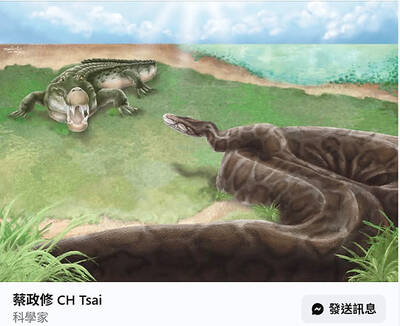
Taiwanese paleontologists have discovered fossil evidence that pythons up to 4m long inhabited Taiwan during the Pleistocene epoch, reporting their findings in the international scientific journal Historical Biology. National Taiwan University (NTU) Institute of Ecology and Evolutionary Biology associate professor Tsai Cheng-hsiu (蔡政修) led the team that discovered the largest snake fossil ever found in Taiwan. The single trunk vertebra was discovered in Tainan at the Chiting Formation, dated to between 400,000 and 800,000 years ago in the Middle Pleistocene, the paper said. The area also produced Taiwan’s first avian fossil, as well as crocodile, mammoth, saber-toothed cat and rhinoceros fossils, it said. Discoveries

Taiwanese paleontologists have discovered fossil evidence that pythons up to 4m long inhabited Taiwan during the Pleistocene epoch, reporting their findings in the international scientific journal Historical Biology. National Taiwan University (NTU) Institute of Ecology and Evolutionary Biology associate professor Tsai Cheng-hsiu (蔡政修) led the team that discovered the largest snake fossil ever found in Taiwan. A single trunk vertebra was discovered in Tainan at the Chiting Formation, dated to between 800,000 to 400,000 years ago in the Middle Pleistocene, the paper said. The area also produced Taiwan’s first avian fossil, as well as crocodile, mammoth, sabre-toothed cat and rhinoceros fossils, it said. Discoveries

Whether Japan would help defend Taiwan in case of a cross-strait conflict would depend on the US and the extent to which Japan would be allowed to act under the US-Japan Security Treaty, former Japanese minister of defense Satoshi Morimoto said. As China has not given up on the idea of invading Taiwan by force, to what extent Japan could support US military action would hinge on Washington’s intention and its negotiation with Tokyo, Morimoto said in an interview with the Liberty Times (sister paper of the Taipei Times) yesterday. There has to be sufficient mutual recognition of how Japan could provide


 RSS
RSS