


The Ministry of Foreign Affairs (MOFA) is planning to establish a representative office in Phoenix, Arizona, with the goal of opening within this year, a source familiar with the issue said yesterday.
The government is preparing to set up a representative office in Phoenix, where Taiwan Semiconductor Manufacturing Co (TSMC) and several other Taiwanese investments are located, the source said.
The ministry is negotiating it with the US government, which has given its initial consent, and efforts are under way to open the office within this year, they added.

Photo courtesy of the Ministry of Foreign Affairs
The government believes that as the US is trying to consolidate its global leadership in artificial intelligence (AI), Taiwan, with its critical role in semiconductor and AI supply chains, the two countries can further deepen their partnership by opening more direct flights or establishing new representative offices, they said.
Such efforts would help Taiwan and the US collaborate and build a “joint fleet,” the source said.
Taiwan has representative offices in Washington, Atlanta, Boston, Chicago, Guam, Honolulu, Houston, Denver, Los Angeles, Miami, San Francisco and Seattle.
The Phoenix office would be the first new office established in the US in nearly 40 years.
US states are also establishing representative offices in Taiwan.
Oklahoma, Tennessee and Iowa last year announced they would open offices in Taiwan. To date, 22 state governments and Guam have set up representative offices in Taiwan.
Minister of Foreign Affairs Lin Chia-lung (林佳龍) revealed the government’s strategic direction during the inaugural flight ceremony for Starlux Airlines’ direct route to Phoenix on Thursday last week.
The ceremony was also attended by American Institute in Taiwan Deputy Director Sandra Oudkirk.
They saw off Phoenix Mayor Kate Gallego as she boarded the first direct flight back to Phoenix.
Lin said he often heard that Taiwanese or TSMC employees in Arizona have two primary wishes: to have direct flights to Taiwan, which has now been fulfilled, and for the ministry to set up a representative office there.
After TSMC set up a manufacturing campus in Phoenix, about 300 babies have been born to TSMC-related employees in Arizona over the past five years, and there is a growing Taiwanese community there, he added.
The ministry would enhance local service capacity to ensure that Taiwanese abroad receive care and support from the government, Lin said, adding that he looked forward to taking the direct flight to visit the Phoenix himself.
Phoenix is one of the TSMC’s most-crucial overseas investment hubs, and demand for business travel, family visits and tourism is expected to continue growing, he said.
Lin said he hoped opening direct commercial flights would encourage Taiwan and the US to come together in building a “joint fleet” to create mutual prosperity while bolstering the overall resilience of the “non-red supply chain.”

FUKUOKA SITUATION: Japanese media reported that the pathogen is expected to be identified by the summer, while the CDC downplayed the idea that it was hMPV A “mysterious cold-like illness” reported in Japan’s Fukuoka Prefecture does not seem to be a new disease, but Japanese authorities have been asked about the situation, the Centers for Disease Control (CDC) said yesterday. The Fukuoka Prefectural Medical Association on Wednesday told a news conference that a “mystery cold” that has become a hot topic on social media is “highly likely to be caused by some kind of viral infection,” Japan’s KBC News reported. “Many people are experiencing symptoms starting with a sore throat, followed by a runny nose, phlegm and a severe cough,” KBC News reported, citing association officials. Health authorities are

Nvidia Corp CEO Jensen Huang (黃仁勳) arrived in Taiwan yesterday ahead of upcoming AI and technology events, saying he plans to meet with clients and Taiwan Semiconductor Manufacturing Co Chairman C.C. Wei (魏哲家) during his visit. After landing at Taipei Songshan Airport, Huang posed for photos with fans and handed out Yakult drinks to reporters and supporters waiting at the scene, saying he has “a lot to do” during the trip. Asked about reports that Nvidia’s planned headquarters site in Taipei’s Beitou Shilin Technology Park could break ground on May 27, Huang said that if the company holds an event, he would

The Ministry of Finance this afternoon announced the winning numbers for the March-April uniform invoice lottery. The winning number for the NT$10 million (US$318,060) special prize is 19531471, and the winning number for the NT$2 million grand prize is 85941329. Three numbers were drawn for the NT$200,000 first prize: 07225810, 20231230 and 83518781. Those with receipts matching the last seven digits of any of the first-prize numbers will win the NT$40,000 second prize, while those matching the last six digits will win the NT$10,000 third prize. Those whose receipts match the last five digits of the first-prize numbers can claim the NT$4,000 fourth prize,
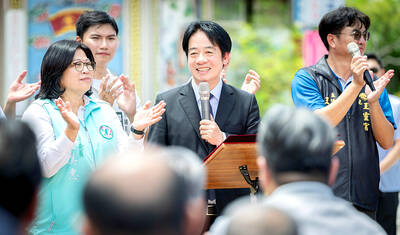
SIX SUBSIDIES: The monthly allowance for older farmers is to increase to NT$10,000, and NT$5,000 is to be given to homemakers under the national pension system, Lai said The government is to implement major welfare policies for disadvantaged groups, including raising the monthly allowance for older farmers to NT$10,000 and providing homemakers with NT$5,000 per month, President William Lai (賴清德) said yesterday. Lai made the remarks during a visit to Wangling Temple in Chiayi County, saying that the planned increases were being introduced amid economic growth and an increase in tax revenue. Touting a policy, in which the government plans to provide a monthly allowance of NT$5,000 for every child under the age of 18 in a bid to address Taiwan’s low birthrate, Lai said that if received for the


 RSS
RSS