


The Ministry of Sports said it would work with other ministries to highlight its mountain guide certification and encourage people to hire certified guides, following the death of a guest on a hiking tour.
The government has been encouraging the public and foreign tourists to explore Taiwan’s forests and mountains. However, the death of a retired school principal during a hiking tour two months ago has sparked debate over inadequate oversight of commercial mountaineering groups.
A 62-year-old retired school principal surnamed Kuo (郭) died on Nov. 27 last year while hiking on the back four peaks of Jade Mountain (Yushan, 玉山) — Taiwan’s highest peak — with a tour group. During the ascent, Kuo fell behind the group after stopping to rest and was not found until two hours later when the tour leader turned back to search for him, missing a critical window for medical intervention.
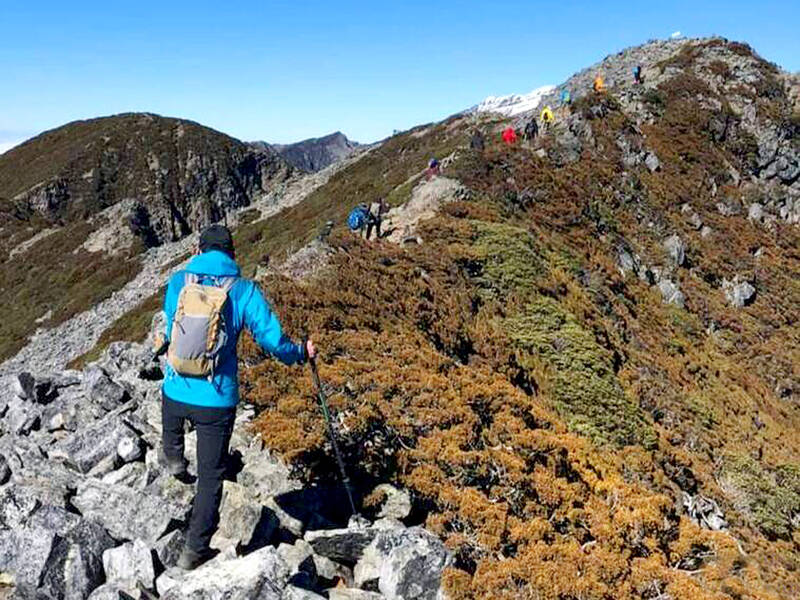
Photo: Wu Liang-yi, Taipei Times
The incident prompted public discussion over whether the
tragedy could have been avoided had the group been led by a properly licensed guide.
“Guides play a crucial role in mountaineering groups, as they are responsible for route navigation and participant safety,” the ministry said.
“While the ministry has established a certification system for mountain guides, there is no legal requirement for hiking groups — including fee-charging commercial tours — to employ licensed guides,” it said.
The ministry issues the Mountain Area Guide Certificate (山域嚮導證書), which is divided into four categories: mountaineering, river tracing, rock climbing and snow climbing. Applicants must complete 48 hours of training at recognized institutions, undergo basic life support training or hold certifications such as emergency medical technician or wilderness first aid credentials and pass written and practical exams. They must complete at least three consecutive days of mountain-area field training before qualifying for certification.
Certified guides are responsible for tasks including trip planning, risk assessment, route identification and environmental interpretation, it said.
The certificate is valid for four years and can be renewed for an additional four years upon completion of a 24-hour refresher course and 12 hours of safety courses during the validity period, it said.
“However, obtaining the certification is time-consuming and costly, while offering little practical advantage, and only 209 people nationwide currently hold mountain guide certificates,” it said.
The ministry last year proposed legislation that would require guides to be present at all times during commercial mountaineering activities, but does not mandate specific guide qualifications or certifications.
Department of Sports for All
Director-General Fang Jui-wen (房瑞文) said that specifics about guide qualifications and whether hiring certified guides should be mandatory would be included in further discussions on the proposed bill.
Huang Jih-hung (黃日虹), chief executive officer of Thomas International Travel Service, who holds a guide certificate herself, acknowledged the certification process is costly and time-consuming, offering limited tangible benefits and insufficient incentives.
Huang said that Mount Kinabalu in Malaysia attracts climbers from across the world, and local regulations there require visitors to hire licensed local guides.
“Since Taiwan’s Jade Mountain and Hsuehshan (雪山) also draw many foreign climbers, similar requirements in Taiwan could improve safety while encouraging more people to obtain certification,” she said.
Lee Chun-ching (李俊慶), guide division head at the Linkou Mountaineering Association, echoed Huang’s sentiment, saying that commercial hiking tours should be required to employ certified guides.
“Mountaineering carries inherent risks. Hypothermia can cause loss of consciousness within three hours, with even brief delays posing life-threatening dangers,” he said, citing a fatal hypothermia incident that occurred on Hsuehshan last month.
As Taiwan’s national parks are considering entrance fees to fund ecological conservation and trail maintenance, part of the revenue could be used to hire certified guides to assist visitors from across the world, he said.
Additional reporting by Lin Yueh-fu and Liu Li-jen

FUKUOKA SITUATION: Japanese media reported that the pathogen is expected to be identified by the summer, while the CDC downplayed the idea that it was hMPV A “mysterious cold-like illness” reported in Japan’s Fukuoka Prefecture does not seem to be a new disease, but Japanese authorities have been asked about the situation, the Centers for Disease Control (CDC) said yesterday. The Fukuoka Prefectural Medical Association on Wednesday told a news conference that a “mystery cold” that has become a hot topic on social media is “highly likely to be caused by some kind of viral infection,” Japan’s KBC News reported. “Many people are experiencing symptoms starting with a sore throat, followed by a runny nose, phlegm and a severe cough,” KBC News reported, citing association officials. Health authorities are

Nvidia Corp CEO Jensen Huang (黃仁勳) arrived in Taiwan yesterday ahead of upcoming AI and technology events, saying he plans to meet with clients and Taiwan Semiconductor Manufacturing Co Chairman C.C. Wei (魏哲家) during his visit. After landing at Taipei Songshan Airport, Huang posed for photos with fans and handed out Yakult drinks to reporters and supporters waiting at the scene, saying he has “a lot to do” during the trip. Asked about reports that Nvidia’s planned headquarters site in Taipei’s Beitou Shilin Technology Park could break ground on May 27, Huang said that if the company holds an event, he would

The Ministry of Finance this afternoon announced the winning numbers for the March-April uniform invoice lottery. The winning number for the NT$10 million (US$318,060) special prize is 19531471, and the winning number for the NT$2 million grand prize is 85941329. Three numbers were drawn for the NT$200,000 first prize: 07225810, 20231230 and 83518781. Those with receipts matching the last seven digits of any of the first-prize numbers will win the NT$40,000 second prize, while those matching the last six digits will win the NT$10,000 third prize. Those whose receipts match the last five digits of the first-prize numbers can claim the NT$4,000 fourth prize,

SIX SUBSIDIES: The monthly allowance for older farmers is to increase to NT$10,000, and NT$5,000 is to be given to homemakers under the national pension system, Lai said The government is to implement major welfare policies for disadvantaged groups, including raising the monthly allowance for older farmers to NT$10,000 and providing homemakers with NT$5,000 per month, President William Lai (賴清德) said yesterday. Lai made the remarks during a visit to Wangling Temple in Chiayi County, saying that the planned increases were being introduced amid economic growth and an increase in tax revenue. Touting a policy, in which the government plans to provide a monthly allowance of NT$5,000 for every child under the age of 18 in a bid to address Taiwan’s low birthrate, Lai said that if received for the


 RSS
RSS