


The Ministry of Environment yesterday signed a memorandum of understanding (MOU) with the Miaoli County Government to promote resource circulation developments via collaborations between the local and central governments.
The MOU was signed by Minister of Environment Peng Chi-ming (彭啟明) and Miaoli County Commissioner Chung Tung-chin (鍾東錦), with the goal of building a climate technology circulation park in the county’s Jhunan Township (竹南).
Peng said resource circulation is the key to the development of the circular economy, which has an annual output value of about NT$168.8 billion (US$5.35 billion) at a growth rate of 10 percent.
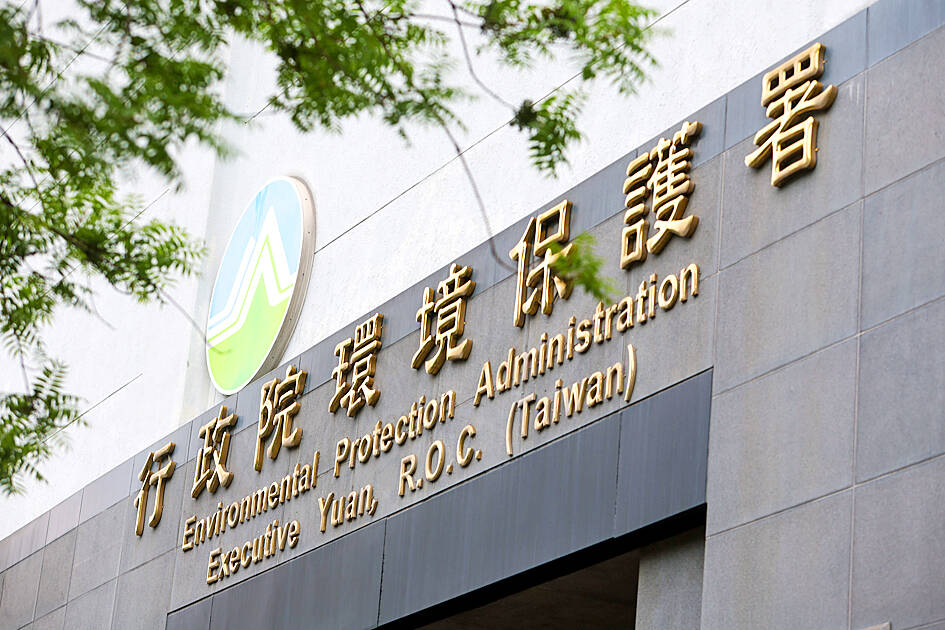
Photo: CNA
The county is the first entity to sign an MOU with the ministry to promote resource circulation, he said, adding that the ministry would plan the construction of the park jointly with the county government to establish a resilient resource processing mechanism.
The county government would utilize 25 hectares of land at the Jhunan landfill to set up the park, Chung said.
Advanced technology would be introduced to repurpose waste into energy, thereby helping to reduce local waste processing loads, he said.
In other news, the ministry entered another local cooperation with the Hsinchu County Government by jointly initiating an environmental improvement project for the Douzihpu River (豆子埔溪) and its surrounding areas in the county’s Jhubei City (竹北).
The county government is to invest nearly NT$190 million — of which about NT$120 million is from the ministry — in the project, with the goal of building an urban waterfront green corridor for local residents by the end of next year.
Hsinchu County Commissioner Yang Wen-ke (楊文科) said the project area is a 1.6km section of the river between Jhihshan Bridge (至善橋) and Boai Bridge (博愛橋), adding that he expects the river to be improved at least to the standard of the Cheonggyecheon River in Seoul.
The ministry said the project would focus on water quality improvements and pollution reduction, with interception facilities and a cobble contact bed system to purify an estimated 5,000 tonnes of river water per day.
The ammonia nitrogen removal rate is expected to reach 70 percent, while the removal efficiencies of biochemical oxygen and suspended solids could reach 80 percent, it said.
That would not only enhance the use of various waterfront spaces, but would also create diverse habitats for wildlife, it added.
Additional reporting by Chang Hsun-teng and Liao Hsueh-ju

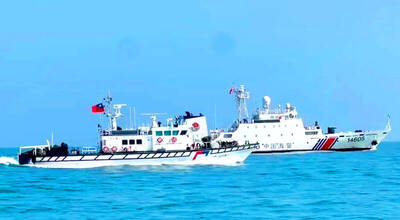
The military has spotted two Chinese warships operating in waters near Penghu County in the Taiwan Strait and sent its own naval and air forces to monitor the vessels, the Ministry of National Defense (MND) said. Beijing sends warships and warplanes into the waters and skies around Taiwan on an almost daily basis, drawing condemnation from Taipei. While the ministry offers daily updates on the locations of Chinese military aircraft, it only rarely gives details of where Chinese warships are operating, generally only when it detects aircraft carriers, as happened last week. A Chinese destroyer and a frigate entered waters to the southwest
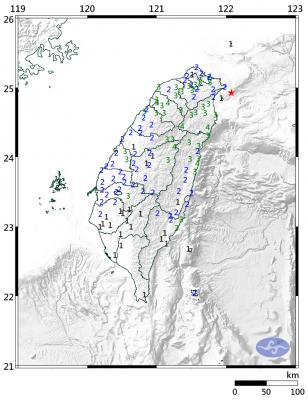
A magnitude 6.1 earthquake struck off the coast of Yilan County at 8:39pm tonight, the Central Weather Administration (CWA) said, with no immediate reports of damage or injuries. The epicenter was 38.7km east-northeast of Yilan County Hall at a focal depth of 98.3km, the CWA’s Seismological Center said. The quake’s maximum intensity, which gauges the actual physical effect of a seismic event, was a level 4 on Taiwan’s 7-tier intensity scale, the center said. That intensity level was recorded in Yilan County’s Nanao Township (南澳), Hsinchu County’s Guansi Township (關西), Nantou County’s Hehuanshan (合歡山) and Hualien County’s Yanliao (鹽寮). An intensity of 3 was
Instead of focusing solely on the threat of a full-scale military invasion, the US and its allies must prepare for a potential Chinese “quarantine” of Taiwan enforced through customs inspections, Stanford University Hoover fellow Eyck Freymann said in a Foreign Affairs article published on Wednesday. China could use various “gray zone” tactics in “reconfiguring the regional and ultimately the global economic order without a war,” said Freymann, who is also a nonresident research fellow at the US Naval War College. China might seize control of Taiwan’s links to the outside world by requiring all flights and ships entering or leaving Taiwan
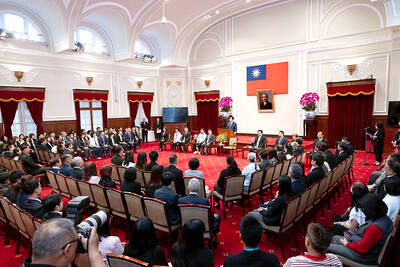
The next minimum wage hike is expected to exceed NT$30,000, President William Lai (賴清德) said yesterday during an award ceremony honoring “model workers,” including migrant workers, at the Presidential Office ahead of Workers’ Day today. Lai said he wished to thank the awardees on behalf of the nation and extend his most sincere respect for their hard work, on which Taiwan’s prosperity has been built. Lai specifically thanked 10 migrant workers selected for the award, saying that although they left their home countries to further their own goals, their efforts have benefited Taiwan as well. The nation’s industrial sector and small businesses lay


 RSS
RSS