


Opposition lawmakers today fast-tracked a motion to the second reading that would authorize the disbursement of NT$71.8 billion (US$2.2 billion) for 38 projects under the central government budget.
During a plenary session, the Chinese Nationalist Party (KMT) and Taiwan People’s Party (TPP) used their combined majority to bypass committee review and send the motion covering 38 budgetary items directly to the second reading and cross-party negotiations.
Despite objections from the Democratic Progressive Party (DPP), the motion passed 59 to 49, with one abstention from KMT Legislator Hsieh Yi-fong (謝衣鳯).
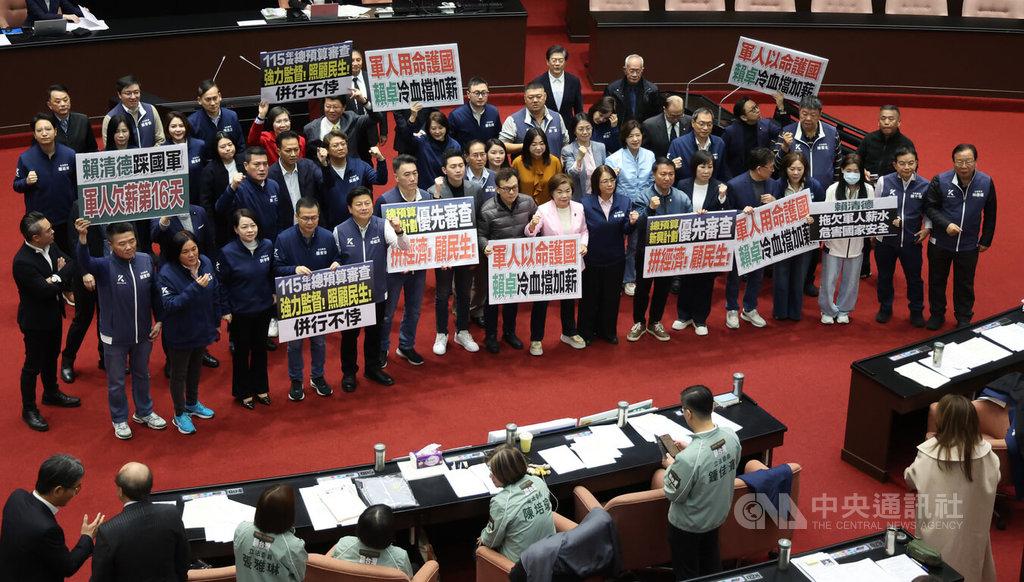
Photo: CNA
The 38 proposed projects include subsidies to address Taiwan’s low birthrate, funding for the TPass program, and flood control and water management initiatives.
Regarding the birthrate, the subsidies include NT$235 million to cover gaps in government employee birth benefits and NT$2.96 billion for labor insurance birth subsidies.
For the TPass program, the subsidies include NT$1.58 billion for the TPass Executive Yuan implementation program, and NT$5.94 billion for local governments to implement TPass from this year to 2029.
As for flood control and water management, the proposal includes subsidies for river and drainage improvement projects to address climate change.
In the proposal, the KMT and TPP said that amid international uncertainty and rising cross-strait tensions, the Executive Yuan had “maliciously and illegally” failed to budget for pay raises for volunteer military personnel and higher replacement ratios for police and firefighter pensions.
They accused the Cabinet of failing to present viable alternatives and of undermining the Constitution and public opinion by spreading misinformation and sowing social division.
The proposal cited a “non-shutdown mechanism” in the budgetary process, arguing that under Article 54 of the Budget Act (預算法), the legislature may adopt a resolution allowing the advance release of urgent and major livelihood-related capital expenditures and new projects included in this year’s general budget.
The opposition hopes the legislature would first approve funding for these projects, TPP caucus deputy whip Chang Chi-kai (張啓楷) said.
However, the Executive Yuan should address the root of the issue by fully budgeting for military pay raises and related items to enable substantive review of the overall budget, he added.
The motion mainly targets new local and livelihood-related projects, or specific expenditures within new initiatives, KMT Legislator Lo Chih-chiang (羅智強) said.
It is regrettable that the matter was not handled by the Executive Yuan, as it could have sought legislative approval to release funds for these initiatives, he said.
This year’s general budget had not even been submitted for review, DPP caucus chief executive Chung Chia-pin (鍾佳濱) said, questioning how the opposition could selectively deem NT$71.8 billion in projects especially urgent without full review.
The Legislative Yuan usually refers the central government budget to committees for item-by-item scrutiny before second and third readings in plenary.

FUKUOKA SITUATION: Japanese media reported that the pathogen is expected to be identified by the summer, while the CDC downplayed the idea that it was hMPV A “mysterious cold-like illness” reported in Japan’s Fukuoka Prefecture does not seem to be a new disease, but Japanese authorities have been asked about the situation, the Centers for Disease Control (CDC) said yesterday. The Fukuoka Prefectural Medical Association on Wednesday told a news conference that a “mystery cold” that has become a hot topic on social media is “highly likely to be caused by some kind of viral infection,” Japan’s KBC News reported. “Many people are experiencing symptoms starting with a sore throat, followed by a runny nose, phlegm and a severe cough,” KBC News reported, citing association officials. Health authorities are

Nvidia Corp CEO Jensen Huang (黃仁勳) arrived in Taiwan yesterday ahead of upcoming AI and technology events, saying he plans to meet with clients and Taiwan Semiconductor Manufacturing Co Chairman C.C. Wei (魏哲家) during his visit. After landing at Taipei Songshan Airport, Huang posed for photos with fans and handed out Yakult drinks to reporters and supporters waiting at the scene, saying he has “a lot to do” during the trip. Asked about reports that Nvidia’s planned headquarters site in Taipei’s Beitou Shilin Technology Park could break ground on May 27, Huang said that if the company holds an event, he would

The Ministry of Finance this afternoon announced the winning numbers for the March-April uniform invoice lottery. The winning number for the NT$10 million (US$318,060) special prize is 19531471, and the winning number for the NT$2 million grand prize is 85941329. Three numbers were drawn for the NT$200,000 first prize: 07225810, 20231230 and 83518781. Those with receipts matching the last seven digits of any of the first-prize numbers will win the NT$40,000 second prize, while those matching the last six digits will win the NT$10,000 third prize. Those whose receipts match the last five digits of the first-prize numbers can claim the NT$4,000 fourth prize,

SIX SUBSIDIES: The monthly allowance for older farmers is to increase to NT$10,000, and NT$5,000 is to be given to homemakers under the national pension system, Lai said The government is to implement major welfare policies for disadvantaged groups, including raising the monthly allowance for older farmers to NT$10,000 and providing homemakers with NT$5,000 per month, President William Lai (賴清德) said yesterday. Lai made the remarks during a visit to Wangling Temple in Chiayi County, saying that the planned increases were being introduced amid economic growth and an increase in tax revenue. Touting a policy, in which the government plans to provide a monthly allowance of NT$5,000 for every child under the age of 18 in a bid to address Taiwan’s low birthrate, Lai said that if received for the


 RSS
RSS