


The Taiwan High-Speed Rail Corp (THSRC) sold 700,000 tickets for the Lunar New Year holiday period in the first hour that tickets went on sale this morning, a record high.
With this year’s Lunar New Year running for nine days from Feb. 14 to 22, the THSRC set an 11-day holiday transport period from Feb. 13 to 23 to accommodate heavy passenger demand, the company said on Wednesday.
The THSRC is operating 395 additional trains during that period, 170 running southbound and 225 running northbound, bringing the total number of trains operating during the period to 2,162.
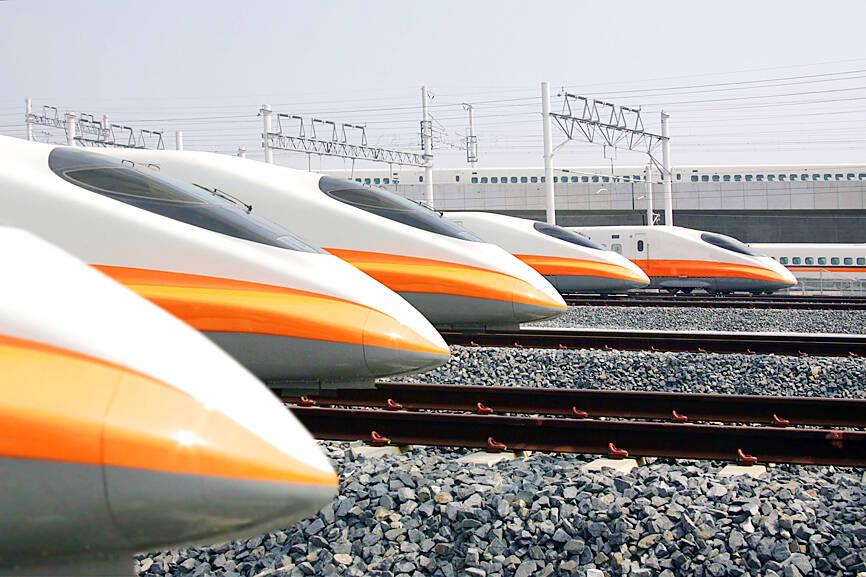
Photo courtesy of Taiwan High Speed Rail Corp via CNA
Within an hour of tickets for the 11-day period going on sale at midnight, the company sold a record 700,000 tickets, 40,000 more than the first hour of ticket sales last year, its data showed.
Ticket sales reached 826,000 as of 8am, 12.5 percent more than during the first eight hours last year, the THSRC said.
Before opening holiday ticket sales, the company adjusted its online reservation system to accommodate up to 38,400 people simultaneously, it said.
It sold 58,000 tickets just four minutes after they went on sale, 172,000 after 12 minutes, 268,000 after 22 minutes and 374,000 after 32 minutes, it added.
The company said it would continue to monitor bookings to ensure passengers can all smoothly reserve tickets.
To encourage off-peak travel, the THSRC said it would continue to offer early-bird discounts during the holiday period.
A total of 617 designated off-peak services would offer limited early-bird fares with 50 percent, 20 percent or 10 percent discounts, providing more than 84,000 discounted seats over the 11-day period, the company added.

LOUD AND PROUD Taiwan might have taken a drubbing against Australia and Japan, but you might not know it from the enthusiasm and numbers of the fans Taiwan might not be expected to win the World Baseball Classic (WBC) but their fans are making their presence felt in Tokyo, with tens of thousands decked out in the team’s blue, blowing horns and singing songs. Taiwanese fans have packed out the Tokyo Dome for all three of their games so far and even threatened to drown out home team supporters when their team played Japan on Friday. They blew trumpets, chanted for their favorite players and had their own cheerleading squad who dance on a stage during the game. The team struggled to match that exuberance on the field, with
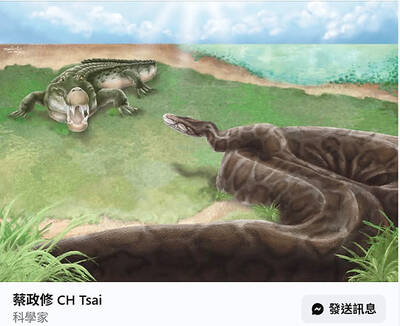
Taiwanese paleontologists have discovered fossil evidence that pythons up to 4m long inhabited Taiwan during the Pleistocene epoch, reporting their findings in the international scientific journal Historical Biology. National Taiwan University (NTU) Institute of Ecology and Evolutionary Biology associate professor Tsai Cheng-hsiu (蔡政修) led the team that discovered the largest snake fossil ever found in Taiwan. The single trunk vertebra was discovered in Tainan at the Chiting Formation, dated to between 400,000 and 800,000 years ago in the Middle Pleistocene, the paper said. The area also produced Taiwan’s first avian fossil, as well as crocodile, mammoth, saber-toothed cat and rhinoceros fossils, it said. Discoveries

Taiwanese paleontologists have discovered fossil evidence that pythons up to 4m long inhabited Taiwan during the Pleistocene epoch, reporting their findings in the international scientific journal Historical Biology. National Taiwan University (NTU) Institute of Ecology and Evolutionary Biology associate professor Tsai Cheng-hsiu (蔡政修) led the team that discovered the largest snake fossil ever found in Taiwan. A single trunk vertebra was discovered in Tainan at the Chiting Formation, dated to between 800,000 to 400,000 years ago in the Middle Pleistocene, the paper said. The area also produced Taiwan’s first avian fossil, as well as crocodile, mammoth, sabre-toothed cat and rhinoceros fossils, it said. Discoveries

Whether Japan would help defend Taiwan in case of a cross-strait conflict would depend on the US and the extent to which Japan would be allowed to act under the US-Japan Security Treaty, former Japanese minister of defense Satoshi Morimoto said. As China has not given up on the idea of invading Taiwan by force, to what extent Japan could support US military action would hinge on Washington’s intention and its negotiation with Tokyo, Morimoto said in an interview with the Liberty Times (sister paper of the Taipei Times) yesterday. There has to be sufficient mutual recognition of how Japan could provide


 RSS
RSS